
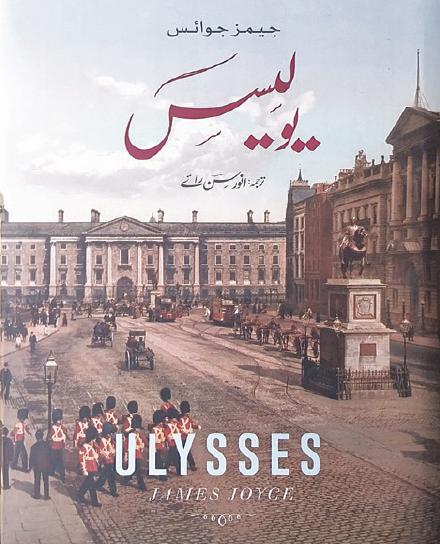
URDU has world classics in translation and some of them have been translated more than once. Aristotle’s Poetics, for instance, has been rendered into Urdu by three different translators: Aziz Ahmed, Badr Muneer Dar and Shamsur Rahman Farooqi. Likewise, Jameel Jalibi, Suhail Wasti and Abul Fazl Siddiq have translated George Orwell’s Animal Farm into Urdu.
But Ulysses, a world-renowned modernist novel by James Joyce, had to wait for 104 years. First published in February 1922, Ulysses has been translated into Urdu by Anwer Sen Roy and it appeared in June 2026. Why it took so long? Why the translators, who have rendered hundreds, if not thousands, of books over the years, did not try their hand at translating a masterpiece like Ulysses? Simply because Ulysses is famously, rather notoriously, ‘untranslatable’.
For example, quirky use of the language that disregards conventional grammar, use of stream-of-consciousness technique without punctuation marks to depict the way a wandering human mind thinks, and other linguistic peculiarities that translators would likely get stuck on since much of it can hardly be replicated in other languages. On top of it, the Irish ethos that is interwoven in the story requires familiarity with so many things Irish, say, history, literature and the social and cultural norms.
Some critics say Joyce has used pastiche, too, a technique that emulates classics, but unlike parody it does not mock and rather praises. Joyce has grounded myth in reality, using Homer’s Odyssey as structural model in some portions of Ulysses. And the novel is so steeped in the local Dublin culture that without a proper background it can prove frustrating to read. All these factors make Ulysses a translator’s worst nightmare. But Anwer Sen Roy had the courage and flair to get it translated into Urdu. Without proper annotations, many ideas and effects would have been lost in translation, but reading a novel with footnotes surely ruins the fun. So, instead of writing footnotes, Roy has devoted some 80 pages for the translation of excerpts taken from some well-known critical works on Ulysses in English.
Immediately after the publication of the Urdu translation, many dissenting voices were heard, many of them blaming the translator for their disappointment that they had to go through while trying hard to read Roy’s translation.
The problem is, they would have been even more disappointed had they tried to read it in original as Joyce poses such challenges that even the native readers, without background knowledge about Irish culture and opaque literary allusions, may be irritated, not to mention the sarcastic tone and stylistic and linguistic playfulness that Joyce is known for.
The secret is to understand Joyce’s style first. As put by Muhammad Hasan Askari, ‘unless one understands Joyce’s signature style and his technique, one cannot enjoy his books’. To comprehend Ulysses, one must understand Joyce’s thought and his life, as wrote the editors of The Oxford Anthology of English Literature about Joyce in introduction to his work: ‘Both his life, and his literary career which that life produced and which fed back into it, were directed towards an escape from isolation to universality’. They contend that Joyce escaped from Ireland to Europe, which had been an earthly paradise to him, but it was ‘hemmed in on all sides by narrowness, bigotry, puritanism, and grey despair’. And ‘the journey of his imaginative life was from small forms to large, from lyric to epic, from literature to myth’.
While there may be some minor lapses on the part of the translator, at least one must credit him for bringing the world-famous novel to Urdu. Secondly, we must remember that Ulysses is one of the most difficult books to translate and it is quite normal if a translator errs while trying to achieve this Herculean task. We must acknowledge the hard work that must have gone into it.
Anwer Sen Roy is a poet, novelist, journalist and translator. In addition to five poetry collections and two novels, he has to his credit some commendable translations including works by such greats as Chilean Nobel Laureate Pablo Neruda and Palestinian poet Mahmoud Darwish.
Published by Book Corner, Jehlum, the book’s inner title says it is volume one. In his longish intro, Roy has described the novel’s Irish background and other elements that might pose difficulties for readers. Translating Ulysses into Urdu is so great a feat that it must be celebrated, though doubters may have their reservations.