
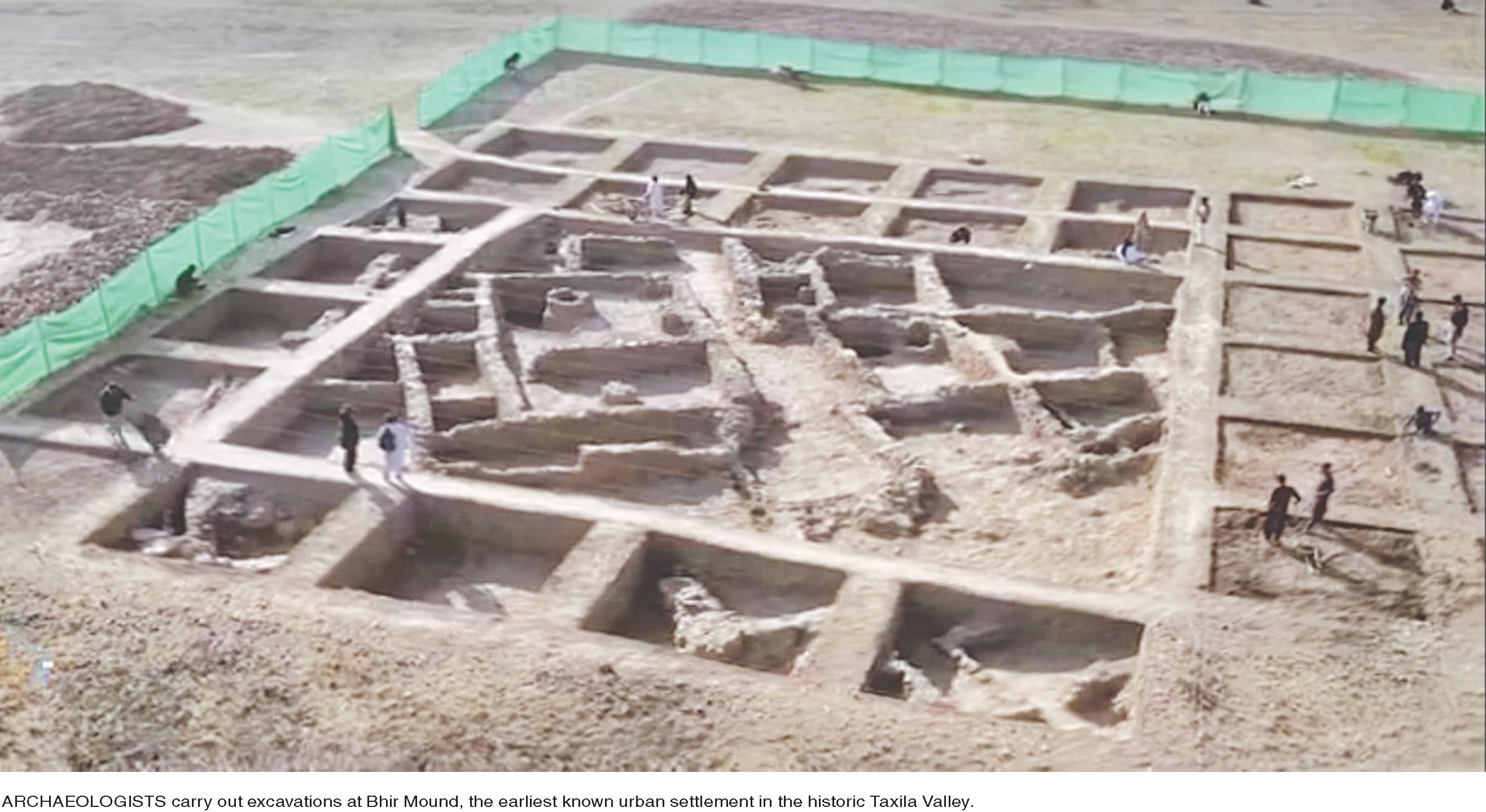
Beneath the weathered earth of Bhir Mound, one of South Asia’s earliest urban settlements, the buried story of ancient Taxila is gradually emerging once again, as renewed archaeological excavations reveal residential quarters, streets, drainage networks, wells and an array of artefacts that offer a rare glimpse into the city’s social, economic and architectural life more than two millennia ago.
Situated immediately south of the Taxila Museum, Bhir Mound represents the earliest known urban settlement in the historic Taxila Valley. Occupied from around the sixth century BC until the early second century BC, the ancient city witnessed successive political and cultural transitions, including Achaemenid Persian influence, the arrival of Alexander the Great, the Mauryan Empire and the emergence of Indo-Greek power in the region.
Unlike the geometrically planned city of Sirkap, which succeeded it, Bhir Mound evolved organically, its narrow and irregular streets winding between residential compounds, courtyard houses, private wells and rudimentary drainage arrangements. Its architectural remains, largely constructed from locally available stone and rubble masonry, offer compelling evidence of an early urban community whose inhabitants developed organised systems of habitation, water management, construction and commercial activity.
Director General, Punjab Department of Archaeology Zaheer Abbas Malik said that under the Magnificent Punjab initiative and the vision of the Punjab chief minister, the Directorate General of Archaeology, Punjab, has returned to the site with renewed investigations, bringing fresh archaeological attention to a settlement whose historical significance extends far beyond its present-day ruins. Mr Malik said that the latest excavations have exposed an extensive section of the ancient habitation, revealing residential and public structures, street alignments, drainage systems, wells, soaking pits, possible industrial installations and floors of varying construction techniques. ‘The architectural remains comprise limestone, Kanjur and graphite stone, rubble masonry and, in certain areas, burnt bricks, predominantly bonded with mud mortar’, he added.
According to Aasim Dogar, Deputy Director of the Punjab Department of Archaeology and head of the excavation team, Bhir Mound settlement’s archaeological importance is underscored by four principal occupational phases, documenting the evolution of urban life and the changing cultural influences that shaped the ancient city.
He said that pottery, punch-marked coins, beads, sealing, jewellery and other material remains recovered from the site have helped establish its significance as a centre of trade, administration and cultural interaction in northwestern South Asia. Mr Dogar said that evidence of compacted mud flooring and pavements laid with graphite stone slabs has also emerged, offering further insight into the construction practices and spatial organisation of the settlement.
Mr Dogar said that equally significant is the diversity of the archaeological material recovered during the latest fieldwork. The assemblage includes red-ware pottery, fragments of Northern Black Polished Ware, terracotta human and animal figurines, stone and terracotta beads, ivory and shell bangles, grinding stones, copper objects, tools and coins.
Beyond their individual archaeological value, these objects offer a tangible record of everyday existence in the ancient city, pointing towards domestic activities, specialised craftsmanship, technological practices, personal adornment and commercial connections. He added that the renewed investigations have consequently opened an important window into the architectural traditions, urban organisation and material culture of early Taxila, while raising the prospect of a more comprehensive understanding of how the settlement developed, functioned and eventually gave way to later urban centres.
Rabab Chishti, a conservation architect, told Dawn that the preliminary observations suggest a complex, multi-layered occupational sequence, with certain remains tentatively associated with the Mauryan and Indo-Greek periods. She maintains that further excavation, scientific examination and detailed stratigraphic analysis will be necessary to establish the precise chronology and cultural attribution of the newly exposed structures and artefacts.
She said that the significance of the discoveries extends beyond excavation itself. ‘Newly exposed archaeological structures are particularly vulnerable to weathering, environmental deterioration and human interference, making scientific documentation, conservation and effective protective measures essential to preserving the integrity of the site’, Rabab added.
According to Malik Tahir Suleman, a renowned numismatist, for Taxila, whose archaeological landscape bears testimony to centuries of encounters between South Asian, Persian and Hellenistic civilisations, Bhir Mound is more than an assemblage of ancient walls and artefacts. ‘It is the material record of a formative period in the region’s urban history’, he added.
As the earth gives up further fragments of its buried past, the renewed excavations are helping reconnect contemporary generations with a civilisation that flourished here long before the better-known monuments of Taxila took shape. The challenge now is to ensure that the rediscovery of this ancient city is matched by an equally determined commitment to its conservation, scientific interpretation and preservation for posterity.