
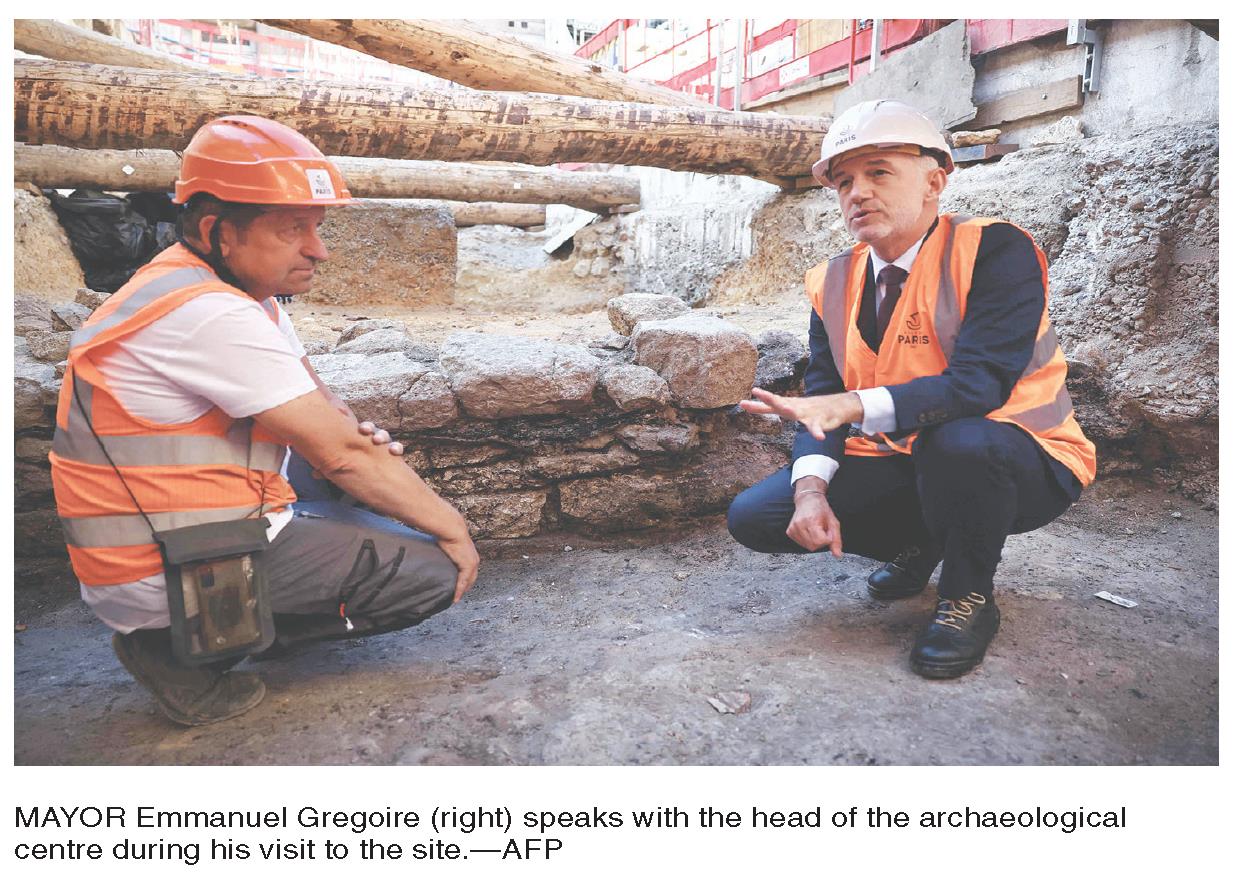
PARIS: An ancient wall discovered beneath Paris was described as a ‘major breakthrough’ on Wednesday by France’s culture ministry, with the archaeological find possibly confirming the location of the city’s original settlement.
A roughly 20-metre (65-foot) wall dating from the Gallo-Roman period was discovered in Paris this summer beneath a hotel on the Ile de la Cite, a stone’s throw from Notre Dame Cathedral in the heart of the City of Light.
The stone-and-wood find is thought to be a fragment of the ramparts of Lutetia the ancient name for Paris built by the Gallic Parisii tribe which lived along the river Seine in the Iron Age.
The Ile de la Cite has traditionallybeen regarded as the centre of Lutetia, but a rival theory, backed by archaelogical research, contends that it was in Nanterre, a suburb to the west. ‘We may be looking at one of the most important remains ever discovered for understanding Gallic Lutetia,’ Culture Minister Catherine Pegard said in a statement from her ministry.
‘Scientific caution still requires that we verify its function and its chronology, but the convergence of evidence is particularly remarkable at this stage.
Lutetia was first mentioned in book seven of Roman leader Julius Caesar’s ‘Gallic Wars’ series, where it was said to be on an island in the river Seine a vague description that has given rise to many theories about its location.-AFP