
RIYADH: The Saudi capital’s tallest skyscraper was struck for the second time in days on Tuesday, injuring 11 people. The strike targeted the 80-storey Public Investment Fund Tower, which houses Saudi Arabia’s sovereign wealth fund and dominates Riyadh’s King Abdullah Financial District (KAFD).
The building, which was also attacked last week, is one of several high-profile targets hit since hostilities between the Saudi-led coalition restarted in July.
‘One of the towers in the financial centre was targeted in a cowardly terrorist attack,’ coalition spokesperson Turki al Malki said in a social media post, without naming the building. ‘The authorities are currently inspecting the attack site.’
Saudi Arabia’s civil defence later said 11 people were injured in the attack it blamed on the Houthis.
‘The attack resulted in 11 people being injured,’ read a report by the Saudi Press Agency, saying Indian, Nepali and Egyptian nationals along with Saudi citizens, were among those wounded.
A source briefed on the details of the attack said several people were in the tower repairing the damage caused by last week’s attack when the building was struck again on Tuesday.
The source said two of the 11 injured were in critical condition after sustaining severe burns during the strike.
An attack on the PIF is symbolic as the fund is driving efforts to diversify the oil-reliant Saudi economy — a project that has been complicated by the Iran war and Houthi strikes.
A tower belonging to state oil giant Aramco in KAFD was hit earlier this month, while Riyadh’s international airport was repeatedly struck last month with one attack killing 14 people.
About the attack on the PIF, an eyewitness told journalists a vehicle fitted with a speaker had warned pedestrians in the area to take cover. No warning was sent to mobile phones about any threats to the capital.
Afterwards, police cars blocked some entrances to the gleaming financial district, a showpiece of Saudi Arabia’s modernisation under Crown Prince Mohammed bin Salman.
A waiter at a KAFD restaurant said: ‘We just reopened a while ago. They evacuated all of us telling us a tower has been hit. They closed the streets and they banned people from passing in streets or entering.’
Last week, Saudi officials said an attack on a tower in the financial district damaged several floors and two adjacent buildings, but caused no casualties.
Although authorities did not identify the building, photos released by the civil defence agency appeared to show shattered glass and other exterior damage to the PIF tower.
The Houthis claimed responsibility for last week’s attack, but they did not announce any fresh attacks on Tuesday.
Air strike leaves 26 dead
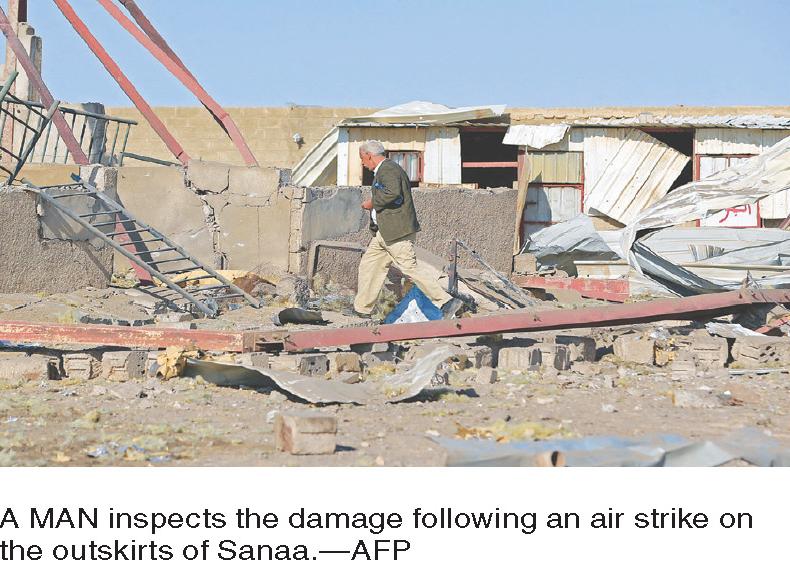
According to the authorities in Yemen’s southwest, a Houthi-controlled region, an air strike on trucks and buses killed 26 people on Monday.
Two officials said coalition warplanes struck Houthi vehicles in Lahj province, where the group has advanced in recent weeks towards Aden, the government’s interim capital.
The aircraft ‘targeted two vehicles belonging to the Houthis at the moment when a truck and a bus were passing by, in an area considered a front line’, one of the officials said, adding 12 Houthi fighters and 14 civilians were killed.
The second official confirmed the death toll. Witnesses reported seeing charred bodies at the scene.
The Houthis’ military spokesman blamed the Saudi air force for the strike, saying it would not go ‘unanswered’.
But the Aden-based government said the Houthis had carried out the attack.
The ‘group targeted civilian vehicles’ bearing no military markings, on a road that is a vital artery for the population’, government forces spokesperson Majed al Nazli said.
Separate strikes on Monday killed 17 people and destroyed several buildings in the coastal province of Hodeida, the Houthis’ telecommunications ministry said.
Britain sanctions Houthis
As the conflict shows no sign of slowing, Britain sanctioned the Houthis and four of the group’s top officials ‘for deliberately attempting to undermine stability’.
The measures include an asset freeze against the group and an asset freeze and travel ban on four figures, including security and intelligence head Abdul Hakim Hashem Ali al Khaiwani, and interior affairs official Abdulkarim Amir al Din Hussein al Houthi.—AFP