
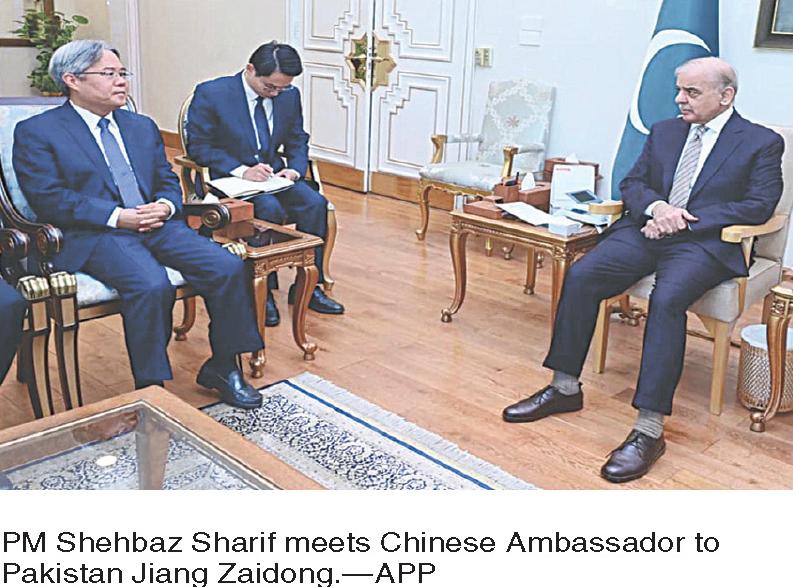
ISLAMABAD: Prime Minister Shehbaz Sharif on Thursday described the Shenzhou-24 mission as ‘living proof of the ironclad friendship’ between Pakistan and China, expressing hope that it would inspire Pakistani youth to reach the Moon and beyond.
The premier made the remarks during a meeting with Chinese Ambassador Jiang Zaidong, who called on him at the Prime Minister House.
On Wednesday, Wing Commander Muhammad Zeeshan Ali became the first foreign astronaut to board China’s Tiangong space station, marking a milestone in Pakistan’s space ambitions and Beijing’s efforts to expand its space diplomacy.
According to the Prime Minister’s Office, Mr Shehbaz congratulated the Chinese envoy, leadership and people on the successful launch. He said Pakistan was grateful to China for the opportunity to participate in the historic mission, through which a Pakistani had become the first foreign astronaut to visit the Chinese space station.
He added that cooperation between the two countries had now ‘truly reached the stars’.
The prime minister appreciated the Chinese institutions involved in training Pakistani astronauts and paid tribute to the Space and Upper Atmosphere Research Commission (Suparco), academic institutions, scientists and the armed forces for their contributions to the achievement.
He asked the ambassador to convey his greetings and best wishes to Chinese President Xi Jinping and Premier Li Qiang.
Mr Shehbaz reaffirmed Pakistan’s commitment to working with China for the peaceful exploration and utilisation of outer space, the statement said.
The two sides also reviewed bilateral relations, including activities to mark the 75th anniversary of the establishment of diplomatic ties this year. The prime minister handed over congratulatory letters addressed to President Xi and Premier Li to the Chinese ambassador.
Mehfooz Dawa app
The prime minister also launched the Mehfooz Dawa (safe medicine) application to help prevent the circulation of counterfeit and substandard medicines, describing it as a major step towards restoring public confidence in the healthcare system.
Speaking at the launch ceremony organised by the Ministry of National Health Services, Mr Shehbaz said healthcare facilities and education should be equally accessible to all citizens. He stressed the need for federal and provincial governments to work together to ensure the availability of affordable, quality medicines.
Federal Minister for National Health Services Mustafa Kamal and Drug Regulatory Authority of Pakistan (Drap) Chief Executive Officer Dr Obaidullah Malik also addressed the ceremony.
Recalling the 2012 incident at the Punjab Institute of Cardiology, where counterfeit medication was blamed for the deaths of more than 100 patients, the prime minister called for ‘learning from the past and preparing ourselves’ for the future.
Dr Malik said the application was designed to address three issues: counterfeit medicines, shortages and quality compliance. It offers three features: medicine verification, complaints and shortage reporting.
Users can scan a medicine’s batch number or 2D barcode to check its authenticity against the database. A green screen will indicate that the medicine is genuine, while a red screen will indicate that it is counterfeit.
Consumers will also be able to lodge complaints about counterfeit medicines and report shortages through the application. The database linked to the app contains details of around 92,000 medicines, the Drap chief said.
The idea of introducing a barcode system was first proposed in 2015 and approved by the federal cabinet in 2017, but bureaucratic delays held up its implementation.
Bangladesh ties
The prime minister also hosted a dinner at the Prime Minister House on Wednesday night in honour of Bangladesh Parliament Speaker Hafiz Uddin Ahmad Bir Bikram and members of a visiting parliamentary delegation.
Welcoming the speaker and his delegation, Mr Shehbaz said Pakistan attached great importance to its fraternal ties with Bangladesh.
He said regular parliamentary exchanges would provide a strong foundation for closer bilateral cooperation in areas of mutual interest.