
KARACHI: Big crowds were witnessed at the 4th International Food & Agriculture Exhibition organised by the Trade Development Authority of Pakistan (TDAP) at the Karachi Expo Centre on Thursday, the fourth and concluding day of the Exhibition as it was opened for the general public.
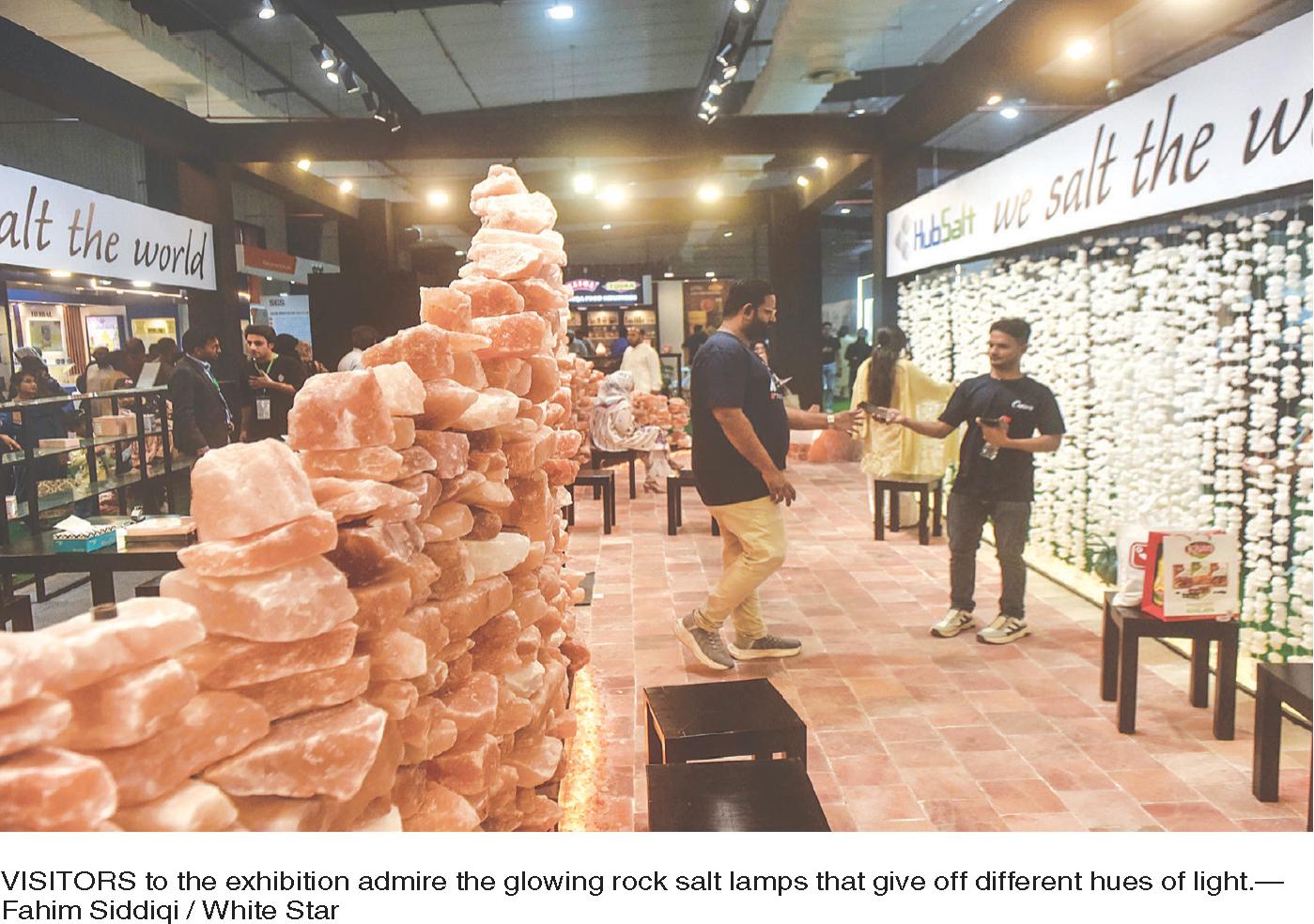
One was greeted at the entryway with huge sunflower cutouts and sunflowers on the big screens. Inside, products made from Himalayan pink salt decorated the pathways. There were also appetising pictures of fresh green olives and jumbo prawns being flashed on the big screens.
Halls 1 to 6 had something or the other of interest for everyone. The local stalls represented all the local brands of cooking oil, butter, ghee, sauces and other preservatives, juices, syrups, soft drinks, spices, confectionery items and what not. It was basically all about harvesting, innovation and sustainability.
There were also international stalls. The Bangladesh Agro-Processors’ Association stall for food and beverage consultants Banga Flavour and Fragrance had bakery items, confectionery, seasonings, etc. Anselm Lawrence Martin, the Chief Business Development Officer, said that they had been invited by the Export Promotion Bureau here to set up a stall at the exhibition and that they have received very good response for business opportunities in Pakistan.
Martin also offered samples of their orange and mango drinks, prepared from mixing flavourful powder in water. ‘Think of it as a variation of Tang,’ he smiled. For the ladies visiting their stall, the company’s Director Mohammed Rahul Amin Shobuj and Managing Director Moin Uddin Tutul had another special treat of fruity tamarind jelly candies.
At the Uzbekistan Embassy stall, which was busy wrapping up a little early, one could sample dried fruit, including the sweetest of sultanas, which you could not refrain from popping in your mouth again and again. The preserves from Uzbekistan, including their jams and jellies, were also very tasty. The country stall also had on offer packaged foods such as biscuits, sweets and toffees, juices and pulses.
They may not have been Japanese but the Pakistanis representing Jetro, an integrated support organisation of foreign direct investment, at the Japan Street stall were there for facilitation for Japan and Pakistan in trade promotion and investment. ‘We are Japan’s second oldest office in Pakistan,’ said Maria Qureshi.
Another organisation, Pakistan Agriculture Research (PAR), which is Pakistan’s first interactive agri-intelligence platform looking to improve access to agricultural information and increasing data transparency, was proving its worth at the exhibition. Umme Hani, at the stall, explained that they share daily market-level commodity prices with the international market, which improves trade. ‘That way our foreign buyers know where to get the best prices for what’s available in our market,’ she said.
Coming back to the Himalayan pink salt, so prominent at the Exhibition, one truly appreciated the beauty of the rock salt crystals, especially when merged with light to be turned into decorative items such as lamps. Mohammed Yasa of a Lahore-based company, which gets its salt from the mines in Mattan Khurd in the Kallar Kahar Tehsil of Chakwal District in Punjab, said that rock salt has varied crystalline structures. ‘But pink salt has more mineral content,’ he said while talking about the health aspects of rock salt.
During the four days of the exhibition, a Global Cuisine Show featured 17 international chefs who transformed Pakistani ingredients into international dishes during live demonstrations.
The four days of intensive business activity at the Exhibition brought together 400 Pakistani exporters from more than 20 agro-food sub-sectors and over 900 international buyers from 80 countries, including major global brands.
A total of 100 MoUs, export contracts, distribution and trade agreements were signed between Pakistani exporters and international buyers, with quantified transactions of approximately $167.82 million, comprising export contracts worth $135.18 million, MoUs worth $31.83 million and a trade agreement worth $0.82 million.
The key commitments include 5,000 metric tons (MT) of fresh pineapple and 15,000 MT of fresh kinnows with Bangladesh, 10,000 MT of maize with Vietnam, and 864 MT of dates annually to China worth $820,800. China led with a $50 million sales order, a $12m sesame agreement, an $8m seafood and storage agreement and several fish and fish-meal agreements of $5m each, followed by the United Kingdom ($12.11m), Saudi Arabia ($7.6m), Kenya ($7.5m for rice and a $25,000 olive-oil MoU), Uganda ($779,600 for rice) and Bahrain ($43,002), nine MoUs with an indicative value of $2 million with Malaysian buyers.
On the third and fourth days, international buyer delegations also visited Pakistani production facilities to assess processing capacity, quality systems and food-safety compliance first-hand.
A series of seminars and panel discussions addressed the key issues shaping Pakistan’s food exports.