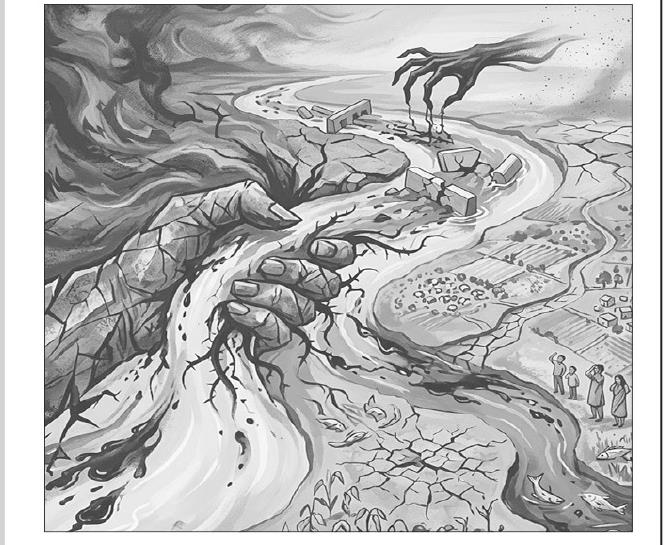
Eco-terrorism by a reckless neighbour
2026-07-28
THE subcontinent remains trapped in a dangerous, decades-old deadlock. While a recent joint appeal by over a hundred civil society members, former diplomats and academics from both Pakistan and India has urgently called for `meaningful and sustained` peace talks, New Delhi continuesits policy ofstubborn evasion.
Thisrefusalto engageisnolongerjusta diplomatic stalemate it is a high-stakes gamble with the security of over a billion people.
Pal(istan has repeatedly demonstrated strategic maturity by leaving the doors openfor astructured dialogue.In sharp contrast, India`s ruling political setup has consistently weaponised hostility for domestic electoral gains, feeding a jingoistic media narrative to its voter base.
However, it is fair to say that this frozen stance completely ignores the shifting ground realities of 2026.
The regional strategic matrix has fundamentally changed. The subcontinent has entered a highly volatile sub-conventional grey zone where India keeps attempting to normalise `punitive conventional strikes` under the guise of counterterrorism. To preserve deterrence stability, Pakistan has had to rapidlyinnovate, investing heavily in precision-guided munitions, drone technology, and intelligence,surveillance and reconnaissance (ISR) capabilities that were largely based on artificial intelligence (AI).
However, the most immediate threat to regional survival is ecological. The Indus Waters Treaty (IWT) is facing a severe strain as New Delhi continues to unilaterally suspend crucial transboundary communications. When senior Indian ministers openly threaten to blocl( downstream water flows amidst severe Himalayan glacial retreat, it ceases to be political rhetoric it becomes ecoterrorism. Unilateral isolation on shared water resources is a recipe for mutual disaster, risking uncoordinated flash floods and devastating droughts that do notrecognise borders.
History proves that even the most bitterof arch-enemies must eventually sit at the negotiating table when existential stakes are high. France and Germany, for instance, transformed centuries of bloody warfare into the bedrocl( of European cooperation via the 1963 Elysee Treaty. Similarly, the United States and China broke their decades oficyisolationin1972 because both recognised that complete decoupling was globally catastrophic.
For Pakistan, stabilising an economy and investing in its human capital remains the supreme national priority. True patriotism demands a fierce defence of our territorial sovereignty while actively pushing for a rational regional framework that stops resource weaponisation.
Unilateral isolation is failing. True strategic strength does not lie in running away from the negotiating table; it lies in taking one`s place at the table, restoring full diplomatic connectivity, and securing for South Asia a truly shared future.
Majid Burfat Karachi