
MUZAFFARABAD: For Kashmiris whose aspirations for self-determination remain unfulfilled, the tragedy of a divided homeland continues to take a devastating human toll. The death of 54-year-old Irfan Hassan Shah is the latest example.
Shah’s body was spotted on Monday morning floating in the icy Neelum River near Keran village in Neelum Valley. Since the river forms the Line of Control (LoC), retrieving the body was a challenging operation involving rescue officials and a local army unit.
An identity card issued by the Indian government identified the deceased as Irfan Hassan Shah, son of Ghulam Hassan Shah, born in April 1972. Officials initially planned to hand over his body to Indian authorities through a suspension bridge linking Chilyana in Azad Jammu and Kashmir (AJK) with Titwal across the LoC.
However, a photograph of the identity card posted on social media brought an unexpected revelation. Muzaffarabad-based journalist Akhtar Hussain Bukhari recognised Shah as his sister’s husband and the father of her three sons.
Shah, a resident of Baramulla district in occupied Kashmir, crossed over into AJK, and married Bukhari’s sister in 2002. The couple had two sons. But 2008 proved a poisoned chalice for many Kashmiris, including Shah. That year, then chief minister Omar Abdullah announced an amnesty for former Kashmiri freedom fighters living in AJK, inviting them to return to their homeland, surrender before the authorities and lead normal lives.
The offer, however, proved illusory for many Kashmiris who had married in AJK. They returned across the divide with their families, only to find that the promises made to them were all hollow.
While nearly all former fighters remained under strict surveillance, Indian authorities refused to recognise their wives and children, let alone grant them citizenship, according to family members.
Last year, following the Pahalgam attack, which India blamed on Pakistan, the families of former freedom fighters including their AJK-born wives and children, once again found themselves bearing the brunt of the deteriorating situation.
By then, Shah had become a father for the third time. However, Indian authorities put the women and children from AJK on buses and handed them over to Pakistani authorities at the Wagha border, separating them from their husbands and fathers.
Shah’s life became increasingly miserable in the absence of his family, while Indian forces stepped up pressure on his relatives.
Fearing torture if he surrendered, Shah apparently decided on Monday to swim across the Neelum River from Keran to the AJK side. However, the seemingly shallow winter river proved fatal.
‘He believed that reporting to the Indian army camp would mean being tortured to death. Crossing the river was also fraught with danger, but he apparently considered it the lesser of the two risks,’ a family member told Dawn.
Meanwhile, Bukhari’s timely intervention prevented Shah’s body from being handed over to Indian authorities. After recognising the identity card on social media, he contacted officials in Athmuqam and explained that Shah’s wife and children lived in Muzaffarabad.
‘I was sipping tea in the press club canteen when, as part of my routine, I browsed social media and came across images of the body posted by rescue officials in Neelum Valley. I was stunned. I immediately contacted officials in Athmuqam and informed them that Shah’s wife and children were living in Muzaffarabad, requesting that his body not be handed over to Indian authorities,’ Bukhari told Dawn.
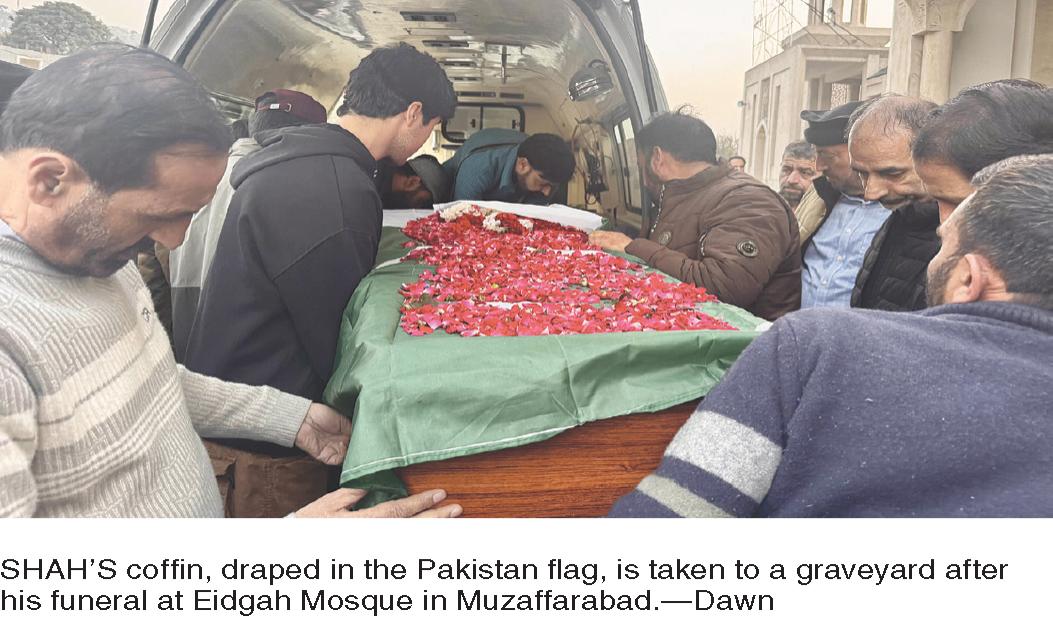
The body was shifted to a mortuary in Muzaffarabad on Tuesday and handed over to the family on Wednesday after completion of the formalities, including approval conveyed by his family in held Kashmir through Indian authorities.
His coffin was draped in the Pakistani flag.