
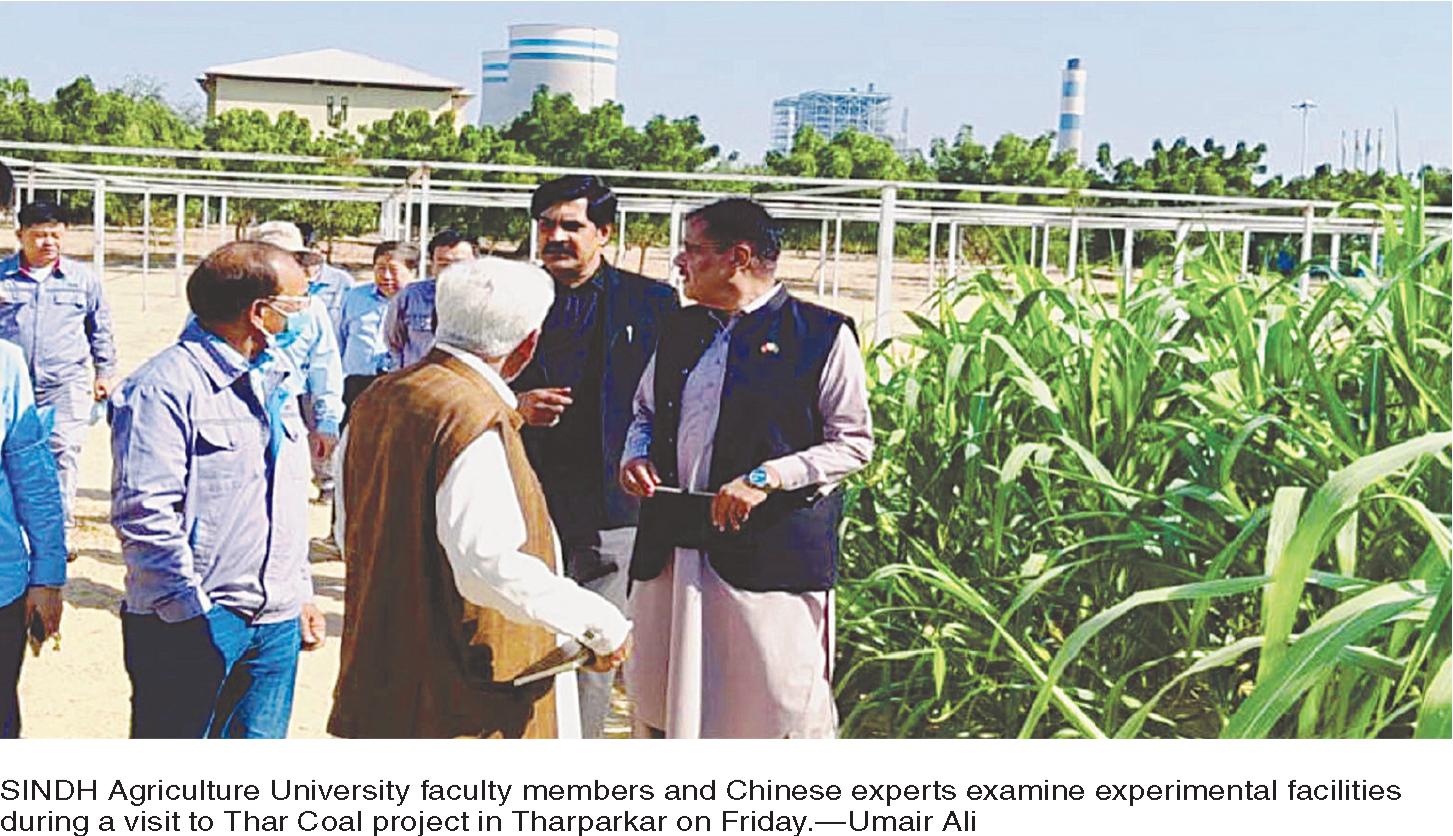
HYDERABAD: Sindh Agriculture University (SAU), Tandojam, and Sino Sindh Resources (Private) Limited (SSRL), a China-Pakistan Economic Corridor (CPEC) project, have launched a joint initiative to explore the productive use of water extracted from coal mines for agriculture, land rehabilitation and ecological restoration in Thar, marking a new phase of Pakistan-China scientific and academic cooperation.
The initiative aims to turn water pumped out of the coal mines into a potential resource for sustainable agriculture through scientific research, biosaline farming, innovative water management and the identification of salt-tolerant plant species suited to the arid conditions of Tharparkar.
The first joint implementation meeting was held at Thar Coal Block-I under a memorandum of understanding (MoU) signed by the two institutions in Shanghai, China, in October 2026. The agreement focuses on the efficient, productive and environmentally responsible use of water generated by coal mining.
The SAU delegation was led by Vice Chancellor Engr Prof Dr Altaf Ali Siyal. It included Dean of the Faculty of Crop Production and biosaline agriculture expert Prof Dr Inayatullah Rajpar, Engr Dr Rahim Bux Vistro, Engr Dr Imran Ali Lakhiar and other technical experts.
The SSRL delegation was led by Chief Executive Officer Li Jigen. It included Shang Zhonghai, former president of the Henan Academy of Forestry Sciences and current vice chairman and secretary-general of the Henan Forestry Society; Prof Wang Sen of Central South University of Forestry and Technology and director general of the Belt and Road Initiative; and SSRL Vice Chief Executive Officer Chaudhary Abdul Qayyum.
Speaking on the occasion, Dr Siyal said water extracted from coal mines should not be viewed merely as an industrial management challenge, as scientific assessment and appropriate management could turn it into a valuable alternative water resource for agricultural and environmental development.
He said SAU had considerable expertise in biosaline agriculture, soil and water management, agronomy, horticulture, plant biotechnology and climate-resilient farming. He expressed confidence that collaboration with SSRL would help develop practical and environmentally sustainable solutions suited to Thar’s distinctive agro-ecological conditions.
Li outlined the company’s roadmap for translating the MoU into practical outcomes through collaborative research, technological innovation and sustainable environmental management. Prof Wang highlighted the potential of mine water for agricultural and ecological development and briefed the delegation on SSRL’s ongoing initiatives at Thar Coal Block-I. These include the establishment of resilient grass varieties, an operational plant tissue culture laboratory and aquaculture facilities for tilapia farming.
Technical discussions focused on identifying and evaluating indigenous salt-tolerant crops, grasses, shrubs, trees and other plant species that could survive in saline and arid environments. Both sides explored joint laboratory and field research on water quality, soil-water-plant interactions, salinity management, plant propagation, land rehabilitation and ecological restoration.
Dr Rajpar shared his research experience in biosaline agriculture and soil science, highlighting scientific approaches to conducting field trials, evaluating salt-tolerant plant species and developing sustainable soil and water management strategies at the mining site.
The two institutions also discussed joint postgraduate research, co-supervision of MS and PhD scholars, faculty and student exchange programmes, specialised technical training, internships and international conferences to strengthen academic and industry linkages.
After the meeting, the SSRL team and the SAU delegation visited various facilities at Thar Coal Block-I. They inspected a plant tissue culture laboratory established for the mass propagation of bamboo grass and reviewed ongoing plantation, aquaculture and land reclamation activities.
The proposed collaboration seeks to develop a scientifically validated and replicable model of a circular water economy. Under it, mine water, subject to quality assessment, necessary treatment and environmental safeguards, could contribute to agricultural production, land rehabilitation, biodiversity conservation and livelihood opportunities for local communities.
The initiative is expected to extend Pakistan-China cooperation under CPEC beyond energy and infrastructure into agricultural innovation, environmental sustainability and climate resilience.