
ISLAMABAD: A compelling body of work on display at Tanzara Gallery offers a profound meditation on the limits and possibilities of visual communication and the relationship between language, memory, and perception.
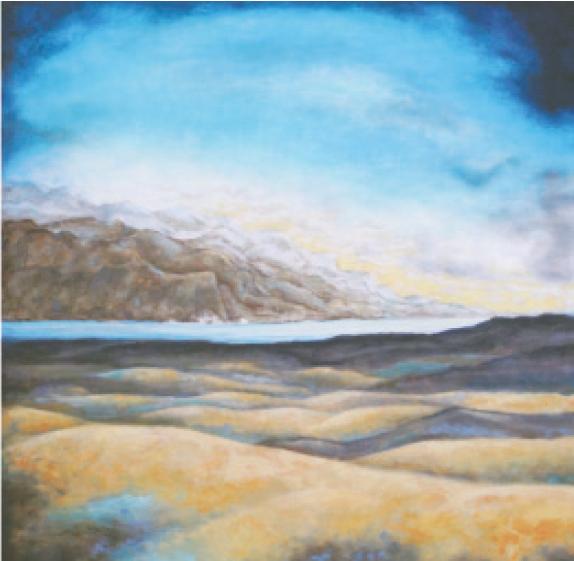
Through a series of large oil paintings, visual artist Nazia Ejaz navigates the tension between abstraction and representation, offering the viewer a visual vocabulary that is simultaneously familiar and foreign.
Curated by Noshi Qadir, the exhibits invite viewers into a liminal space where meaning is felt rather than read.
In ‘Between Words and Worlds’, ‘the artist moves fluidly between abstraction and representation. Drawing upon alphabets, grids, horizons and recurring marks, her paintings investigate the emergence and elusiveness of meaning,’ commented Noshi Qadir, the curator.
Horizons dissolve into bands of colour, while pale, recurring trees create rhythms across the surface, revealing and obscuring the spaces beyond them, she observed.
The exhibition suggests that understanding transcends linguistic certainty, emerging through sustained attention and the unspoken possibilities of painting.
Born in Lahore and now living in Karachi Nazia Ejaz’s career spans more than two decades across Pakistan, the UK, and Australia. She studied at the National College of Arts and the Slade School of Fine Art, and her work is held in prestigious collections including the Victoria and Albert Museum in London.
‘My work is concerned with how we experience the world around us, how we understand ourselves within it, and construct meaning through that relationship,’ Nazia says in her statement.
The exhibition is an interplay between structure and spontaneity. It features distinct series: Cipher paintings evoke unreadable scripts, while geometric compositions and architectural jaalis (perforated screens) negotiate concealment and revelation; landscapes and recurring trees evoke memory, distance, and the experience of seeing; repetition becomes a contemplative practice, mediating between intention and intuition, structure and spontaneity. ‘Like the movement of a tasbih (beads), repetition becomes a form of sustained attention,’ the artist says.
The artist draws heavily on her diverse background, including printmaking and the writings of Ibn al-Arabi, a great Muslim mystic-philosopher and poet of 13th-century Spain for whom letters carry significance beyond their visible forms.
‘The act of making, for me, is a way of thinking, questioning and discovering, of arriving at an understanding that might not otherwise be possible,’ says Nazia.
The artist balances organic, calligraphic curves with rigid geometric elements. Some of the captivating pieces are: ‘Between Words and Worlds’, ‘What Remains Unsaid I’. ‘The Shape of Silence,’ ‘Music Unheard,’ and ‘In Plain Sight’ are a cohesive body of work. The use of colour is exceptional. The exhibition runs until Dec 9.