
Hi, pen pal!
I have been thinking about how I should introduce myself, and today I decided that the best way to begin a lifelong friendship is by sharing our passions. Well, mine is to live by consciously making sustainable choices that help conserve the Earth’s resources. So, in my first hologram, I’m going to tell you how I have incorporated sustainable choices into my daily life. Believe me, it has been easier than I thought.
Since the most important thing is to remain connected with the world, we need to charge our holographs early in the morning. We rise at 3 am, before sunrise. Then, we spend an hour in our moonlit vegetation patch, pampering the suckle berries (they’re delicious and taste just like dragon fruit with a touch of moonshine dust), highlas and nistromas.
The next hour is spent pleasure-reading by the holfire. My current read is my dad’s birthday present, and it’s printed on recycled silicone. Breakfast is at 5 am sharp, to get the digestive clock going with the rising sun.
Demi, my younger brother, is a good kid but has to be perpetually reminded that the Earth’s resources, like his bathwater, have a limited lifespan. Dad makes delicious sugar-cane hotcakes. It’s tough to control my appetite because of the heavenly aroma, but I calculate the amount of energy I will need to sustain myself through the day and eat accordingly. School lunch is a calorie-calculated snack, which I carry in a lunchbox I made myself by sticking bamboo bark together with wood sap.
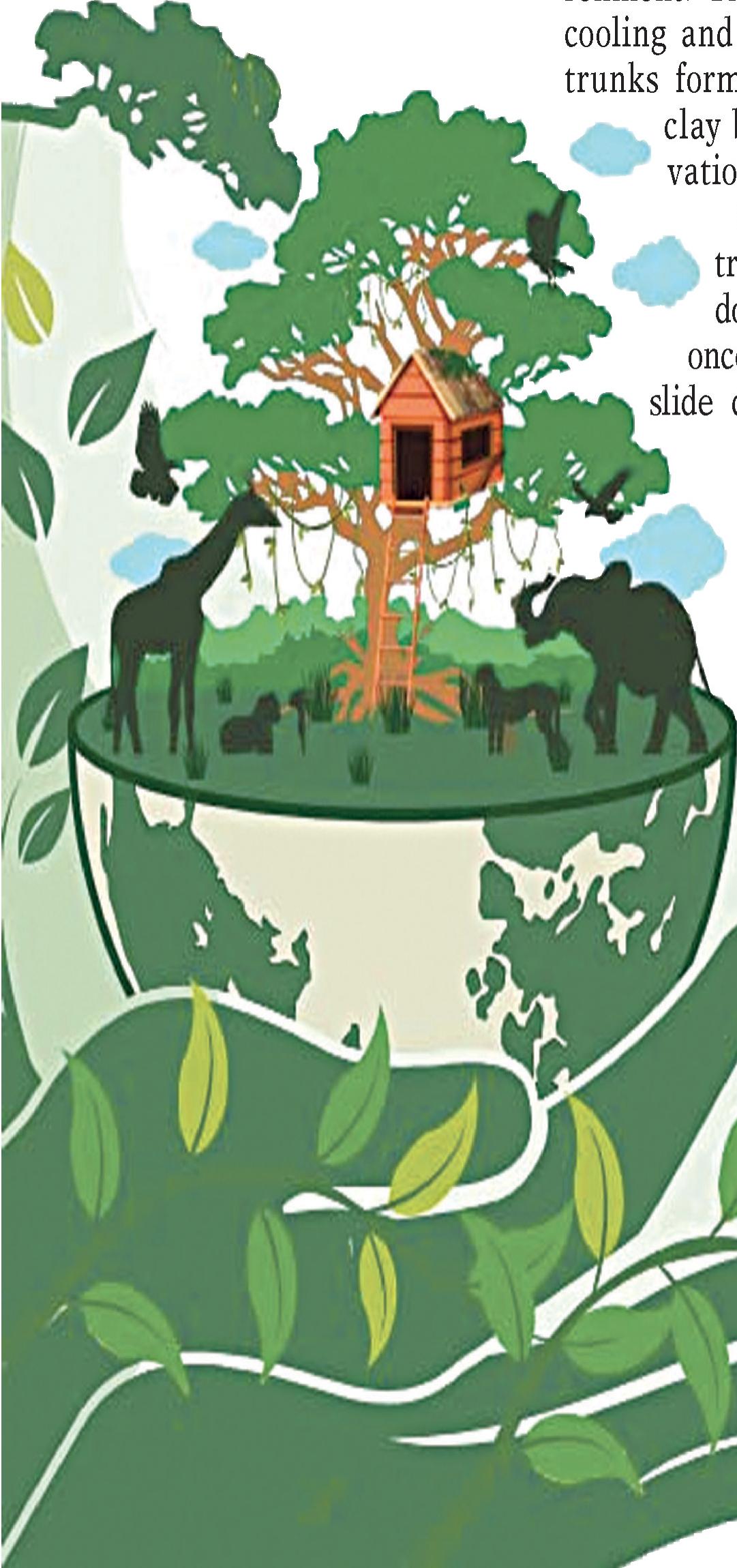
My house is built into a colony of redwood trees. It is six feet above the ground, which gives us access to oxygen. In return, the carbon dioxide we exhale feeds the environment. The tree cover acts as a cooling and heating unit. The tree trunks form the rear walls, while clay bricks complete the elevation.
Getting down from the trees is a bit tricky, but you don’t really think about it once you get used to it. We slide down some thick vines, and even at peak hours, there’s no traffic jam because there are so many of these aerial roots. Don’t worry, we have safety measures. Our backpacks have hooks, so we just attach them to the vines and slide down.
Before joining my friend Sephonie for the walk to school, I deposit the previous night’s kitchen waste into the community compost pile to return the nutrients to Mother Earth.
On our way to school, we love listening to the birds and quizzing each other about their contribution to the environment. It is fun and makes the walk shorter. We get to school in 20 minutes, just as the bellbirds are chirping.
The school’s structure is similar to our houses, but five times larger and much more difficult to navigate. The foundation is made of about ten or fifteen giant sequoias, and inside each tree is a different department, made of bamboo, recycled silicone and sustainable glass.
Today, in the first lesson, we studied for our naturalist exam, which is the most stressful and high-stakes exam for everyone under 17. For this exam, we have to raise a maidenhair fern from sowing to flowering. It is a year-long programme and if the plant dies at any point, you have to wait a whole year to retake the exam.
I generally do well in all my lessons, but my favourites are definitely astronomy and energy conservation. In energy conservation, we study all the different types of renewable energy, what is currently being done with them to provide us with energy and how to use them without burdening the Earth.
It teaches us the importance of renewable energy and how integral it is to daily life. It’s also a favourite lesson because, to learn more about it, we go on field trips every Friday to different renewable energy-generating locations. It is interesting to see how these energies are actually produced and how they keep the Earth clean and green.
At school today, we helped install new clear solar panels on the treetops. It was fun to see how the solar panels caught the sun’s rays and converted them into light inside the classrooms. This was the highlight of today’s lessons, with teachers, friends and foes, flora and fauna, all focused on the single ambition of protecting the environment.
School ended at 11:30, and I was far too tired to walk back home, so I just took the underground. The underground is a train system made of hardened clay mixed with spider silk and sustainable glass, with tracks made of bamboo and sugar-cane rods. I got home at 12 and had lunch with Demi in Dad’s greenhouse. It was then time to head to the service centre.
The service centre is essentially an area where children aged 14 to 17 have to volunteer three times a week for four years. They get involved in the stewardship of the city, and it is a sustainable social practice that encourages them to give back to society. We exchange ideas about environmental protection.
Today, we thought up new sources of renewable energy, how they would work and what they could replace. Later, we planted a new type of seed that government labs have created to grow precious minerals as fruits. These products will be used to power transport without any CO2 emissions. Since these minerals grow twice as fast as normal vegetation, they are economically feasible.
By 4 pm, I’m back home. The next two hours are for family, homework and hobby time. Dinner is a satisfying meal at 5:30, much before we need any artificial light. At 6:15, it’s time to sleep.
I’m lucky to be living in a society where we all care about the Earth and its resources. I am proud that I shall leave behind a beautiful ecosystem.
I would love to learn about the choices you make daily.