
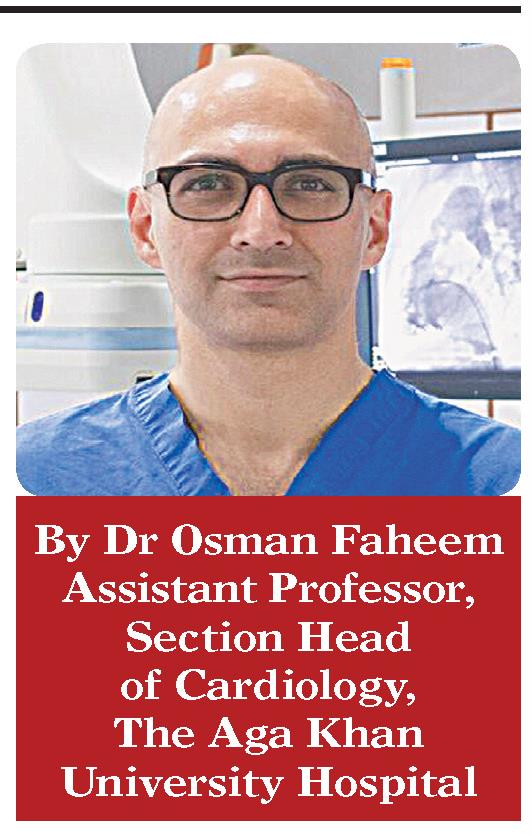
EART disease is the world’s number one killer, claiming nearly 18 million lives each year, according to the World Health Organisation. For much of the 20th century, treatment options were limited: strict lifestyle changes, lifelong medication, and, when things got serious, open-heart surgery.
These surgeries saved countless lives, but they also carried serious risks, long recovery times, and weren’t always available or affordable especially in lowand middle-income countries (LMICs).
Today, however, we are in the middle of what many experts call a quiet revolution: the rise of interventional cardiology. Using thin tubes called catheters, doctors can now treat blocked arteries, repair valves, or even implant mini heart pumps.
What once required a long hospital stay can now be done in days, sometimes even hours. Over the last 10 years, the pace of progress has accelerated like never before. New imaging tools, safer stents, and minimally invasive valve replacements are pushing the boundaries of what’s possible. In wealthy nations, these breakthroughs are now almost routine. In Pakistan the technology is starting to spread though access remains uneven.
A new era in heart treatment Imagine being told you need heart surgery in the 1990s. You would likely have faced a large chest incision, weeks in the hospital, and months of recovery. Today, a patient with a similar condition might undergo a stent procedure through the wrist, walk within 24 hours, and return home the next day.This transformation is the heart of interventional cardiology. Over the last five years, several new advances have taken root: Smarter imaging inside the arteries: With imaging tools such as intravascular ultrasound (IVUS), cardiologists can now see inside blocked arteries in real time. Instead of guessing where to place a stent, they can measure precisely, reducing complications. Recent research has shown that patients treated with imaging-guided procedures often have better long-term outcomes.
Drug-coated balloons and next-generation stents: These new devices slowly release medicines that prevent arteries from narrowing again. This is particularly important in South Asia, where patients often present with more aggressive forms of heart disease at younger ages.
Valve replacement without surgery (TAVI): For patients with failing heart valves, TAVI has been a game-changer. Instead of opening the chest, interventional cardiologists insert a new valve through a blood vessel in the leg. Patients often recover in days instead of weeks, with fewer procedural risks and similar or better outcomes than traditional surgery.
AI and digital health tools: Artificialintelligenceisincreasingly used to interpret scans, predict risks, and even guide treatment decisions.
While still in early stages, these tools could be especially useful in lowto middle-income countries (LMICs) like Pakistan, where highly specialised care is not easily accessible.
South Asia is at the epicenter of the global heart disease crisis.
Heart attacks and strokes occur here at younger ages often in the40s and 50s compared to the 60s and 70s in the West. Busy lifestyles, rising diabetes and obesity rates, smoking, and limited access to preventive care make the region especially vulnerable. In this context, interventional cardiology is not just a medical advance it’s a lifeline.
Hospitals such as the Aga Khan University Hospital have built stateof-the-art cardiac centres providing round-the-clock cardiac care.
A notable development has been the creation of the hub-and-spoke model by NICVD extending emergent cardiac services throughout Sindh. This model connects major cardiac institutes serving as ‘hubs’ with smaller hospitals or clinics.
When a patient in a rural area has a heart attack, they can be rapidly transferred to a hub centre for advanced treatment.
Barriers still ahead Despite rapid growth, several barriers remain before countries like Pakistan, while they can fully benefit from the interventional revolution: Cost of care For all its promise, interventional cardiology is not cheap. Unlike in the West, where national health systems often cover these costs, most of our patients must pay out-of-pocket.
Families sometimes sell land, jewel1ery, or other assets to afford treatment. Almost all the equipment is imported, and a simple stent procedure in Pakistan may cost the equivalent of several thousand dollars, while advanced procedures like TAVI can run into tens of thousands.
This reality affects ‘free’ public sector hospitals as well, where the cost of care is ultimately paid for by taxpayers. This financial strain highlightsone of the central challenges: how to make high-tech healthcare accessible in resource-limited countries.
Training and workforce challenges Interventional cardiology is not just about machines and stents it requires highly skilled doctors, nurses, and technicians. Pakistan faces a shortage of trained specialists, especially outside large cities.
Despite dozens of world-class cardiology training programmes, the ratio of specialists to patients is far lower than in Europe or North America. Job opportunities and living conditions in rural areas are dismal. As such, more training programmes, regional workshops, and telemedicine mentoring can quickly expand the skilled workforce.
Urban-rural divide Despite 61 per cent of the Pakistani population living in rural areas, most advanced care continues to be concentrated in major cities,leavingruralareasunderserved.
There is a lack of high-quality primary and urgent healthcare facilities outside of cities.
Policy gaps Reimbursement policies and government funding lag behind the pace of medical innovation. Policies are institution-specific and there is a lack ofstrategicplanningto address healthcare issues at a national level.
Awareness Public understanding of the critical importance of routine preventive care and a healthy lifestyle remains extremely low. Patients often delay seeking care, resulting in more complex disease states requiring higher-cost treatment.
Research representation South Asian patients are under-represented in global clinical trials, making it harder to know which treatments work best locally.
What the future holds Global experts agree that interventional cardiology is only going to grow.
Over the next decade, several trends are expected to reshape the field: More minimally invasive options Not just for the aortic valve, but also for mitral and tricuspid valves, reducing the need for more invasive, ‘open’ cardiac surgeries and increasing the demand for high-quality, skilled programmes to provide such care locally.
Affordable technology Pakistan has done well in producing relatively low-cost generic medicines, but medical device production is almost non-existent. This requires strategic government planning, incentivisation, and creating an environment for investment in this industry.
Artificial intelligence AI is a game changer in this field and could help predict heart attacks, interpret diagnostic scans, act as a physician assistant, and guide interventionsinregionswherespecialists are scarce.
Preventive care integration A nationwide prevention programme is needed to emphasise the importance of preventive care.
From early childhood, school curriculums should inculcate the benefits of healthy food choices and exercise in future generations. Anti-smoking regulations and enforcement of age restrictions on access to smoking and vaping devices need to be imple-mented at a national level.
Preventive strategies and the identification and treatment of risk factors such as high blood pressure, diabetes, high cholesterol, and smoking are key to reducing the burden of cardiovascular disease on society.
A turning point in cardiac care The past 10 years have shown that heart care can be transformed without open surgery. For Pakistan, where heart disease takes lives earlier and in greater numbers, this transformation could not be more urgent.
The challenge now is not just technological it is political, economic, and social. Will our governmentsexpanduniversalhealthcare? Will awareness campaigns reach villages as well as cities? If these questions are answered with vision and urgency, Pakistan could become not just a consumer of medical innovation, but a pioneer in adapting and spreading it. The heart revolution has begun its future depends on how widely and fairly its benefits are shared.