
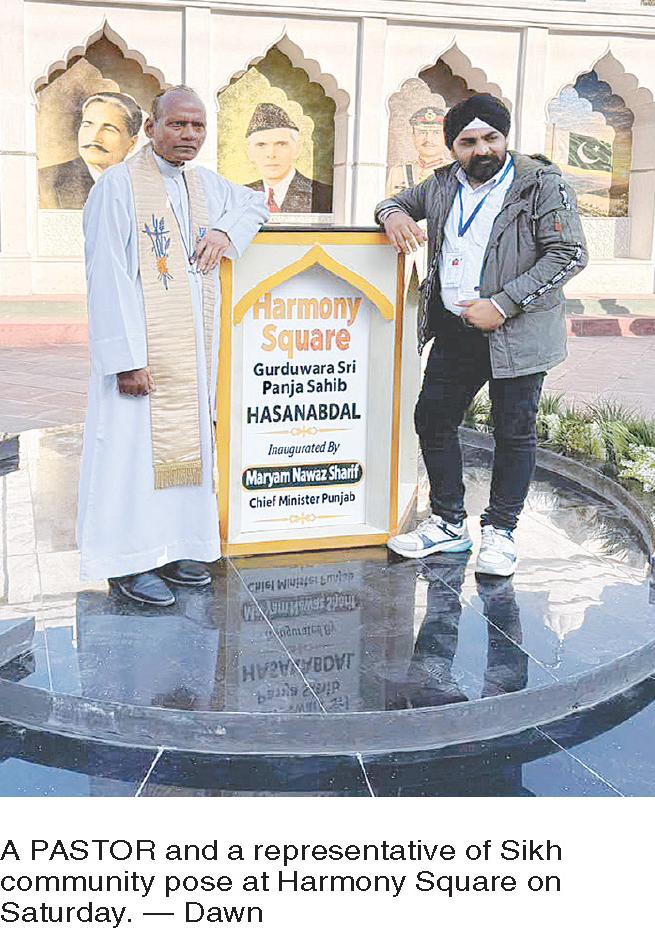
TAXILA: In a city where the sacred landmarks of different religions stand side by side, a newly established ‘Harmony Square’ opposite Gurdwara Panja Sahib is emerging as a symbol of religious coexistence, cultural diversity and mutual respect, reflecting the Attock district administration’s efforts to promote interfaith harmony.
Located at the intersection of the religious heritage of Sikhism, Islam, Hinduism and Christianity, the square offers a striking reflection of Hassanabdal’s pluralistic identity, where centuries-old religious traditions and historic places of worship coexist within a remarkably small geographical space.
Representatives of different religions gathered at Harmony Square on Saturday to demonstrate solidarity and promote a message of peace, tolerance and mutual respect, underscoring the significance of preserving the shared cultural and religious heritage of the historic city. Talking to newsmen at the square on Saturday, Deputy Commissioner Attock Dr Mudassir Ahmed Shah said Pakistan possessed a rich religious heritage and historical association with several faiths, particularly Sikhism and Hinduism, whose sacred places continued to attract pilgrims and visitors from across the world.
He said the square had been developed to showcase the country’s cultural and religious diversity to the international community, promote interfaith harmony and project Pakistan’s soft image through its centuries-old traditions of coexistence, hospitality and respect for different faiths.
The hilltop shrine of Baba Wali Qandhari is an important spiritual landmark associated with Hassanabdal’s Islamic heritage. The saint is also part of the historic religious narrative surrounding Guru Nanak’s visit to the area, making the locality significant to both Muslim and Sikh traditions.
The deputy commissioner said the surrounding religious landmarks represented a living manifestation of the region’s diversity, while a Hindu temple in the vicinity had remained abandoned for years. He said the district administration, in collaboration with the Evacuee Trust Property Board and the Pakistan Hindu Council, planned to restore the abandoned temple and revive it as a functional place of worship, enabling the Hindu community to reconnect with its religious heritage.
The Attock’s Additional Deputy Commissioner Headquarters Arif Qureshi, who conceived the idea of developing the site into a dedicated square while serving as assistant commissioner Hassanabdal in 2024, said the initiative was aimed at transforming a neglected urban space into a landmark reflecting the city’s history, culture and religious diversity.
Assistant Commissioner Eman Zafar told newsmen on this occasion that the initiative complements broader urban renewal and beautification efforts aimed at improving public spaces, preserving Hassanabdal’s historical identity and enhancing facilities for religious tourists.