
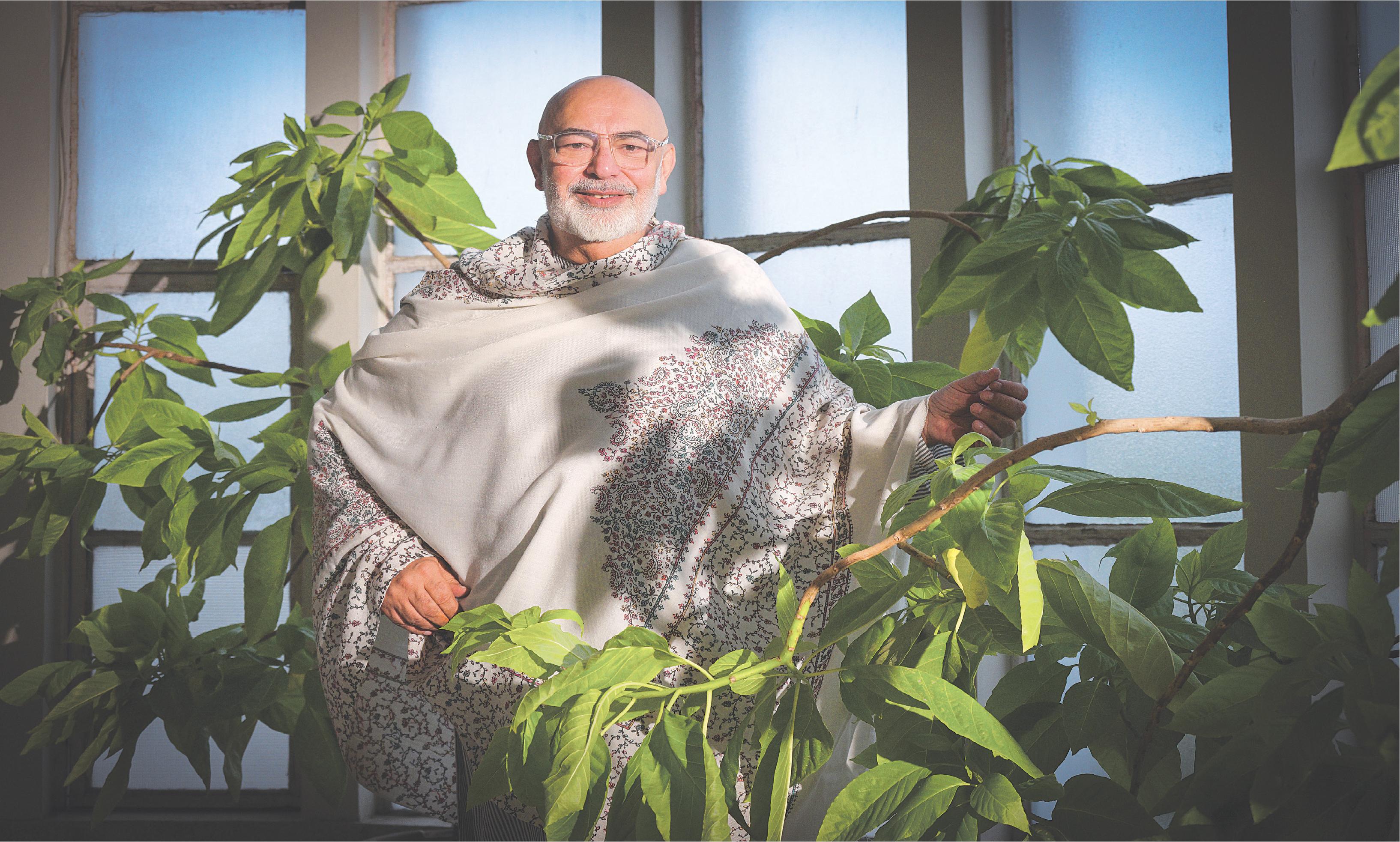
Long before beauty was dominated by artificial filters and social media noise, there was Tariq Amin — coiffing, colouring, transforming and happily ruffling a few feathers along the way.
For 45-odd years, he has been an indelible part of Pakistani fashion and beauty. To date, within his domain, style is innate and opinions are unapologetic and non-negotiable. Tariq’s ‘domain’ in Karachi, literally speaking, is a classy, utilitarian salon in the Avari Towers hotel, with the walls plastered with Vogue covers from over the years. It is a long-standing institution, frequented by clients for more than three decades now. This is where I meet Tariq.
Motioning towards the walls, he quips, ‘These are very expensive walls, with so many Vogue covers on them.’ He is in his ‘work gear’ — a basic black shirt and pants, very practical, in sharp contrast to the razzling dazzling maven he becomes when you meet him at an event. Those who know Tariq are well acquainted with his enviable wardrobe of statement wear, his 10 rings, and his diamonds!
Of course, Tariq has always had a keen sense of style and, at some point in our conversation, he observes, ‘I have seen a lot of fashionable people who are stylish and a lot of stylish people who are not fashionable. Fashion is something you buy and style comes from within. The trick is to find the balance between who you are and how you want to present yourself.’
The Tariq Amin client, I presume, is someone with a knack for style? ‘The Tariq Amin woman or man is someone who is willing to look in the mirror and accept their faults,’ responds Tariq. ‘They are happy with who they are. And they have an understanding of quality, which is why they are coming to me.’
THE LEGACY QUESTION
I wonder what could be counted as Tariq’s legacy.
‘My legacy is the love that I have gotten from everywhere,’ he says, ‘the people who send me duas [prayers] and who have been coming to me for decades. Generations from an entire family come to me — the grandmother, the mother, the daughter, the daughter’s daughter. And when there is a wedding in the family, it is just understood that Tariq will be involved.
‘So many stylists have had their first jobs with me, and I have mentored them: Shazdeh Ali Akhtar, Nida Khan, Nina Lotia, Rukaiya Adamjee, Mubashir Khan, I could go on and on. It is such a pleasure for a hairdresser when another hairdresser comes to him for a haircut, and so many of them do come to me.
‘And then when someone says to me, send me your portfolio for nominations for such-and-such award, it appals me!’ Tariq adds. ‘Does Brad Pitt have to send in his portfolio to provide evidence of his acting career? I have worked for so many years and people who know, know. I won the very first Lux Style Award [LSA] — even then it didn’t mean anything to me.’
He elaborates: ‘I have always done my own thing, never been part of the rat race. Even back when I was supposed to be part of the mainstream lot, I was always more on the fringe of things, entering when I wanted and then retreating. I left Karachi back in 1993, when I was king, because my mother was unwell. But nothing happened when I left, and who died and brought in all these queens?’ He laughs.
‘I still feel that nobody can do what I can do. No one blow-dries, cuts and colours themselves. I have a fantastic team in my salons, but my customers come for me for the specialised treatment I can give them.’
And therefore, for ages now, Tariq’s monthly roster has traversed a three-city network: the first week of the month in Karachi, the second week in Lahore and the last two weeks in Islamabad. ‘I have been doing it for so long that it has become second nature to me,’ he says, shrugging.
Is he still excited by his work? ‘I wouldn’t be here if I wasn’t excited,’ he says emphatically. ‘Everything I do is 100 percent. Customers come to me because they value my work and appreciate my honesty. I am not a fly-by-night operation, which is why I can speak what I feel and get away with it.
‘I am well-educated, from a well-established family, and I had to fight with my parents when I was a man in my 20s, wanting to come into this business. They thought I couldn’t make a living out of this work and assumed that it would be a hobby and I would eventually join the family business. But nothing of the sort happened. I did what I wanted to do and was very good at it too.’
So, when does he think he truly made it? ‘When I did Benazir Bhutto’s make-up for her wedding,’ he says promptly. ‘It really landed me and I think that’s when my parents also agreed that I had made it.
‘My name came in Vogue and I was part of a BBC and Channel Four show called Songs and Memories, presented by Zarmine Safaraz,’ he continues. ‘Fourteen people were part of it, seven from Pakistan and seven from India, including Madam Noor Jehan and Amitabh Bachchan. I was in it as well — in fact, my segment was shot in this very salon! To get that kind of mileage, when you’ve only just started out, was incredible.’
I look around the walls surrounding us, searching for the Vogue in which he had been featured, and he says, ‘No, no, that Vogue is safely set aside in a drawer in my home in Islamabad.’
He continues to reminisce, ‘Ask me whose bridal make-up I haven’t done! I walk into Sana Hashwani’s [of Sana Safinaz] home and I see a portrait of her as a bride and that’s my make-up. I go into so many other homes, and up on walls is some of my work. It’s a wonderful feeling.’
FASHION ACCORDING TO TARIQ
And then there were the fashion shoots.
‘We were having so much fun. I worked with Sana Safinaz back when the brand had just started out and make-up artists still write to me, telling me that they feel so inspired by the shoot we did at the Mohatta Palace.’
Now, though, he feels that the enjoyment has disappeared from fashion.
‘There’s no fun in fashion anymore,’ he says. ‘It has become cutthroat and petty, and mediocrity is ruling the roost. Models used to be classy and now, when I sit in the front row at a fashion show, I am appalled by all the dirty knees and elbows I see on the ramp.
‘Back when I was working backstage at fashion weeks, before anything else, the models would get manicures and pedicures. I would rather that they place my seat in the back row now because I can’t bear to watch the catwalk the way it is today.’
The commentary gets even more colourful: ‘We have turned fashion into entertainment and it has now become a variety show. We have khotis [donkeys], midgets and celebrities on the catwalk. We have Mathira as a showstopper, looking like the Titanic decorated with gota [decorative lace]! We have hair that’s the colour of aaloo gosht [meat and potatoes curry], with a side dressing of tarkaari [vegetables], if you please!’
I intervene, saying that there must be some people that he thinks are taking fashion forward. He nods. ‘There are some designers who are still putting in an effort. I think Fahad Hussayn is a star. He creates his own world, going out of the box and putting out these fashion films. His passion shows in his execution.
‘I feel that Mohsin Tawasuli’s departure from Sana Safinaz has brought him to a totally different design landscape, where he’s changing the silhouette, giving it a wave. It’s lovely. In the realm of bridal wear, I feel Rizwan Beyg is king. In terms of workmanship and silhouette, no one can touch him. You could wear a design of his from 30 years ago, and it would still stand out.’
He adds, ‘I also love Kamiar Rokni’s work. His bridals are whimsical, feminine, airy and wearable. They are reflective of who he is, his creativity and his background. Of course, no one can make a dress like Deepak Perwani. He understands the Western silhouette like no one else and, over the years, he’s made both men and women look hot.
‘And Maheen Khan’s work is impeccable, transforming a simple garment into something that is timeless. I haven’t been to Hussain Rehar’s store, but I feel that, amongst the new lot, he really pushes the boundaries and has a very cool aesthetic.’
Although he has digressed into praise, it is clear I have set Tariq off on a pet peeve that he circles back to. ‘I value originality and creativity and I am just so sick of all the ornamentation that is passed off as fashion these days,’ he adds. ‘The baji brigade has truly taken over, with the embroidery and the 50 yards of bling in an outfit. It might be on-trend at the time at which you buy it but, a few months later, it is just an elephant in your closet that you don’t want to wear again!’
THE SOCIAL MEDIA ‘NOISE’
Moving beyond fashion designers, I ask Tariq what his take is on today’s coterie of stylists. Many of them have strengthened their presence through social media.
‘I stay away from the online noise,’ Tariq replies. ‘I don’t think they even know how to spell ‘stylist’! A lot of them are merely ‘borrowers’, borrowing clothes from designers and getting celebrities to wear them, not even registering that the dress might be two sizes too small! The celebrities, also, usually don’t have any idea about their personal style, just wanting to wear clothes for free.’
He continues: ‘I mean, all the people doing make-up right now, a lot of them haven’t even had a job in a salon! They just have a little box and a ‘number do’ [notorious] chick that they tart up every two weeks, and that is supposed to be their claim to fame.
‘A girl recently came to me and introduced herself as a stylist and her nail polish was all chipped. I asked my staff to clean her nails first, and I told her that I could not have a conversation with someone with dirty nails introducing herself as a stylist!’ Only Tariq could get away with a story like this, I laugh.
‘Social media has stripped off the originality that once existed in fashion and beauty. Everything looks trashy and cheap.’ He pauses, musing over the occasional positives of Instagram. ‘But then you have Saba Qamar coming in and asking me to transform her hair and the pictures hauling in 1.5 billion likes on Instagram in a single day!’
She looked sensational, I comment. ‘Yes, 10 years younger and stunning,’ Tariq agrees.
What is the one beauty trend that he feels needs to go? ‘I feel the shiny face needs to go. Everyone looks like they have dipped their faces in cooking oil and come to a wedding. You have to be flawlessly beautiful to wear so much shimmer, otherwise every pore and every bump will stand out.
‘Matte or semi-matte needs to come back. I have always appreciated originality — to want to look like yourself rather than be a copy of all the people around you. That’s the beauty concept that needs to stay.’
What does he count as his most memorable work? ‘I mean, there is so much,’ he points out. ‘I look out for potential in the people around me. I did not know Abbas Ali Khan or Ali Zafar or Atif Aslam before I worked with them. Look at the video of Fuzon’s Khamaj. I styled it and the people around me appreciated that, in order to be a stylist, you need to be well-acquainted with fashion history.
‘I have worked in so many fashion shows around the world, Tarun Tahiliani, Rohit Bal and Manish Malhotra — when they visited Pakistan for Carnival de Couture — Nilofer Shahid’s shows in Paris and at the Royal Albert Hall in London. I did the make-up of many of the Indian models and celebrities who would visit Pakistan back in the day: Arjun Rampal, Milind Soman, Shilpa Shetty and Urmila Matondkar!’
He could have an entire hall of fame dedicated to himself! But Tariq Amin is not stopping any time soon and the chances are that more and more portraits will have to keep getting added to the wall.
While the world around him rushes about, following the herd, creating illusions through social media, chasing the next big thing, Tariq Amin defiantly, gloriously remains himself.
He is the big thing himself.
The writer is a fashion and entertainment journalist with over two decades of experience. She can be reached at maliharehman1@gmail.com