
The penultimate day of the third World Culture Festival (WCF) at the Arts Council of Pakistan Karachi (ACPK) continued to be every bit the dense whirlwind as its preceding 23 days. There was just too much to see, with too little time to relish it. One always arrived late or missed simultaneous events that were spread across the compound.
It only takes a few hours to reach a definite conclusion: the next WCF should add more days, or one should resort to science and clone themselves. Since neither is a possibility — ACPK President Ahmed Shah has announced the fourth WCF’s dates from October 28 to November 21, 2027 — I guess one has to pick and choose from the best of the performances. The only catch is: most of them are really, really engaging.
WCF’s tagline has been upgraded from ‘Connecting the World Through Culture’ to ‘Bridging the World Through Culture’ (since the ‘connect’ part has been taken care of). While 2024’s WCF ran for 38 days and hosted over 40 countries and 100-plus performances, and 2025’s ran for 39 days with 1,100 artists from 142 countries, 2026 condensed the schedule to 25 days while hosting over 1,500 artists from 153 countries. Iranian, Palestinian, Russian and American artists were among those who flew in so they could share the same stage across 200-plus performances.
Fifteen hundred artists and the word ‘choosy’ wouldn’t necessarily go together, but they do co-exist in Shah’s vocabulary. He told Icon he had to be ‘choosy’ this year because a great number of artists wanted to perform in Pakistan. One shudders to think of the day he lets the floodgates open. Where would he even get the space, one wonders? The events had spilled across six simultaneous venues and 24 rehearsal spaces. Every nook hummed with activity.
Amongst them, 12 new murals were painted across ACPK by artists Jhon Ramirez (Colombia), Edoardo Ettore (Italy), Kaleab Alemayehu (Ethiopia), Domi Forest (Sweden), CHIFUMI (France) and Yip Yew Chong (Singapore). The art reminds one that this year’s WCF — grand as it is — is but a trailer.
The plan is to jump ACPK’s walls and decorate Karachi itself with over 100 murals in the coming years, Icon is told — though the ambition doesn’t stop in Pakistan. There are also plans of international expansion (the presence of Arif Zaffar Mansuri, chairman of Friends of Pakistan, USA, signalled this potential alliance) — though, like everything else, the grand plan remains subject to shifting financial realities.
Despite escalating costs and a flat annual grant from the Sindh government, ACPK kept nearly all of its events free of cost and open to the public. Crucially, cinema — neglected in the first WCF — stood right in the thick of the performing and illustrative arts, with Pakistani features and shorts playing shoulder-to-shoulder with international selections.
Still, when filmmakers gathered at the Arts Council library for the Storytellers Roundtable — moderated by ACPK film department head Dr Omair Ahmed Khan with panellists Satish Anand, Saima Akram Chaudhry, Omer Shahid Hamid, Safina Danish Elahi, Qasim Ali Mureed, Bilal Atif Khan, Anam Abbas, Adeel Afzal, Ali Aftab Saeed, Zaheeruddin, Umair Nasir Ali and Canadian guests Arshad Khan and Lori Braun — consensus remained elusive.
Maintaining decorum despite visible eye-rolls, the room stayed divided along staunch viewpoints, circling familiar arguments about commercialism, shrinking attention spans and artificial intelligence, rather than reaching workable conclusions.
While film screenings slipped past this writer’s schedule, one caught the [Father], screened at over 90 festivals with 17 international awards, as it clashed directly with the closing performances.
At ACPK’s Studio 2, Palestine’s The Freedom Theatre staged Shatha’s Triangle, a non-verbal monodrama authored, directed, and performed by Jenin trainer and actor Shatha. Rather than focusing on the war with Israel (as one would have expected), it follows a young woman navigating life despite roadblocks.
‘Rather than giving neat slogans, the play stays close to the inner friction of holding on to aspiration while living under real-world constraints,’ she told Icon. Watching Shatha’s nearly 40-minute physical storytelling while reading English translations projected on the back wall took some adjusting to. By the time one attuned to it, Music Mania was underway in Auditorium 1.
When this writer got there, the hall was already deep into Algeria’s Farah Baba Ammi’s jam session, followed by performances by Azerbaijan’s Sahib Pashazade Duo, sitarist Ashraf Sharif Khan Poonchwala and Tom Burge’s band Low Stakes. Hard as it was to pull away, another performance was already running parallel.
At the nearly full amphitheatre, Russia’s MD Pride delivered an energetic, theatrical showcase of small, comic vignettes of Russian stories. Arriving mid-set, this writer was nevertheless compelled to stay — and wildly cheer — until the final bow.
WCF’s final day was slightly less hectic. While Hoi Theatre of Georgia led a midday Light and Movement workshop at Studio 2 and the library hosted the panel Artfelt: Art in the Age of AI, the main event was the grand closing ceremony on the lawns of the nearby YMCA.
International ensembles from the US, Algeria, Azerbaijan, the Czech Republic and Italy, alongside Sahir Ali Bagga, Shaina Ali, Khumariyaan and Ustad Noor Bakhsh, performed for a crowd paying Rs4,000 a ticket (half for ACPK members). It was one of the maybe five ticketed events at this year’s WCF.
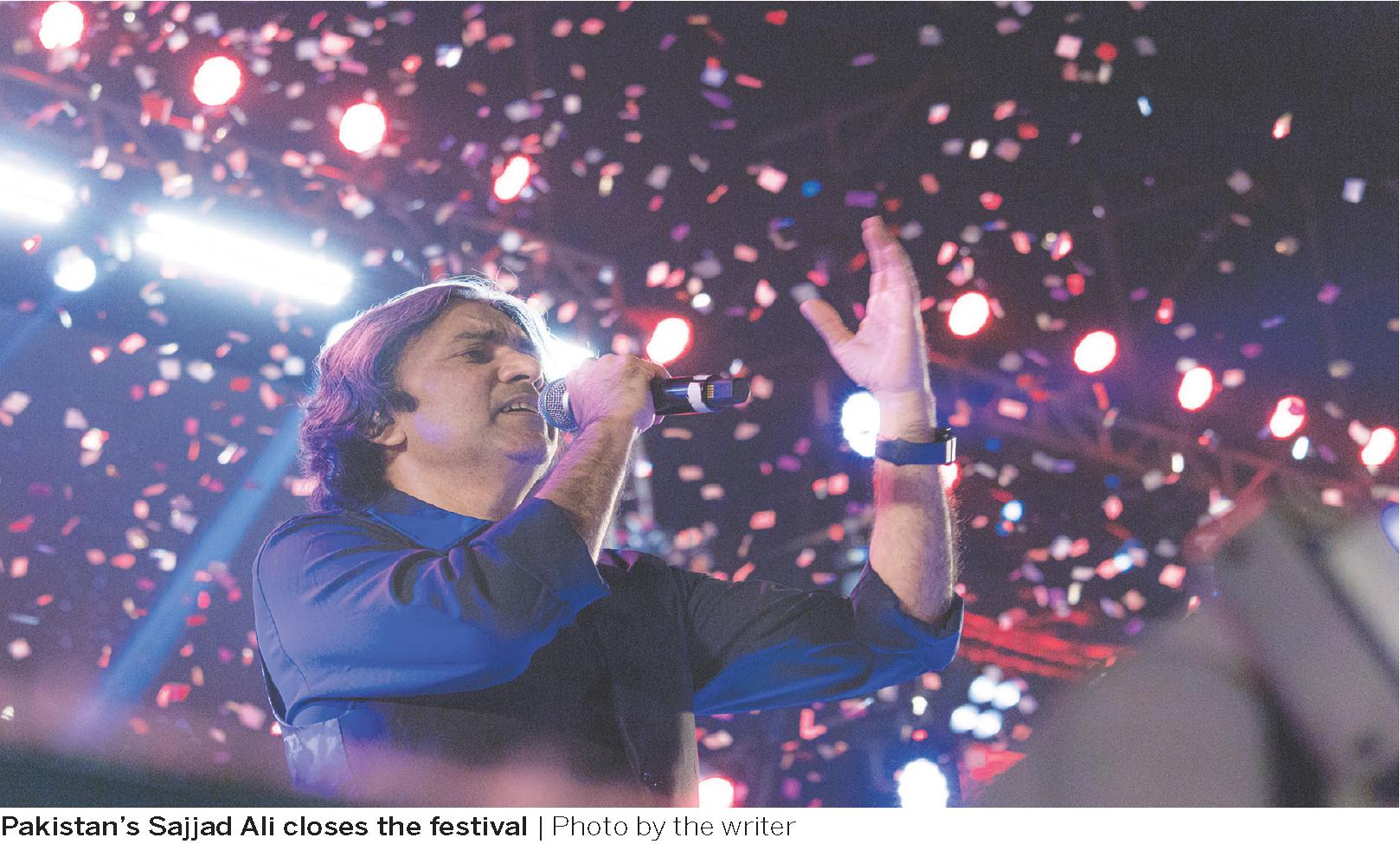
Sajjad Ali, closing the night, rocked as usual, rallying the crowd and quipping about John Cena and Jaun Elia, before bringing his son Khubi Ali on stage to sing a verse of ‘Lagaya Dil’ [Fell In Love]. Jokingly reprimanding the confetti and pyrotechnics staff — they threw off his musical notes — he emphasised with pride that he is, and has always been, a Pakistani pop star, a label that carries a prestige all its own.
Ali didn’t need to say this, because his songs have never left anyone in doubt. The fact is almost as indisputable as WCF’s continued success.
Here’s hoping the next edition will be bigger, denser, and in Shah’s words, ‘choosier’ — meaning the rest of us had better start preparing now to absorb that much world culture without getting overwhelmed.
The writer is an entertainment journalist and Icon’s primary film reviewer