
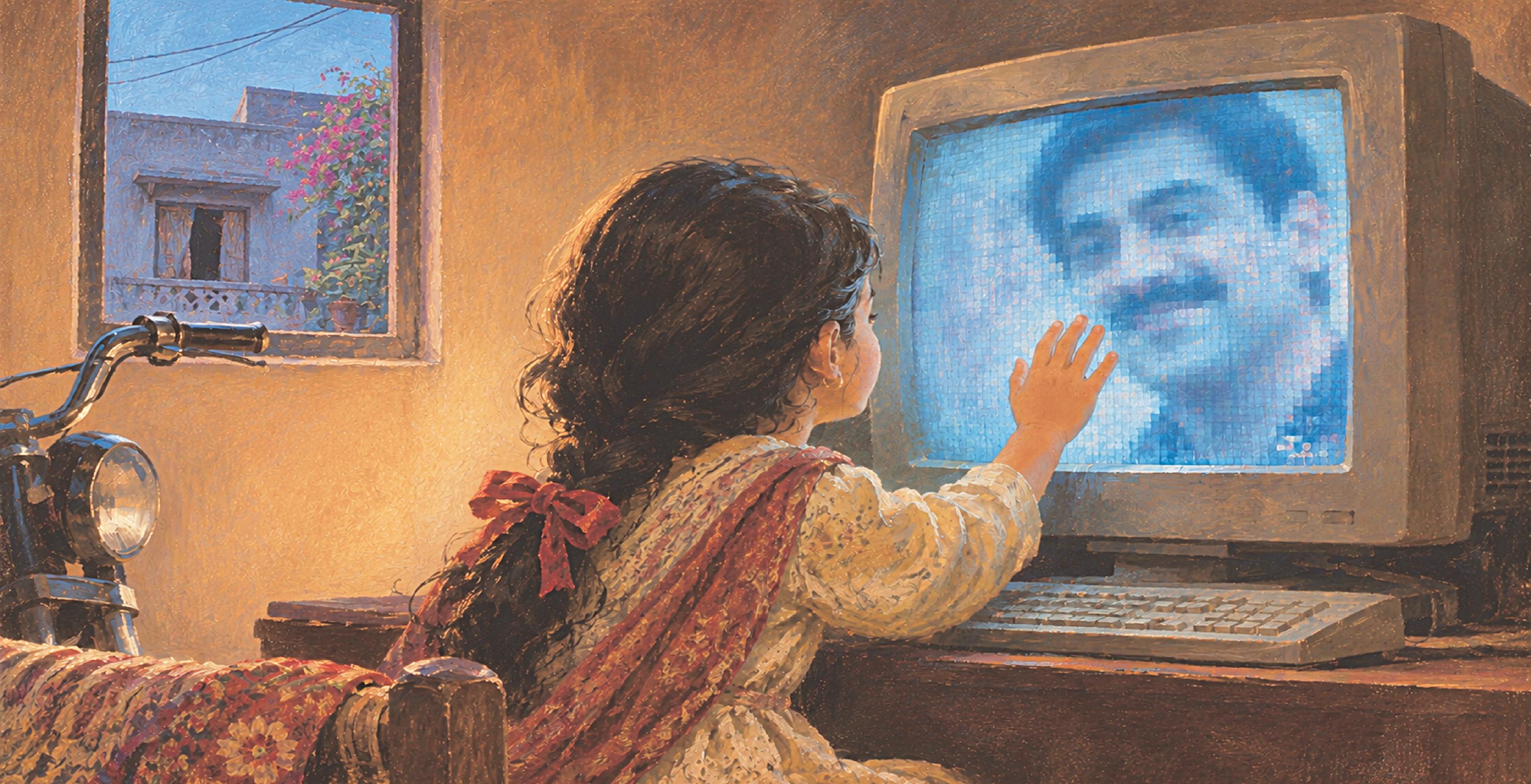
When I was four-years-old, I didn’t know who my father was.
I grew up in Medina Colony, a tight-knit neighbourhood so small it doesn’t even appear on Khairpur’s map, and still, it made up half my world. My earliest childhood memories involve me sitting on a hurtling motorcycle, wedged between the handlebars and my grandfather. He was a large, booming man with a spectacular grey moustache that I would often poke at for fun. I particularly enjoyed how he was bald on top, with a thin ring of grey hair around the sides and back. Safely locked in his arms, I would watch the world with curious eyes.
Khairpur was filled with familiar sights: a trail of buffaloes lumbering down the street, their hides slick in the heat, leaving behind a dotted map of fresh dung; a woman beating a mattress against her rooftop railing; a tailor bent over a sewing machine in his open storefront, coloured thread spools stacked behind him like sweets in a jar; and the corn guy at his usual corner, fanning the smoke from a bed of hot coals as he turned cobs until the kernels blistered and blackened at the tips, then dragged a split lime crusted in red masala across their length in one stroke.
My stomach would immediately rumble at the sight. Eventually, my grandfather would get off to haggle with the vegetable sellers and I’d linger close by, screwing and unscrewing the motorcycle’s fuel tank to catch a strong whiff of petrol. As we drove back home, a fat cob clamped in my hands, I would tell myself: this is my father. My Abba.
But in my life, there was also a Papa. I would often hear about him from my mother — this Papa, who appeared to live on the other side of the world. He also had a moustache, but it wasn’t grey or nearly as spectacular. Instead, it was black; a caricature of the image I had formed in my head of what a moustache was supposed to look like.
The man existed on the computer, a collection of thousands of tiny pixels that my mother somehow could not get enough of. She would stay up late, whispering and giggling into her headset as she talked to him, the room dim except for the glow of her screen. I couldn’t at all understand what was so special about this random stranger.
One day, we received a package in the mail. It was from the man on the computer. The entire household was in a frenzy: Abba beaming and barking rushed orders, my grandmother smiling shyly from the bawarchi khana [kitchen], and my mother, who had abandoned what she was doing and forgotten to wear a dupatta in excitement.
The tape was cut and the box split open, revealing chocolates wrapped in shiny foil, a dozen new T-shirts and, of course, my most prized possession: a Spiderman backpack with wheels. I almost fainted at the sight, because it was exactly what I had wanted. How did the man on the computer know?
At the bottom lay a stack of photographs, held together by a rubber band. My mother carefully pried the rubber loose, a slow smile forming on her face. They were pictures of him: at Universal Studios in front of a giant gorilla, leaning over a pool table at some club, posing next to a The Incredibles character, standing on Golden Gate Bridge, at a conference with important looking men in suits, always smiling the same wide smile.
I studied his face the way you might study strangers at weddings, looking out for any familiar feature or clue that might connect him to me. In the end, I concluded, perhaps he was a celebrity.
It wasn’t long before the man himself arrived in person. The house was scrubbed raw and our room, especially, was adorned with flower garlands. When he finally walked in, ducking his head through our wooden door, his hair ruffled from travel, everyone surged forward in a puddle of hugs and kisses.
Relatives had appeared out of seemingly nowhere, eager to greet the golden son who had returned home after having victoriously procured a foreign degree, something that was — and still is — uncommon in our family. Someone crowned his arrival with a haar [garland] woven from currency notes, the paper rustling against his shirt.
Standing in front of me, he seemed impossibly large in his jeans and Ralph Lauren polo. I clung to my grandfather’s side, clutching his kurta tightly. Eventually, my father looked around, his eyes searching until they landed on me, and his face split into that same big smile I’d seen in the photos. I was horrified.
He bent down, arms open, calling my name. Panic flared and I held tighter on to Abba, who was laughing and pushing me towards the man exclaiming, ‘Your father’s home!’ My father tried to lift me; he smelled of aftershave and the metallic-synthetic tang of his travel jacket. I stiffened. Later that night, I created a ruckus and refused to let him sleep in our bed.
I don’t remember how he eventually won me over. What I remember is my mother a few days later, her hair pulled into a knot above her head and her cadence no longer as practised, as she called the family to breakfast in the veranda. She had stopped wearing her good clothes around him, dressed instead in soft cotton shalwar qameez that was fading from wear. That’s how I knew my father’s arrival had stopped being an event.
Abba’s behaviour also changed, though differently. He’d handed me off to the man like a package he was glad to finally deliver, but I would often catch him watching us from across the room, eyes flicking up every few minutes the way they often did when I went out to play with kids in the neighbourhood. My father and Abba would have long chats on the charpai, discussing politics and family gossip as though no time had passed. That’s when I would see Abba laugh — really laugh, head back, belly jiggling — and something in me began to loosen. If Abba trusted the man, I figured I could rent out a little trust too.
In these months, I learned there was more than one way to be a father. While my grandfather had a temper — he barked at the milkman for shortchanging us and swore at drivers who passed too close — to me, he was my sweet, lovely Abba, who would save me the juiciest Chaunsa, carefully slicing it and placing it in my lap before anyone else could claim it.
My father’s love, by contrast, showed itself in attention. He’d crouch to my eye level to ask me questions on how I felt about things; did I prefer vanilla or chocolate (chocolate), who was my favourite superhero (always him, in every universe) and what did I think about God (unsure). He taught me to question early on, passing on his love for intellectual inquiry. I knew, then, that I had two wonderful fathers who loved me, each in his own grammar of love.
Not long after Papa’s return, we left Khairpur and moved to a flat in Islamabad. I started school, we got our first car and I now had a baby sister whose favourite pastime was crying. Life was as normal as it could be for a seven-year-old — my biggest concern back then was how I’d avoid attending P.E. that week.
It felt like everything shifted in the blink of an eye. Suddenly, we were packing up all our belongings and moving to ‘London’, which in our family — as in many Pakistani families — could mean almost anywhere in the UK. My father had gotten a funded offer for a PhD programme. I had no clue what any of it meant — where London was, what a PhD was supposed to be or how long we were going for — but joined in on everyone’s excitement regardless. Luckily, unlike last time, our visa went through and, before we knew it, we were juddering off to the airport in a taxi full of suitcases.
Bradford was far from London, but we made ourselves at home anyway. It was a miniature Pakistan, littered with Kashmiri, Sindhi and Baloch families, where you could get a £2 deal of seekh kebab and naan at any corner joint. I joined a new school where I made new friends, we bought a car but sold it that very week — it turned out parking was more expensive than the actual vehicle — and I now had another baby sister.
Life was starting to look up. I had made a best friend and our school counsellors talked about options for secondary schools, advising me to apply to a selective programme for G&T [Gifted and Talented] students.
As my father’s five-year degree came to a close, he announced that he wanted to finish his final year alone in the UK. That way, we could also save money. I knew finances were limited, but I also knew that we would need money to settle back in Pakistan, where our schooling and healthcare would not be state-funded. Perhaps my father just needed some time away from us, I thought. Accordingly, my mother, my sisters and I packed up our lives and flew back home to live in Abba’s new house in another part of Khairpur and, once again, my father became the man on the computer.
This time, I knew who he was. He was the man who had put his earnings from his campus job into a three-day school trip that I begged to go to (£55 — I still remember). He was the one who had walked me to the community library every week because I tore through books like water, pushing my sister’s pram home piled high with them. He was also the one who had travelled with us to Manchester for our flight back to Pakistan, waving goodbye until the very last moment we could still see him. And as we lugged the suitcase trolley toward check-in, he’d patted my head and said, ‘Look after your sisters for me.’ That was the last I saw of him in a year.
Back in Khairpur, I hardly cared. I busied myself with school, new friends and computer games. When I had to talk to Papa on our little laptop screen, it felt like a chore. I felt suffocated. The calls always started the same way: how was school, what did you learn, how are the teachers, did you get your test results back. It was like filing a report to someone keeping tabs from afar.
Sometimes the questions weren’t about me: do you help out your mother, is your sister fitting in at school, does anyone need anything. ‘You’re my son,’ he would always say. ‘I’ve left them in your care.’ I was the eldest daughter, but I was also eleven. I had not asked to be anyone’s son. I envied my friends who complained about their own fathers — at least they lived down the hall from them. In the back of my mind, I thought about how, if I closed Skype, I could open another window and disappear into whatever game I was obsessed with that week. Eventually, I stopped talking to my father at all.
Time drew nearer for his return. I felt a dull sense of dread; for a brief moment, I wished he wasn’t my father — or, better yet, that I didn’t have one.
It had not been easy living in Khairpur without a father. The adults always wanted to know when ‘doctor sahab’ was coming back and the kids were particularly brutal. It was during a game with my cousins that, in the middle of an argument, one of them turned to me and spat, ‘At least my father cares enough to actually be here.’
In that moment, there was so much I wanted to say, all the ways my father loved me forming at the tip of my tongue: his bedtime stories, his appearances at school events, how, if I wanted something badly enough, he would make it happen. I wanted to tell her that he had crossed oceans so that we wouldn’t have to spend our lives confined to the same small town he had grown up in. But none of it fit in my mouth quickly enough and I just stood there as everyone moved on to the next game.
Even Abba offered little consolation this time. My grandmother had passed shortly after the birth of my sister and he had remarried and now had a young child of his own to take care of. I had never felt so fatherless. Still, I didn’t want to have to deal with Papa’s unnecessarily ceremonial return or the aftermath of having to build a connection again.
Why did loving him seem to require a new beginning each time? Each one meant relearning not only my father but also how to start anew in a different place, making new friends and finding my bearings in unfamiliar schools. Although it had taught me a great deal about adaptability, I was starting to crave stability now. At the same time, I wondered who Papa would be now.
My father landed in Karachi, a seven-hour drive away and we didn’t get to see him until the next day. A crowd of family members had gathered at our house in anticipation. My hands were clammy as I answered everyone’s eager, ‘How are you feeling? Your father’s coming back!’ questions. The truth was, I didn’t know.
I had grown accustomed to a life in Khairpur, and my father’s return was inevitably going to change that. We would move back to Islamabad, where I would have to start over once again. However, I was also wildly excited about the prospect. A year of living with my extended family had taught me how love could become a burden if it overstayed its welcome. Despite the uncertainty that came with his return, a part of me was relieved. My father would no longer be the man on the computer. He would be here.
The first thing I noticed was that he had shaved off the moustache, a patchy salt and pepper stubble creeping across in its place, and suddenly he looked older. For the first time, I wondered what the year had been like for him, living in a rented room and eating out of cans. I immediately realised it had not been easy on him either.
Despite the change, he was indubitably my father. I could feel it in the way he smiled, how his eyes disappeared, and his skin melted into gentle folds. My body acted before my mind did, and I surprisingly found myself rushing forward to hug him. He didn’t skip a beat as he hugged me back, calling my name the way he had when I was younger.
For a moment, I stayed locked in that position, absorbing his familiarity. The years of distance condensed into that single embrace, as I realised I would keep recognising him, again and again, if that’s what it took.
The author is a journalist and writer from Khairpur Mirs. She is currently enrolled in New York University’s joint master’s programme in Global Journalism and Near Eastern Studies
For more information on the ZHR Writing Prize for Women, please visit https://www.zhrwritingprize.com