
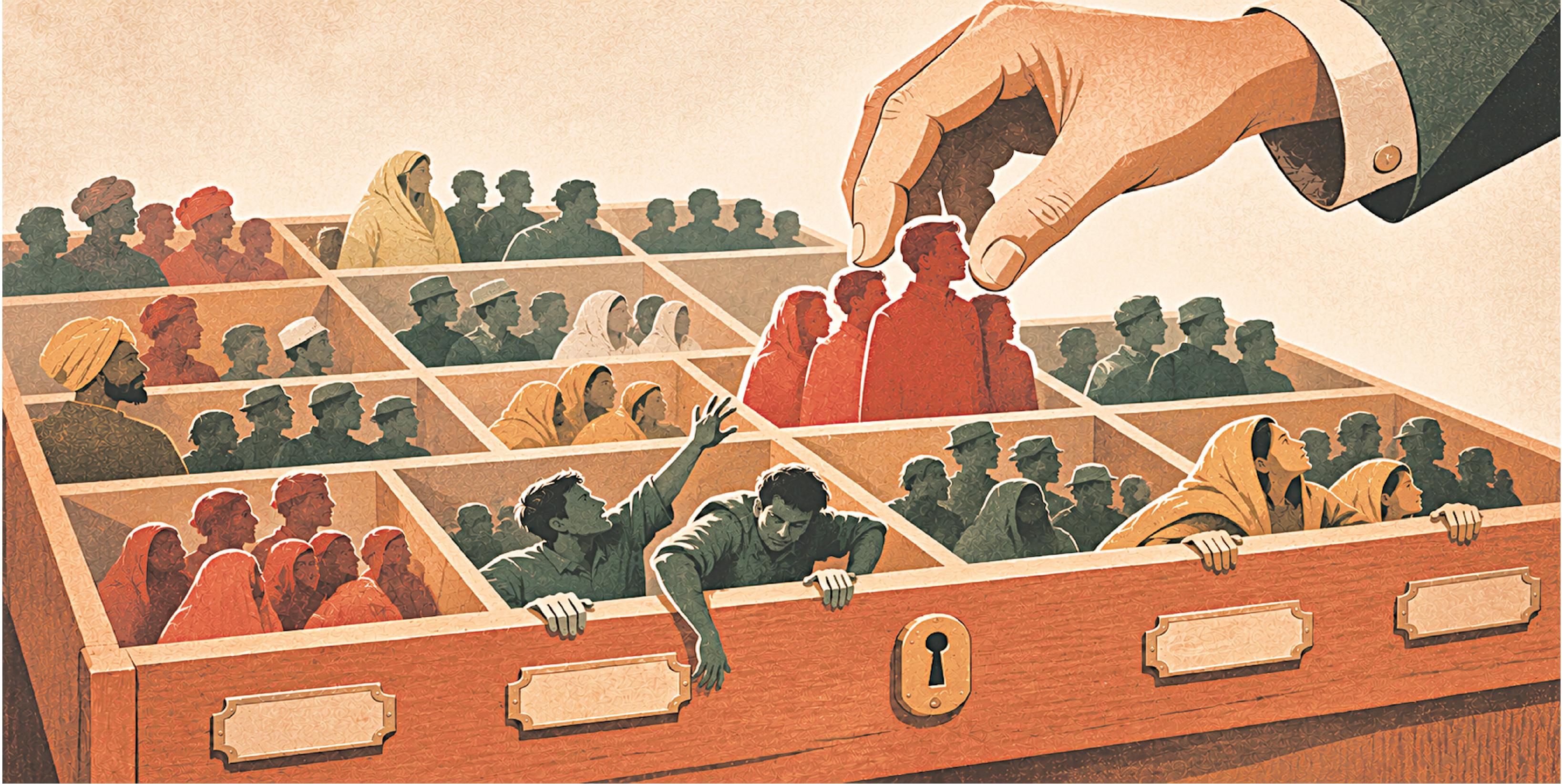
The British left India with their flags, uniforms and offices. They did not leave empty-handed. Neither did they leave us empty-headed.
What remained was harder to see: a way of arranging knowledge, territory and people into things that could be named, counted and governed. A map could turn a living landscape into a boundary; a census, a community into a category; a report, a population into a problem. A schoolbook could make one version of history appear to be the history. This authority had already been built into the system.
This is perhaps why colonialism is easier to remember than to recognise.
We know the dates, governors, wars, laws and transfer of power. We know English became associated with administration and education, that the colonial state extracted revenue, reorganised land and populations, and produced knowledge about those it governed. These histories are familiar. The harder history begins after the colonisers leave.
THE MACHINERY OF COLONIAL RULE
Colonialism did not invent every hierarchy of South Asia. Long before the British, the region had known conquest, empire, caste, religious authority and unequal access to land and power. The Mughal Empire was itself imperial. The British entered a society already full of distinctions. What they brought was a machinery for recording and administering them.
The colonial state wanted to know the people it ruled: their caste, tribe, religion, occupation, landholding and language. The Survey of India’s 19th-century maps turned lived landscapes into territory the state could measure, tax and control. A line on a map could carry more authority than the histories and relationships that had given a place meaning.
The map was more than a picture. It was an argument about what existed.
The colonial census did not simply record identities; it helped fix them. People whose lives did not fit official categories were classified for them. In the case of Muslim identity, census and law helped decide who could be recognised for administrative and legal purposes. A form could make a community visible while narrowing the terms on which it was seen. This is where the history of colonialism becomes a history of imagination.
Palestinian-American academic and critic Edward Said’s great intervention showed that power works through knowledge as well as armies and governments. Through scholarship, literature and political discourse, the ‘Orient’ was produced as traditional, irrational and in need of explanation. This image helped the West imagine itself as modern and rational. Such descriptions shaped how people were approached, governed and judged.
A description can harden into an institution, a classification into policy and a stereotype into an administrative fact. People may then find themselves living under an account of who they are that they had no part in writing.
INVENTING THE TROUBLED FRONTIER
On the North-West Frontier [modern-day Khyber Pakhtunkhwa], colonial officials, soldiers and scholars recorded Pakhtun tribal ties, customs, family structures, codes of honour and political loyalties.
Some wrote out of scholarly interest; others sought knowledge to govern and maintain military control. Their accounts differed, but state records gave many authority. Over time, outsiders’ descriptions became the terms through which Pakhtuns were understood, even by those who had never met them.
Pakhtun society can be seen through a narrow vocabulary of tribe, frontier, honour and resistance. The ordinary life of its towns and villages, families, traders, farmers and their daily concerns receded behind the image of a troublesome frontier requiring exceptional rule. That image had consequences for those who lived there.
That way of imagining the region did not disappear in 1947. The rulers and political purposes changed, but the frontier remained a place apart, shaped by inherited ideas of the periphery that placed certain regions at the nation’s edges. The Frontier Crimes Regulation of 1901 allowed collective punishment and detention without usual legal protections, yet remained in force in the former tribal areas until 2018. Its survival shows how Pakistan retained a colonial system through its own choices.
The British could leave the frontier, census office and map room, but the ideas housed in them survived. Regions remained exceptional, people were divided into categories for easier rule and official boundaries were made to count for more than the lives of those living across them. After Independence, these habits acquired new purposes.
This is why reducing colonialism in Pakistan to the English language is limiting. English and colonial education matter, but they are only the visible part of a deeper inheritance: the belief that some knowledge deserves trust because of where it comes from, while other people’s experience is dismissed as local or difficult to fit into an official category.
DEFINING THE POSTCOLONIAL STATE
After 1947, Pakistan had to imagine a nation across territories with different linguistic, regional, ethnic and cultural histories. A shared national story was not itself colonial. The harm began when unity meant that some differences had to be pushed aside, leaving the people who carried them feeling outside the country being built in their name.
The 1951 census recorded Urdu as the language of only about one percent of East Pakistan’s Muslims, although political tensions affected the responses. Yet Urdu was promoted as the national language. For the Bengali-speaking majority, this raised the question of whether their words and culture could belong fully to Pakistan.
The language movement was more than a struggle over language. It was a struggle over who could define the nation: whether East Pakistan’s majority could belong on equal terms, or whether the political centre would decide what Pakistan sounded like, leaving millions outside that picture.
When police fired on demonstrators in Dhaka in February 1952, the dispute entered the history of the state through the lives lost and those who continued to demand recognition. Bengali was recognised as a state language in 1956, but a constitutional change could not undo the experience of being told that the majority’s language did not belong at the centre of national life.
Colonialism cannot explain every decision made by Pakistan’s early rulers. The British did not create the Bengali language movement. Pakistan inherited a centralised state, but its leadership chose to promote Urdu and marginalise Bengali. History can explain that choice; it cannot absolve those who made it or erase its consequences.
Pakistan was no longer being described by the British; it was describing itself. Yet some people had acquired greater authority to define what the whole country meant. The same pattern can be seen in the physical making of cities.
WHEN PAPERWORK BECOMES POWER
Anthropologist Matthew Hull’s study of Islamabad shows how documents passed among bureaucrats, politicians, property owners, villagers, religious figures, businessmen and builders helped make the city. They do not simply describe it; they help decide whose claims to land are recognised, whose homes can remain and whose understanding of a place matters.
This sounds bureaucratic because it is. Power is often easier to see in a police uniform than in a file.
A file can decide whether land is state or private property; a map whether a settlement is recognised; a planning document whether a place is a road, park, commercial area or illegal occupation. Someone may have lived in a neighbourhood for decades, yet find that knowledge carries less weight than an official map. The document becomes the authority; the life built around the place is left to defend itself.
Bureaucracy existed before colonialism and is part of every modern state. But colonial rule expanded a way of governing in which people and territories became objects of official knowledge. Pakistan inherited that machinery, whose effects are felt most sharply by those whose lives can be reduced to a file, a number or a legal status.
Once someone is called an ‘encroacher’, the story of how they came to live there can disappear. Once a neighbourhood becomes an ‘informal settlement’, the relationships that make it a home are pushed behind its legal status. When a district is labelled ‘security-sensitive’, ordinary life becomes difficult to see. These terms may serve administrative purposes, but people are always more than the category assigned to them.
This is not a plea to abolish categories. A government cannot function without them. The problem begins when an administrative category pretends to describe a whole human being or place. The same problem exists in knowledge about Pakistan itself.
WHOSE KNOWLEDGE COUNTS?
Political scientist Dr Ahmed Waqas Waheed’s work examines how the discourse about Pakistan has been shaped by American and European institutions and by security and international-affairs concerns. Their prestige helps their questions travel further. Other questions, about ordinary lives, local histories and the conditions people endure, receive less attention.
This does not mean Western scholars should not write about Pakistan, or that knowledge becomes false because a foreign researcher produced it. That would simply reverse the hierarchy. The deeper issue is who has the institutional power to decide what Pakistan is worth studying.
Pakistan has often been made legible abroad through security: the army, terrorism, militancy, nuclear weapons, Afghanistan, Islamism and instability. These are real subjects, but not the whole country. When the same frame is repeatedly applied, lives that do not fit it — ordinary, intimate and difficult to quantify — become harder to see.
A society of hundreds of millions becomes a security question. The ordinary becomes invisible because it is not strategically important. Representation does not merely follow reality; it determines which parts of reality become visible.
This process does not remain outside Pakistan. Pakistani elites reproduce the same hierarchy at home. A foreign degree or international report can outweigh local experience; a consultant’s model is called sophisticated while community practices are dismissed as informal. A resident may understand a neighbourhood better than a planner and still be treated as an obstacle. The knowledge is present; the authority to have it heard is unequal.
The irony is not that we imitate the West. It is that we reproduce its structure of authority while believing we are making our own decisions.
Decolonisation cannot mean replacing foreign names with local ones or rejecting everything Western. South Asia itself has been shaped by movement, exchange, conquest and borrowing. The deeper task is to ask why some knowledge speaks for everyone, while the experience of people living with policy’s consequences is dismissed as merely local.
Why is a community’s understanding of its environment called ‘local knowledge’, while an imported planning model is simply ‘planning’? Why is one person’s history memory and another’s scholarship? These questions do not make local knowledge automatically correct. They ask why some must prove the value of what they know, while others are granted authority before their evidence is heard.
These questions shape decisions about land, education, development, history and public policy, and how people see themselves.
THE HIERARCHIES WE INHERIT
Indian literary theorist Gayatri Spivak’s work offers a warning about representation. Marginalised people may speak, but their words enter institutions where others have the power to interpret and record them. They can appear in a report and still find that what they meant has not reached the page. The subaltern can speak and still not be heard on their own terms.
Pakistan has no shortage of people speaking. It has a shortage of equal conditions under which those voices are received.
The farmer becomes a figure in an agricultural policy report; the displaced family, a line in a rehabilitation survey; the worker, a labour statistic; the resident of a demolished settlement, an entry in a land record. These documents may be necessary, but they can make a person disappear behind the description. A family’s loss becomes a survey result; the file remains after the life it describes has been pushed aside.
We may resent the stereotypes through which foreigners describe Pakistan and still describe another region as backward. We may criticise Western representations of our society while assuming that people who live differently are less modern, less capable or less entitled to decide what is good for themselves. The hierarchy survives because we have learned to use it ourselves.
This is not simply hypocrisy. It is what happens when hierarchies become ordinary.
A system does not need everyone to believe in it to be reproduced. We can oppose discrimination and still inherit its categories; reject colonialism and still think through distinctions made familiar by history. The point is not to call every Pakistani prejudice British, but to recognise how different histories of power settle into the habit of deciding a person’s place before listening to them.
Colonialism is one layer in the history of how power learns to see, alongside Mughal, feudal, bureaucratic, nationalist, military, and religious and class hierarchies. These histories overlap in people’s lives. Those at the bottom experience the accumulated weight of decisions about their homes, work, language and place in society.
A state need not be colonial to reproduce colonial forms of knowledge. We classify people at the edges of cities and the nation, decide which histories belong at the centre, and determine which neighbourhoods can be displaced. We have inherited the power to describe other people’s lives without always asking what those descriptions cost them.
These decisions rarely announce themselves as acts of power. They arrive through forms, maps, curricula, planning documents, statistics and expert opinion, carrying the appearance of common sense. For those whose homes or identities are being decided, the consequences are real.
Pakistan’s problem is not that it has failed to reach some pure state of decolonisation. Its political and cultural life holds precolonial hierarchies, colonial institutions, postcolonial ambitions and newer forms of global power together. People live with their consequences at once.
The task is not to find a Pakistan untouched by outside influence. It is to question systems that make one person’s description more real than another person’s life, and to recognise how easily we, too, take part in that erasure.
The British did leave, and the empire ended as a political system. But the power to classify, order, represent and decide what counts as knowledge did not disappear on August 14, 1947. It changed hands. Perhaps independence must also mean learning not to use that power against others, and allowing people some authority over the stories told about their own lives.
The empire did not leave empty-handed. It left behind a way of seeing. The harder task is learning to see that way of seeing.
The writer is a researcher whose work centres on cultural critique and social realities.
She can be contacted at hamnasyed66@gmail.com