
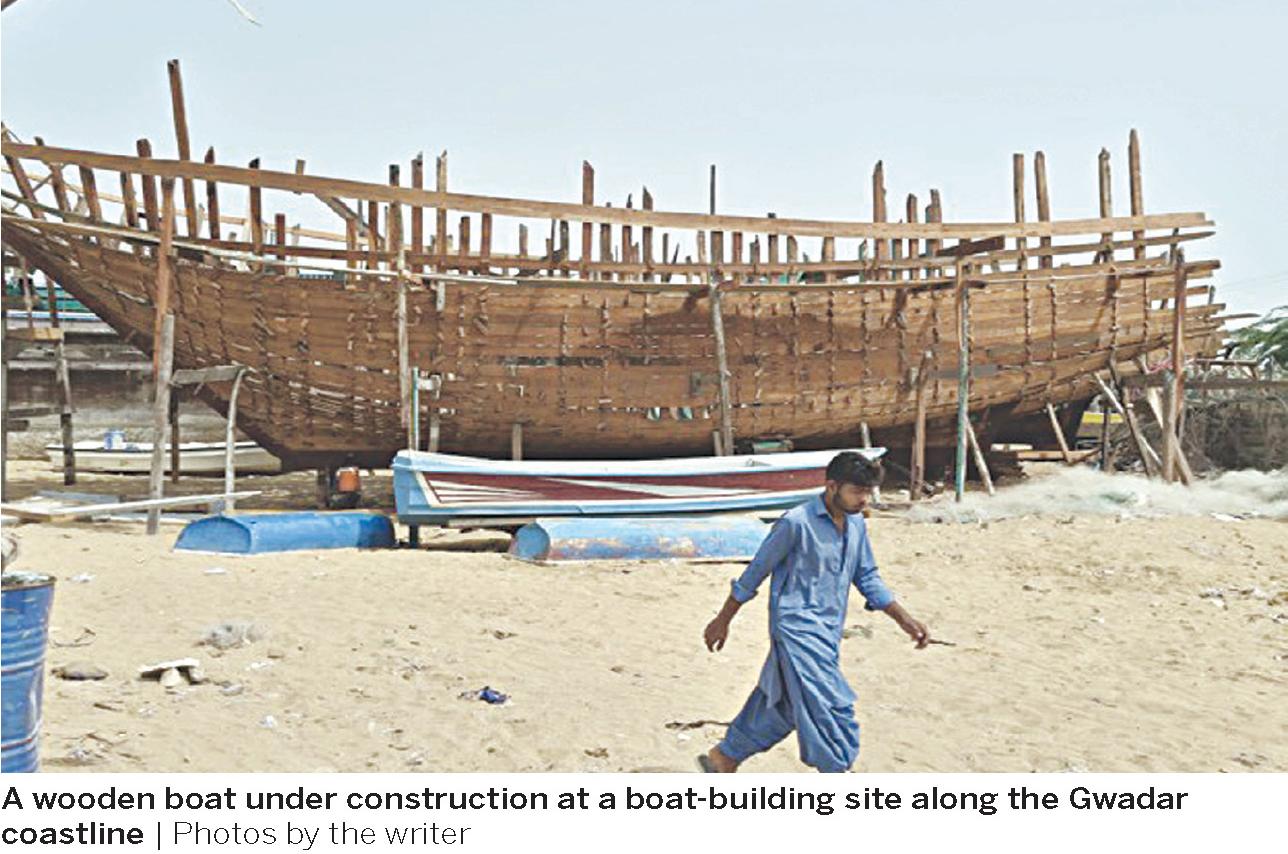
Before sunrise, Ghulam Ismail makes his way, his legs trembling, towards Padi Zir, the shallow western bay in Gwadar, Balochistan, where the cliffs of Batil Mountain overlook the Arabian Sea.
Ismail is headed to Wahdoo Ani Jah, where the local boat-building yards are located. Two of his friends, Taj and Siddiq, are already there — sitting in the shade of a tree. Together, they watch the fishermen prepare their vessels.
One after another, small fibreglass speedboats are pushed into the water. Their engines roar to life and they race towards the open sea. Ismail watches them go. ‘See, they are not made of wood anymore,’ he tells Eos.
For 35 years, Ismail has built the wooden boats that carried generations of Gwadar’s fishermen to sea. He belongs to the Wahdoos, a community of hereditary boat-builders whose knowledge of timber and hulls has been passed down through generations.
Ismail learned the craft from his elder brother, Ishaq, who inherited it from their father. Before them came their grandfather and great-grandfather. His sons learned the trade too, but none makes a living from it.
‘It’s not that they don’t want to,’ Ismail says. ‘But we can’t get two meals a day from it anymore.’
Ismail remembers when boat-building yards stretched almost from the foot of the mountain to where he now sits. ‘We had to make people wait because there were so many orders,’ he recalls. ‘Now we wait for someone to give us an order for a single boat.’
Ismail and his friends still return to the same stretch of shore where generations of craftsmen shaped wooden hulls. But the boats leaving Gwadar’s shores are increasingly being made of something else.
A PORT CITY, LEFT BEHIND
Barely five kilometres away, Gwadar’s Chinese-developed commercial port stands as a centrepiece of the China-Pakistan Economic Corridor (CPEC), intended to connect China’s Xinjiang region to the Arabian Sea, as part of Beijing’s Belt and Road Initiative.
Gwadar has also acquired renewed significance as the US-Iran conflict has disrupted shipping through the Strait of Hormuz. In April 2026, the port reportedly handled about 11,000 containers, compared with approximately 8,300 throughout 2025.
But the expansion of commercial activity has brought little improvement to the livelihoods of the men whose boats once sustained Gwadar’s fishing economy. ‘If there is development, it is for those who are already enjoying it,’ Ismail says. ‘We are deprived, as before.’
He remembers when Rs150 a week was enough to support his household. Today, he can earn around Rs18,000 a week while building a boat, but months, sometimes years, can pass without a single order.
One reason for the decline in orders is the steep rise in the cost of boats. A boat that once cost around Rs3.5 million now costs at least Rs20 million, according to Ismail, putting it beyond the reach of many fishermen.
Building a large wooden launch can take months. During that time, the costs of timber, labour and other materials may rise, eating into the builder’s already uncertain earnings.
‘Back then, if we took a loss, it was in the thousands,’ says Amjad, another Wahdoo craftsman. ‘Now it is often in the lakhs.’
Even the contractors who arrange orders for wooden boats have little business left, Ismail says. ‘Only one or two are still finding work,’ he adds.
A FLEET IN TRANSITION
Gwadar’s wooden fishing fleet includes vessels of different sizes, from the small yakdar to the launch, the largest. Increasingly, however, these vessels are giving way to the khaik, a smaller fibreglass speedboat, valued for its speed and manoeuvrability.
Ismail is unconvinced. To him, the khaik is little more than a ‘taxi of the sea.’
Wooden vessels, he argues, provide better shelter for fishermen on long fishing trips and are easier to repair. ‘A breakdown at sea can threaten both a fisherman’s livelihood and safety,’ he says.
But for Ismail, the shift from wood to fibreglass is about more than the material used to build a boat. Each wooden vessel represents months of skilled labour and generations of accumulated knowledge. As orders dwindle, so do the opportunities for younger builders to learn and practise the craft.
The decline is not confined to the boat-building yards. A 2022 study of the fishing community in Gwadar’s west bay found that the 26-kilometre Marine Drive project displaced boat-building and forced some craftsmen to move their work away from the city.
Another study, published in the Journal of Asian Studies in 2025, found that port development under the China-Pakistan Economic Corridor had contributed to exclusion, livelihood loss and dispossession among parts of Gwadar’s fishing community.
THE COST OF BEING LEFT OUT
In April 2026, the Balochistan’s Fisheries Department announced a scheme to provide 92 fibreglass boats to low-income fishermen, with the provincial government covering 90 per cent of the cost of each. Each 24-foot vessel was priced at approximately Rs5.3 million.
For the selected fishermen, the scheme offers a way to acquire vessels they might otherwise be unable to afford. But Ismail questions how much difference 92 boats can make, and why craftsmen such as the Wahdoos have received no comparable assistance. ‘A very small portion of fishermen will benefit from this,’ he says.
Ismail says authorities have provided little support to boat-builders over the decades, whether in the form of financial assistance, generators or even shaded spaces in which to work. ‘They have zero interest in our work,’ he says. ‘They don’t even bother to look after us.’
Despite the dwindling orders, Ismail continues to build boats, aware that his livelihood remains tied to those of the fishermen who take them out to sea. The relationship he describes has sustained generations: fishermen needed boats, boat-builders needed fishermen, and both depended on the sea. But as the demand for wooden vessels declines, that relationship is weakening.
For years, the boat-builders tried to support one another through their own union, with members contributing to a common fund to help families facing difficulties.
Shakoor, another Wahdoo, says he contributed for about a year and a half before losing confidence. He recalls that the union’s activities gradually dwindled until it existed largely only in name.
The skills have survived within families. Ismail’s sons know how to build wooden boats; what they lack is the opportunity to make a living from that knowledge.
Back at the Padi Zir shore, the boats continue to leave for the Arabian Sea. Ismail sits beneath the tree with his old friends, watching the fibreglass vessels disappear into the distance.
He remembers when fishermen came in search of wooden boats and the yards struggled to keep up with demand. Now, the craftsmen wait for orders that may never come.
The writer is a Balochistan-based journalist who is currently pursuing a master’s in journalism in Karachi. He can be contacted at changeeznazir@gmail.com