
I was recently invited to speak at a school and was dismayed to learn from the principal that the school had ended its art programme because there were hardly any takers.
High school students, it seems, are more inclined towards computers or business studies. The diminishing interest in art education, and the apparent lack of value attached to it, is a matter of considerable concern and is particularly unfortunate in a country blessed with an extraordinary wealth of artistic talent and practitioners.
It was therefore with a sense of delight, and perhaps some reassurance, that I encountered the three-person exhibition ‘The Language of Traces’ — featuring the artists Bushra Waqas Khan, Ghulam Mohammad and Mahbub Jokhio — at Canvas Gallery that same evening. Here was a compelling example of the intellectual rigour, technical accomplishment and imaginative possibilities of contemporary art in Pakistan.
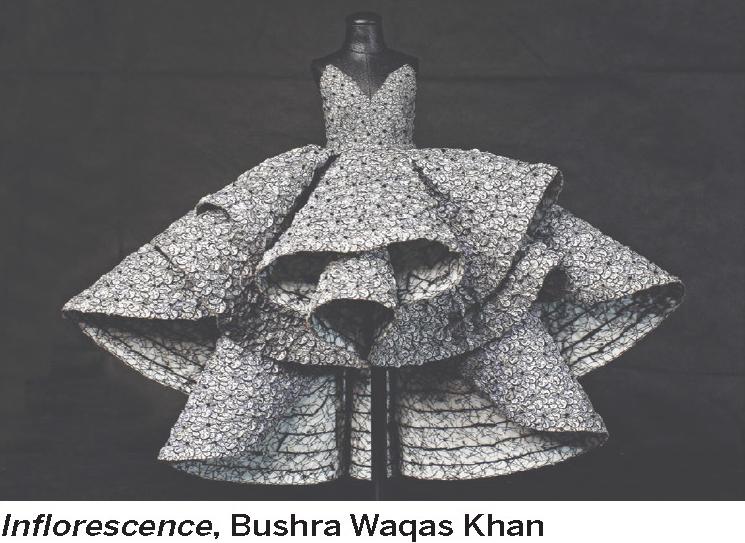
Khan’s practice is rooted in an engagement with textiles, but her work moves well beyond conventional ideas of fabric and its decorative or functional associations. She manipulates, gathers and transforms material, drawing attention to its physical properties while exploring its potential as a sculptural medium. Her sculptural textile work, positioned on a central pedestal, introduced a physical, almost figurative presence into the gallery.
In Punctum, a narrow strip of silk was perforated with a surprising regularity of tiny openings. Suspended against a light background, it cast a shadow that became almost another work in itself. The repetitive pattern created a delicate tension between solidity and transparency, existence and absence. In another work, Khan used densely textured material to construct a sculptural garment, inviting us to look closely, to consider the labour involved in its making, and to recognise how something as seemingly ordinary as fabric can acquire an entirely different identity.
Mohammad’s practice explores the gradual erosion of language. Working with Urdu and Persian scripts, he manually carves letters out of books and reassembles them into complex three-dimensional compositions on wasli paper.
In La Mutnahi III, Iranian ink and paper collage on wasli came together in a composition whose intricate linear patterns suggested movement across a landscape. An orange-red circular form provided an arresting focal point against the impenetrable, rhythmic marks surrounding it. Another work, Qissa Go, was particularly absorbing in its use of perforated pages from a book, presented within an acrylic box. The open book preserved the familiar appearance of a storehouse of stories and knowledge, yet the intervention changed how we encountered it. There was an evocative connection here between the durability of the written word and the brittleness of the material on which it was recorded.
Jokhio approached the idea of traces from a different direction. His works demonstrated an interest in geometric construction, form and the relationship between an image and the surface on which it appeared. Perhaps the origami-inspired compositions, in which an angular bird occupied the centre of a large arrangement of intricate triangular forms, stem from his 2024 fellowship at the Fukuoka Asian Art Museum, Japan.
Against the pale, faceted background, the dark silhouette of a single bird became especially pronounced. The works held a curious tension between the natural world and the geometry imposed upon it. The falcon, for example, is associated with speed, precision and flight, but here it appeared momentarily halted within this complex arrangement of planes. The marks and folds seemed to suggest both construction and movement, as though the image might be capable of unfolding into something else.
Returning to my initial concern about the place of art in education, I would say that art is not simply about acquiring technical skills or learning to produce aesthetically pleasing objects. It involves curiosity, experimentation, observation and the willingness to question familiar ways of seeing — as evidenced by the exhibition. These are not dispensable accomplishments, nor are they relevant only to those who choose to become artists.
‘The Language of Traces’ was on display at Canvas Gallery in Karachi from November 17-26, 2026
Rumana Husain is a writer, artist and educator. She is the author of two coffee-table books on Karachi, and has authored and illustrated 100 children’s books