
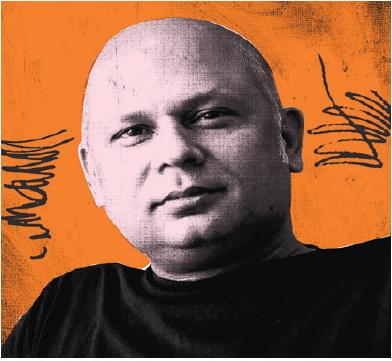
From my childhood, I remember Anwar Ahmad Zai from Hyderabad in Sindh as one of the most well-known educationists-cum-bureaucrats. He held several postings that were consequential in nature, heading multiple school and college examination boards across the province.
His interests straddled art, literature and culture, making him a regular speaker at public events like seminars, book launches, investiture ceremonies or conferences. His speech always unveiled his passion for reading and dabbling in new ideas. After living a rich, purposeful life, he passed away in Karachi in 2020.
Six years later, upon arriving at my workplace in Lahore, I find a book sitting on my desk. It is titled Somewhere In Between: A Memoir, written by Azeez Ahmad Zai. I find out that Azeez Ahmad Zai is Anwar Ahmad Zai’s son, who has sent me his memoirs, which are anchored in the relationship between a father and a son.
He has also written about family members, his experiences in Pakistan’s civil service and other mentionable life events, including travels and visits to art galleries in Europe. But the shoulders he stands on are his father’s. I remember my grandmother telling me that one should learn to celebrate grief. It took me time to understand what she meant. But Zai understands it well. The bereavement caused by the passing of his father, coupled with his desire to express what he has experienced and felt, has produced a beautifully written memoir.
On a social media platform, a friend quoted someone saying that a truly intelligent mind keeps itself away from the burden of memory or delusions caused by imagination. Maybe that’s true for an intelligent mind in the worldly sense, but it is certainly not true for a creative mind. Creativity draws upon memory and imagination — memories of the past and imagining the future.
There is a difference between memory and nostalgia and a difference between hallucinations and imagination. Personally, I do not have a problem with fantasies and deliria either, which make stories that enrich and entertain us. But I understand that this may not necessarily be everyone’s choice. However, in a country such as ours, where history is either not told at all or distorted in ways that are unacceptable, personal memories have a major role to play. Through bringing back the memories of an individual, you also bring back the milieu in which they lived — the society, the polity and the economy of the times.
There are a certain kind of people possible only in a certain part of the world. I remember reading in Paul Mariani’s biography of the poet and author Hart Crane, Mariani saying about a woman that ‘Only in New York was someone like this woman possible.’ Zai and his father, from whom he imbibed a lot during his childhood and youth, were possible only in Hyderabad of yesteryears.
They may not be Sindhi-speaking Sindhis, but a cosmopolitan outlook and inclusivity of divergent thoughts and beliefs are signatures of Sindh. Our state and parts of our communities tried hard to change the texture of Hyderabad, like other major cities of Sindh, but Zai’s book brings back those earlier memories, at least to me, who has spent a long time in Sindh as a child and young person.
The thing that makes me praise Somewhere In Between includes a crispness that comes with depth. Zai’s writing is easy to hold, not cumbersome. His sentences are heartfelt, not clever. He has no desire to create a universal text. It is totally personal.
I have been writing about fathers and fatherhood in these columns. Sara Suleri’s tribute to her father — whom she had little in common with in terms of worldview — titled Boys Will Be Boys, and Farrukh Yar’s amazing long poem ‘Karez’ have been mentioned before, besides other writings on the subject. But Zai’s memoirs are a powerful addition to the not-so-big corpus of writings on fathers. As mentioned above, he does not limit himself to only writing about his father. But the lens he uses to see the world comes from his father. Zai writes, ‘A father may pass down books, language, habits, and a love for beauty. But the man himself remains inimitable.’
Zai has written about his schooling leading to a degree in engineering, his teachers, mother, wife, relatives and sibling Saima, whom he adores. He has related interesting events and incidents from his travels abroad. He has a desire to seek simplicity in a complex world with kindness and a love for literature.
In one place, he writes, ‘After my father, my uncle, whom we call Phool Chacha, built on that foundation. But the most memorable lesson from him did not occur in a classroom. It happened at a wedding. It was his daughter’s valima [wedding reception] in Hyderabad. The formal duties were over, the afternoon had slowed and we were sitting together with enough time for serious conversation which, in our family, often means literature appears without warning.’ The training in literature that Zai imbibed was from such encounters at home, not from the classroom.
Zai’s first meeting with his beloved is explained in simple words. ‘I arrived exactly on time, carrying all the emotions known to young men in love: excitement, nervousness, optimism, and the belief that history was about to become memorable. History did become memorable.’ I like the play upon words where history and memory are used with distinction.
Zai’s book also gives me another idea. Once Imaan Hazir Mazari is released from prison, I will request her to write about her illustrious and humane father, Dr Tabish Hazir, who was a son of the greatest English-language poet this country has produced, Taufiq Rafat.
The writer is a poet and essayist. His latest collections of verse are Hairaa’n Sar-i-Bazaar and No Fortunes to Tell