
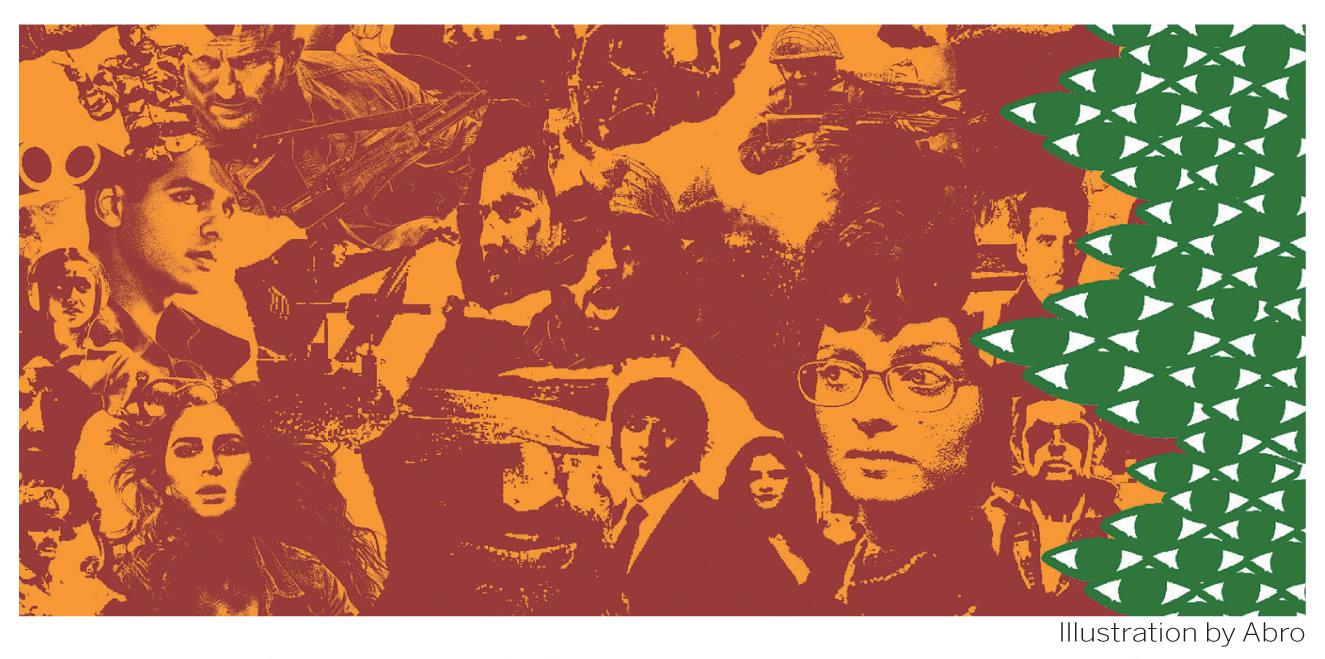
It never ceases to baffle me how Bollywood films, frequently stuffed with overt, heavy-handed propaganda against Pakistan, effortlessly climb to the top of Netflix’s trending charts in Pakistan.
This dichotomy is by no means an indictment of the patriotism of Pakistani viewers. It is, instead, a fascinating sociological puzzle worth exploring.
The contradiction feels all the more glaring given that the Indian state openly pursues policies aimed at destabilising Pakistan, notably through its now hardly discreet patronage of proxy networks such as the Tehreek-e-Taliban Pakistan (TTP) and armed Baloch separatist factions. Let’s investigate.
One can posit that, ever since the 1980s, when Pakistan’s cultural trajectory was gradually shifted to the right by a military dictatorship in league with moralist groups, local audiences began starving for high-production cinematic entertainment. They craved slick action choreography, sweeping soundtracks and genuine star power and/or elements that Pakistani media industries, crippled by social constraints and lack of adequate financial resources, struggled to supply.
As a result, every time a high-budget Bollywood spectacle drops on a popular streaming platform and, crucially, in a language (Hindi) that is effortlessly understood across Pakistan, this acts as an irresistible pull.
So how do Pakistani viewers cope with the dichotomy of putting anti-Pakistan Indian films at the top on streaming services? My own ongoing research suggests that they handle this by neatly compartmentalising and isolating certain geopolitical contexts. They treat the screen as an insulated fantasy world, where entertainment value trumps geopolitical friction. This allows them to relish the cinematic spectacle while disconnecting themselves from the underlying anti-Pakistan hostility of the movies’ narratives.
This is bolstered by a deeply ingrained historical and linguistic familiarity.
Shared idioms, musical heritage and emotional resonance allow cross border cultural products to easily bypass the psychological and cultural barriers that typically confront other foreign media products.
In my discussions on this phenomenon with various observers, including figures within Pakistan’s cultural industries, a clear pattern emerges. Pakistanis consume hostile (but glossy) Indian content not as an endorsement of the content’s ideological messaging, but through a lens of detachment and often outright amusement. This detachment creates a shield, enabling Pakistani viewers to enjoy a Bollywood blockbuster without feeling that their national identity is compromised by a piece of theatrical fiction.
So far, so good. But there is another side to this phenomenon. This one is tied to the mechanics of what is often referred to as ‘soft-power hegemony.’Astheearly20thcentury Italian theorist Antonio Gramsci posited, a dominant force maintains control not only through physical state power but by manufacturing cultural consent. This shapes the everyday values, aesthetic desires and the social logic of subordinate groups.
The rightward shift in Pakistan’s social realm from the 1980s onwards was driven as much by state sanctioned ‘Islamism’ as it was by the gradual ‘Indianisation’ of the Pakistani middle-class lifestyle. It is this class that often dominates the social/cultural, economic and political terrains of most countries.
Now let’s explore how cross-border soft-power hegemony operates in this context. As state-enforced puritanism under a right-wing dictatorship in Pakistan in the 1980s restricted urban leisure, it inadvertently created a wide cultural vacuum. Indian popular culture, initially smuggled via VCR tapes in the 1980s and later broadcast through satellite television and digital platforms, swiftly stepped into this void. For over four decades now, Bollywood blockbusters, Indian soap operas, and wedding aesthetics subtly rewired the Pakistani middle-class imagination, embedding Indian linguistic tropes, fashion paradigms and ritualistic sensibilities into the domestic fabric.
This occurred at the expense of Pakistan’s own popular culture, which was dismantled and replaced with an enforced, cosmetic veneer of statesanctioned piety. This synthetic moral order was cynically crafted and therefore unable to resist the pull of Indian cultural products, even as these products grew increasingly hostile towards Pakistan’s existential narratives.
Indian cultural products engage Pakistani audiences by treating them as cultural subordinates, moulding their mindset to mirror and reinforce India’s broader political and cultural hegemony in the region. These products have become cultural weapons, as effective as the Hollywood products that leaked into former communist countries during the Cold War. Sometimes overtly and sometimes subtly, Hollywood productions during that period equated glossy Western consumerism with democracy and freedom. Communist audiences were bagged. Securing a pair of Levi’s jeans became an act of fighting communist tyranny.
Nevertheless, watching Bollywood films wouldn’t be as harmful, though, if India and Pakistan regularly exchanged movies and media. When two countries trade media back and forth, money keeps extreme nationalism in check. Filmmakers treat their work like global brands, avoiding storyline choices that would offend audiences in neighbouring markets and hurt sales. However, when governments ban this trade, commercial restraint disappears.
Without foreign box-office revenue on the line, entertainment media easily transforms into political propaganda.
The Pakistani government bans Indian movies from local cinemas.
This means that Bollywood faces zero financial risk when portraying Pakistan in a negative light. Free from foreign box-office stakes, its primary goal is to cater to hyper-nationalist audiences at home and exhibit how superior this strand of nationalism is compared to Pakistani nationalism. Indeed, the Indian state too maintains a blanket ban on Pakistani cultural products.
But the fact is. Bollywood continues to profit off Pakistani viewers through foreign streaming platforms that collect monthly subscription fees.
That money ends up in the pockets of Indian filmmakers.
The ‘detached consumption’ habit of Pakistani audiences casually watching even the most absurd anti-Pakistan propaganda films made by India can further mutate into something odder.
For instance, I was witness to some corporate brands in Pakistan asking their advertising agencies to hire ‘Indian talent’ for their commercial campaigns.
While cross-border collaboration is not inherently unusual, the timing was astounding. This occurred during the 2025 military confrontation between India and Pakistan, right when Indian drones were targeting buildings in Pakistani cities. The sheer tone deafness of it was baffling, as if these corporate executives lived in a bubble, where nothing existed outside their fixation on all things Indian.
Bollywood is a powerhouse, while Pakistan’s cinema industry has struggled with economic instability and lack of support. As a result, one country easily exports its political views while the other lacks the industry size to offer a strong counter-narrative. It just can’t or is unwilling to go beyond making terrible rom-coms. Cultural consumption stops being a shared exchange and becomes a one-sided relationship, where the larger industry routinely demonises and mocks its cross-border audience without any pushback.
While Pakistanis may grin and say they are watching Indian cinematic propaganda to make fun of it, the truth is, the joke is really on them. They are paying Pakistani money to mock it. If so many Pakistanis can successfully boycott giant commercial brands and replace them with local ones as a protest against Israel’s genocide in Gaza, what’s stopping them from ignoring Bollywood films that exude obvious anti-Pakistan propaganda?