
Tazeen Qayyum’s exhibition ‘How to Trace a Pattern’ curated by Sarah Quinton at Canvas Gallery, transported me back to a Canadian department store in Halifax, Nova Scotia, in the mid-1970s.
It was during the year I spent at my uncle’s there that I discovered the world of dressmaking patterns.
The two dominant and fiercely rival department stores there were Simpsons and Eaton’s. Besides the window shopping trips, I would spend time at Simpsons, browsing through the large Simplicity, Vogue and other pattern books. For a dollar or two, I could buy a pattern, trace it onto fabric and make a garment. Sometimes my grandmother would accompany me and advise me on the selection of fabrics.
I had not thought about those patterns for years, until I walked into Qayyum’s exhibition. What might once have seemed merely functional pieces of paper showing where to cut a sleeve, a corsage or a pair of trousers become, in Qayyum’s hands, a way of tracing memory, family histories, migration, cultural exchange and the complicated journey of images and ideas between East and West.
Qayyum is a Pakistani-Canadian multidisciplinary artist who graduated from the National College of Arts (NCA), Lahore, in 1996, specialising in miniature painting. She was one of the pioneers of the neo-miniature painting movement, alongside Shahzia Sikander and others, and took a unique approach by being one of the first miniature painters to exclude figures from her works.
Quinton says that ‘as a young girl in Pakistan in the 1970s, Qayyum wore clothes sewn by her mother using European dressmaking books featuring blonde, fair-skinned children. Western children’s fashion became a fixture of family life and her mother carefully assembled sketchbooks filled with sewing notes, magazine clippings, fabric samples and design ideas. Decades later, Qayyum, who immigrated to Canada, returns to this family archive of dress patterns and sewing manuals, including a collection of her childhood garments, stirring memories and deepening an already rich connection with her mother.
How to Trace a Pattern’ has three distinct sets of works. The floral patterns in the Easy Cutting series become a site for another history, through which Qayyum addresses the elaborate floral designs of William Morris, the influential British designer of the 19th century. His work has been criticised for appropriating motifs originating in Indian chintz traditions.
There is something wonderfully mischievous about Qayyum’s juxtaposition, as she meticulously copies Morris’ floral designs, painting with a squirrel-hair brush used in miniature painting. A familiar Western dressmaking pattern becomes the ground on which the artist re-examines the journey of the very motifs that decorate it. The painstaking precision of miniature painting is applied to these Western templates, turning the pattern itself into a site of reclamation.
There are many other examples of misappropriations by the West, including labelling of South Asian mirror embroidery as ‘boho mirror work’ or zardozi as ‘metallic trims’, which erase the communities behind the art.
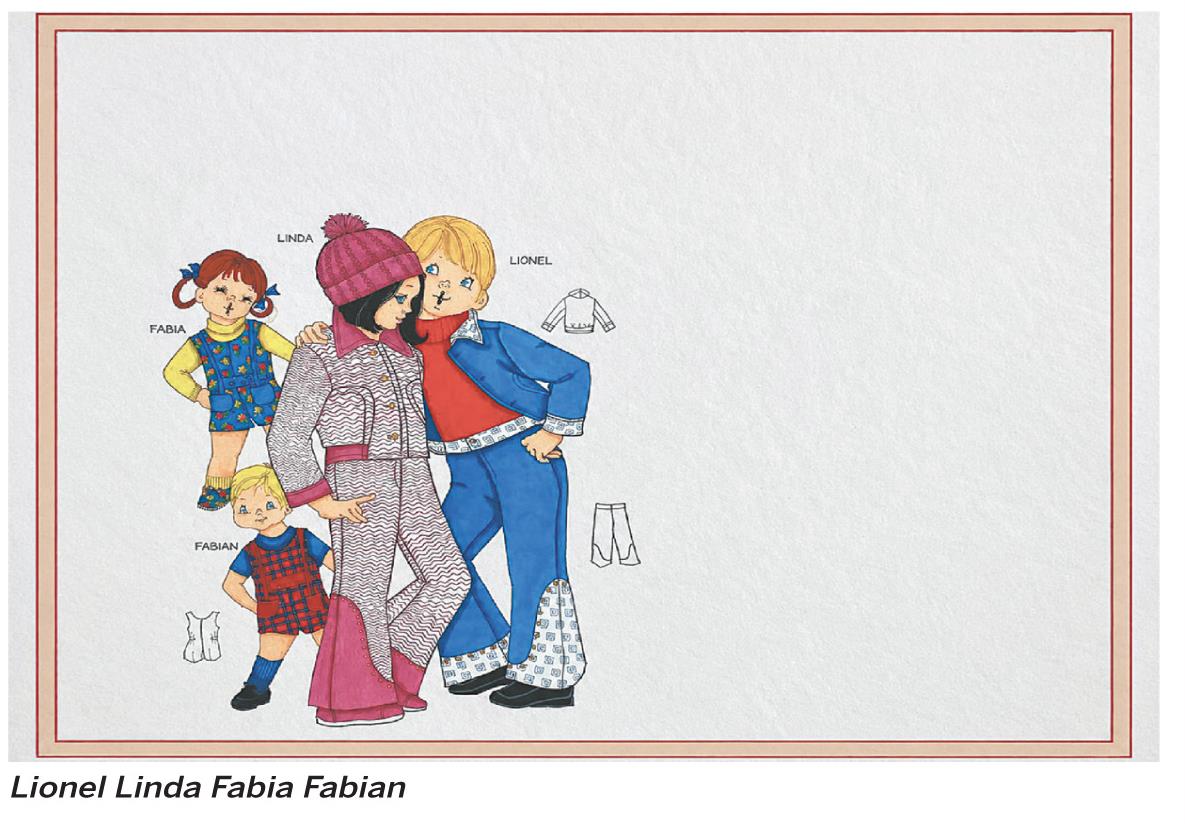
The second set is titled Pamela John Daisy Harold, after the names printed on commercial pattern envelopes that contained patterns for children.
Qayyum has painted other children as well, including Fabia, Fabian, Alison, Cynthia, Linda, Lionel and Jon. The figures are familiar and oddly nostalgic, yet their presence also makes visible the Eurocentric image of childhood that was being circulated through these Western dressmaking publications.
These fair, blonde, curly-haired children served as promotional models for the clothing that Qayyum’s mother stitched, revealing what we absorb, almost unnoticed, from the things that surround us in childhood.
The third sct, The ‘Iracing Pattern series, is a most exciting body of work, as the lines, curves and angles of the paper patterns are converted by the artist into coloured running stitches that appear much like a maze of roads. There is no respite from these congested and complex lines, and no respect for space for each pattern to be deciphered separately, as they form densely packed compositions.
One imagines them to be road networks for a city such as Karachi, where Qayyum was born, or Lahore, where she studied art, or Toronto, where she has been living since 2003 with her husband, Faisal Anwar a prominent digital artist.
I began by remembering the patterns I once bought in Halifax. Looking at the artworks in ‘How to Trace a Pattern’, I found myself thinking about how much more than clothing a pattern can carry memories of mothers and daughters, ideas of beauty, journeys between countries and histories that are stitched into things we once regarded as entirely ordinary.
‘How to Trace a Pattern’ was on display at Canvas Gallery in Karachi from September 22-October 1, 2026 Rumana Husain is a writer, artist and educator. She is the author of two coffee-table books on Karachi, and has authored and illustrated 90 children’s books