
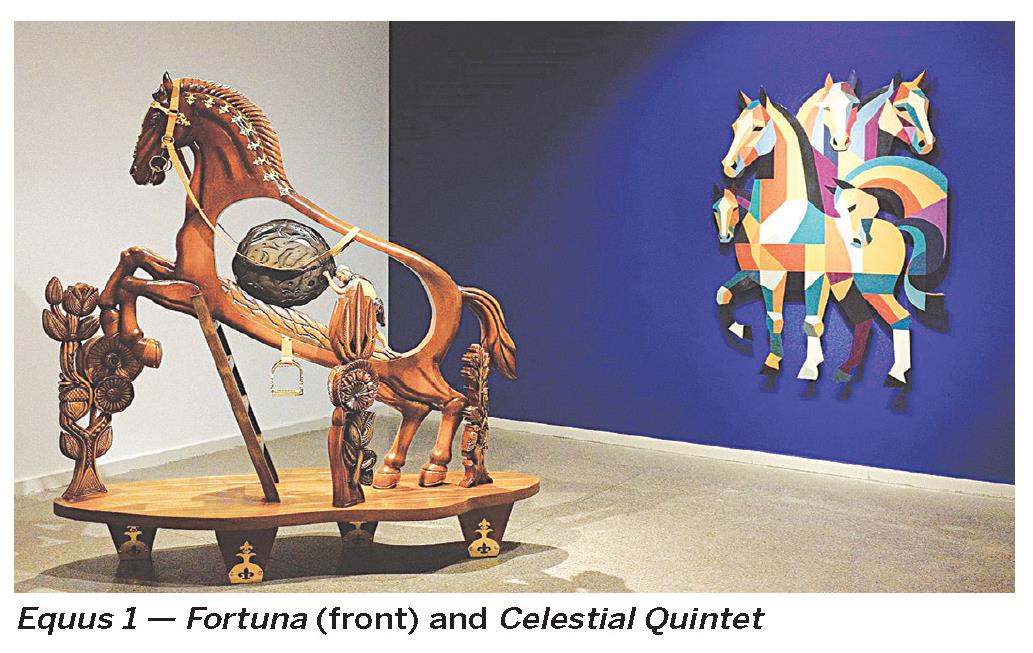
My Kingdom for a Horse’ showcases a new body of sculptural work by Adeela Suleman, marking a pivotal point in her artistic journey. It is a sculptural archive of violence, political and judicial torture and censorship through material such as beaten metal, brass, copper, hammered and carved sheets of stainless steel, repousse and wood Stainless-steel drainage covers, for example, formed vessels of exquisite beauty and craftsmanship in Suleman’s works in the 2000s. In the 2010s, hand beaten repousse work on stainless steel, brass and metal in the relief forms of the headless Mubarizun [an elite unit of the Rashidun army] accompanied imagery of flora alluding to the gardens of paradise.
Figures of the Mubarizun were mounted on the wall in a theatrical tableau, lamenting that there are no Mubarizun to save us today. An alternate reality always accompanies the depiction of death in her work, transforming raw pain into meaning, empathy and transcendence.
The rider-less steeds in herlatest show are carved out of wood, which has an inherent warmth and carries the cellular memory of a once-living organism. Sheesham [rosewood] and kikar [acacia nilotica] carry deep Subcontinental roots. Suleman’s works draw inspiration from the steeds of South Asian history and religious lore, such as the Buraq, Rakhsh and Zuljannah. In the marsiya [a poetic elegy], the Zuljannah stands as a silent archive of historical trauma. It is the archetype of witnessing grief, remembered for returning rider-less and bloodied after the battle of Karbala.
The viewer walks around life size sculptures of steeds, Equus 1, 2, 3, and 4, mounted on pedestals.
Suleman strips the beast of its burden from human ambition, conquest and tyrannical command. In Suleman’s aesthetic, beauty is not far from the banal, as she ‘conceals’ pain with decorative forms referencing the very streets that have been witness to violence. Perhaps this reflects a false sense of security that Karachiites have come to live with. She reimagines the depiction of fear while living in it and her form takes flight into its own dance.
Mirza Ghalib contrasted spiritual inspiration with agonising earthly effort. He used the metaphor of terrha gat [the crooked cut of a pen] to symbolise that raw inspiration must be tamed by meticulous technical mastery. A true master must endure the exhausting discipline of structuring complex, layered thoughts into linguistic form. The meticulously sculpted body of the steed is a semi-carved silhouette on a flat sheet of wood, with painted scenarios of war,peace, heaven and hell installed in the stomach cavity of each horse.
Suleman juxtaposes imagery from miniature albums, digitally creating new compositions with exaggerated theatrical movement. The viewer stands before the sculptures, reminiscent of the great bohemian sculptor Shahid Sajjad’s work, aware of it being an illusion.
Visitors walk in close proximity to the steeds, grounding their loss, making sense of the empty space. It is an encounter with a monument to a fallen hero or civilisation, the artist having deconstructed coloniality and the glorification of conquest in the museum. She borrows the quote, ‘My kingdom for a horse’ from William Shakespeare’s play Richard III, when the king was willing to trade his entire earthly dominion for a single animal to escape death on the battlefield.
As Suleman and I stand before the larger than life depiction of Pegasus and the fallen rider in Pegasus Unseated, she points to it and says, ‘This is the end of Western civilisation.
‘My Kingdom for a Horse’ was on display at Canvas Gallery in Karachi from October 6-15, 2026 The writer is a Karachi-based art critic, editor and curator.
She has edited the publication Homecoming, Rasheed Araeen.
Instagram: @amraalil