
‘I am bipolar,’ says 33-year-old Maria Pervez*. A trained psychologist, Pervez describes her condition as a swing between ‘euphoria and depression’, which can sometimes feel ‘like turning a switch on and off.’ She quickly goes on to add, ‘There’s nothing wrong with practising as a psychologist while having mental health issues of your own.’
Pervez is part of 32.3 percent of Pakistani adults currently living with a diagnosable mental and behavioural disorder, according to the findings of a recently published landmark nationwide survey.
The study, published in the peer-reviewed British medical journal BMJ Public Health earlier this year, is Pakistan’s first nationally representative survey examining the prevalence of mental and behavioural disorders among adults in the country. Researchers interviewed 17,773 adults across Pakistan’s four provinces, achieving a response rate of 86.2 percent.
The findings reveal a substantial mental health burden. While 32.3 percent of Pakistani adults currently experience at least one diagnosable mental or behavioural disorder, 37.9 percent have experienced one during their lifetime. In other words, approximately one in three adults is currently affected.
Dr Ali Hashmi, chairman of the Department of Psychiatry at Lahore’s King Edward Medical University, states, ‘The findings, although shocking, are largely in line with what we had always suspected and also match global surveys of mental illness.’
Dr Raza ur Rahman, head of Hamdard University’s psychiatry department, was at the forefront of this survey. He tells Eos that, by using a standardised assessment tool, the survey examined 17 psychiatric disorders and provided estimates of their current prevalence across the country.
A CLOSER LOOK AT THE NUMBERS
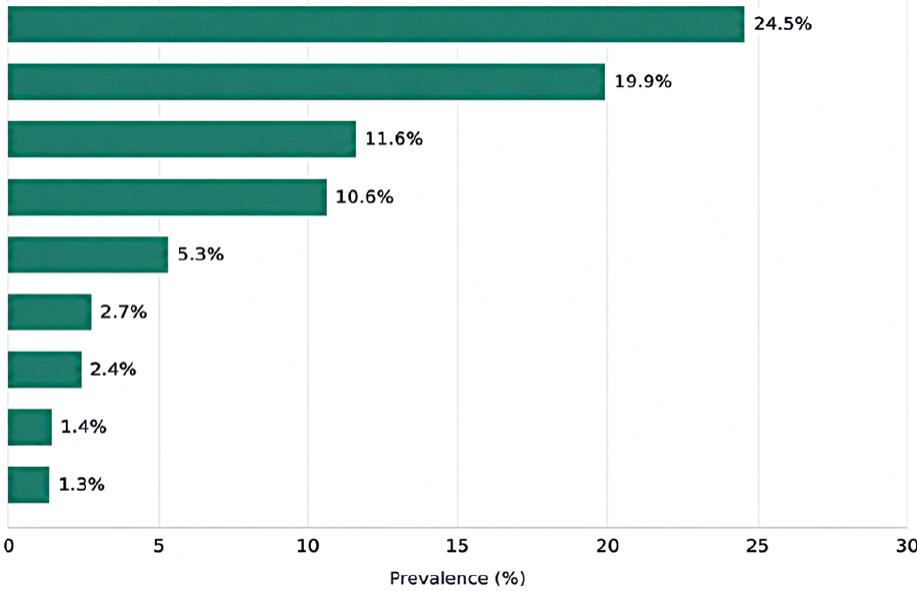
According to the survey, the most prevalent category is neurotic, stress-related and somatoform disorders (mental conditions where a person experiences real, physical bodily symptoms, such as pain, fatigue or stomach issues that cannot be explained by a medical disease or test), affecting 24.5 percent of participants. Particularly striking is the prevalence of post-traumatic stress disorder (PTSD), which affects 19.9 percent of adults, or approximately one in five.
Depressive disorders affect 10.6 percent, with a lifetime prevalence (the proportion of a population that has ever experienced a specific mental health disorder or psychological condition at any point in their life) of 17.8 percent. Other findings included schizophrenia-spectrum disorders (2.7 percent), bipolar disorders (2.4 percent) and obsessive-compulsive disorders (1.3 percent).
Among these conditions, Dr Rahman expresses particular concern about the high prevalence of PTSD. He links PTSD impacting 19.9 percent of adults to decades of socio-political instability in Pakistan — including armed conflicts, population displacement and natural disasters such as floods, earthquakes, droughts and heatwaves — pointing out that these have also been documented in several previous studies.
The study also identifies significant differences across demographic groups. Mental health disorders appear considerably more prevalent among adults aged 40 and above, particularly those between 50 and 59. Divorced and widowed individuals, retired people and homemakers also demonstrate a higher prevalence. Educational attainment and income appear to have an inverse relationship with psychiatric morbidity — people with higher incomes and greater levels of education generally reported lower prevalence.
Women have a slightly higher unadjusted current prevalence of mental and behavioural disorders than men — 33.5 percent compared with 31.1 percent. However, the adjusted analysis (which statistically accounts for other measured characteristics that might influence the results, such as age, marital status, education, employment and income) finds lower odds of psychiatric morbidity among women.
Another important finding concerns suicidal behaviour. Approximately 6.2 percent of participants reported suicidal thoughts or related experiences during the preceding month at the time of the survey, while 1.1 percent reported a suicide attempt at least once in their life. The researchers caution that these figures may underestimate the actual prevalence, because suicide and talking about it remain highly stigmatised in Pakistani society.
The study also found that psychiatric disorders were associated with moderate functional disability, affecting individuals’ ability to perform at work, maintain family responsibilities and participate in social life. But behind these national figures are individual stories of people who have struggled for years.
LIVING WITH BIPOLAR DISORDER
According to Pervez, bipolar disorder comes under mood disorders and belongs to the same family as depression.
‘The difference is, depression is only lows, while bipolar [disorder] has both highs and lows,’ she says. ‘It cannot be cured. It’s like fever, you manage it. With proper treatment and support, people live stable, normal lives.’ In her case, the disorder has been diagnosed and is being treated.
When she was in her early 20s, Pervez’s mood swung rapidly from irritability to anger. ‘Over the next five years, I became even more aggressive and my manic episodes increased,’ she reveals. ‘My family told me I needed professional help.’
In 2019, at the age of 26, she was diagnosed with depression and was put on medication. But it wasn’t until 2023 that she was finally diagnosed with bipolar disorder (earlier called manic depression). Pervez, who has a Master’s degree in psychology, with a specialisation in depression, says, ‘It was one of the most difficult moments of my life, when the doctor told me that I had been diagnosed with bipolar disorder. I thought my life had ended. I thought I’d never be able to have relationships or maintain friendships.’
According to Dr Rahman, the lifetime prevalence of bipolar disorder in Pakistan is about the same as that in the United States, over four percent. Although bipolar disorder currently has no permanent cure, ‘it is highly treatable’ says Dr Asha Bedar, a Karachi-based clinical psychologist. ‘With appropriate medication, psychological support and family understanding,’ Bedar says, ‘people can and do lead stable, healthy and fulfilling lives.’
Pervez links her condition to the time when, at the age of eight, she was sexually abused by a neighbour and also by an older cousin in her joint family. The abuse lasted eight months and, by then, Pervez was a changed person. Pervez recalls, ‘When I finally found the courage and told my mother, her reaction was ‘Chup ho jao [Be quiet]’ and there was no sympathy or even a feeling of shock. From a lively person, I became extremely quiet.’
Pervez wonders how her parents failed to notice the change in her personality at the time, stating, ‘I’d often cry myself to sleep,’ and she still feels anger towards her parents at times ‘for not protecting me when I was most vulnerable.’
Dr Bedar explains bipolar disorder as a complex mental health condition involving biological, genetic and environmental factors. According to her, stigma and lack of awareness, along with delays in diagnosis and treatment, can lead to a worsening of the condition. And while genetics play an important role, the disorder is not always inherited. Dr Bedar says, ‘Stress, trauma, disrupted sleep and major life events can also trigger episodes in vulnerable people.’
Medication can help in mitigation, but it can also potentially have its own set of adverse impacts. As Pervez puts it, ‘The side effects often lead people to stop taking medication. For me, these effects included a loss of appetite, changes to my complexion and days when I felt so low I couldn’t get out of bed.’
While it has now been a year since Pervez stopped taking medication, she cautions against stopping medication without medical advice, stressing that it should be a ‘joint decision between the healthcare provider and the patient.’
Pervez still has bleak days when ‘terrible crying spells’ overwhelm her, but she is learning to use the coping strategies prescribed by her doctor. And providing mental healthcare to others has perhaps been her biggest healer, helping to put her own struggles in perspective.
TACKLING THE SUICIDE STIGMA
Similarly, for Rutaba Syed, who has been fighting mental health challenges since she was 12, helping people through their struggles has become part of her own healing journey. Syed is a trained architect and runs a community and wellness hub in Karachi called the Centre for Art-based Methodologies and Wellbeing (CFAW), where she has found comfort in helping people find peace.
‘I was bullied at school,’ Syed reveals, ‘and I didn’t know how to navigate past those feelings. This continued for two years.’ During this time, Syed was confronted with her first wave of self-harm ideation. And, similarly to Pervez, when she spoke about this with her elders, she was asked to stay quiet. Her second wave of self-harm ideation was when her grandfather, to whom she was very attached, passed away.
Then came an actual suicide attempt. Syed recalls, ‘I remember standing in the middle of Karachi’s crowded Burnes Road until the blaring horns forced me to physically move out of the way.’ It was then that she sought help and was diagnosed with ‘suicidal ideation in high anxiety state.’
Her experience reflects a wider concern highlighted by the national survey, which found that about 6.2 percent of participants reported suicidal thoughts or behaviour, while 1.1 percent had actually attempted suicide.
‘Suicide is basically a cry for help,’ explains Dr Rahman, ‘and victims look for all possible support before taking a final decision.’ However, Dr Rahman says that their distress often goes unnoticed, as ‘few people recognise or respond to the warning signs in time.’
But beyond this lies another concern: how people who attempt suicide are treated, particularly when suicide is a criminal offence in Pakistan. For years, psychiatrists have been campaigning to decriminalise suicide from the Pakistan Penal Code. Even today, argues Dr Rahman, people who attempt suicide and are taken to government hospitals have to face medico-legal formalities and may be exploited, with large sums of money allegedly demanded from families to avoid registering a case.
Dr Shahid Latif, who strongly supports the decriminalisation of suicide and is the chair of the Royal College of Psychiatrists Diaspora Committee, contends, ‘Criminalisation can deepen stigma, discourage people from seeking help and compound the distress experienced by individuals and families.’ He adds, ‘Every life matters and our response must be grounded in dignity, understanding and humanity.’
While Syed was having her sessions with a mental health professional, she took to sketching. She says, ‘They [the sketches] were all black and I realised I was having a kind of dialogue with my inner self — the person inside me who had been bullied. Art has helped me find purpose, self-esteem and, yes, healing.’
Having given up architecture as ‘designing for the rich at the expense of the poor’ did not make sense to her, the 28-year-old Syed now uses long-term approaches to wellness through art, creativity and storytelling with the community, so people can ‘explore emotions, connect and heal’ at her wellness hub called Nani Ghar.
‘We also offer formal therapy,’ Syed says, ‘but when it comes to community healing, we don’t use the word therapy. We see it simply as a meeting place, where like-minded people can come together, support one another and feel accepted without being judged.’
THE SOCIO-ECONOMIC TOLL ON MENTAL HEALTH
The national survey also points to a huge and, possibly growing, number of disenchanted Pakistanis. Social demographer Dr Mehtab Karim, who provided technical support for the national survey, attributes the high proportion of adults living with mental and behavioural disorders to a growing disillusionment among Pakistanis, largely driven by mounting economic pressures. ‘Real incomes are declining, pushing more families below the poverty line and increasingly squeezing the middle class,’ he says.
At the same time, Dr Karim, who has over four decades of experience regarding population, health and migration issues in South Asia and Muslim-majority countries, points to another growing concern: the steady departure of young Pakistanis in search of work abroad. Dr Karim points to a recent study of university students in Sindh that found that about one in three would consider migrating abroad for work. But the impact is also being felt by those left behind.
In a Karachi-based study, Dr Karim found that 45 percent of elderly parents whose children had migrated were suffering from clinical depression. As stated earlier, the national study also found psychiatric disorders to be significantly more common among people aged 40 and above, women, urban residents, those who were separated, divorced or widowed, those with no formal education and those who were retired or homemakers. The findings clearly point to a growing need for mental healthcare, but Pakistan has very few specialists to meet it.
THE OVERLOOKED TRANS EXPERIENCE
If so many cisgender Pakistanis are struggling with their mental health, imagine the everyday stresses faced by trans people in the country.
‘I’ve thought of ending my life,’ says 29-year-old Ahmed*, who was assigned the female gender at birth. His parents know his gender identity now but have yet to fully accept it. They continue to call him by his birth name, which he intensely dislikes. According to Ahmed, the invisibility of trans people — because many cannot reveal their identity — and the isolation that comes with a lack of family and social support, can begin to take a toll from a very young age.
According to Ahmed, the mental anguish begins quite early on. ‘It starts with yourself,’ he says. ‘You always know you’re different and the battle within continues until that realisation turns into acceptance. And that can be even more frightening, because you then have to find the courage to come out and tell the world — or lead a dual life.’
‘Family rejection is the biggest problem,’ says Kami Choudhry, a transwoman and the executive director of Sub Rang Society — a community-based organisation in Karachi focused on human rights, equality, advocacy and economic empowerment for the transgender and LGBTQIA+ community. ‘We are navigating several challenges at once, often starting life with low self-esteem,’ Choudhry adds. ‘We internalise stigma and cannot explore, express or discuss who we are because our society, norms and culture recognise only two genders.’
The worst part, Ahmed says, is that ‘there is absolutely no guidance’ to help trans individuals navigate this journey.
Aradhiya Khan, a communications manager at the Gender Interactive Alliance (GIA), an organisation working for trans persons’ rights, says, ‘For a young trans person, family rejection, social judgement and isolation can pile on top of the challenges of relationships, financial crises or medical emergencies. Dealing with so many things at once can be extremely overwhelming.’ Khan adds that the community has recently lost several young trans people to suicide.
To address this often overlooked dimension of Pakistan’s mental health crisis, Khan reveals that GIA has recently partnered with the British Association for Counselling and Psychotherapy to pilot a counselling service for those who need support. ‘I am also undergoing therapy myself,’ Khan adds.
Ahmed, who is also undergoing therapy, says the sessions have helped him immensely, teaching him to ‘cope with the triggers.’ But not every trans person can afford psychiatric care, even if they recognise the need for it. Choudhry says that many trans people say bluntly that ‘they need to fill their stomachs before they can get their brains treated.’
Khan adds: ‘Plus, it is not always easy to find a therapist you feel comfortable opening up to about your depression or about your darkest thoughts.’ Mental health awareness within Pakistan’s trans community is still very low, Khan states, with many unaware that physical symptoms such as headaches, anger and irritability could be linked to deteriorating mental health.
And therapy alone cannot address this aspect of Pakistan’s mental health dilemma if societal attitudes do not change. As Ahmed puts it, ‘My small circle of trans people and allies is exhausted about constantly grieving for our friends who are committing suicide or being killed due to sheer medical negligence.’
PLUGGING THE GAPS
According to Dr Hashmi, the number of psychiatrists in Pakistan is minuscule compared to the country’s population. Pakistan has one of the lowest psychiatrist-to-population ratios in the world, with just 0.19 certified psychiatrists for every 100,000 people. Pakistan has roughly 470 psychiatrists in total, most of whom are based in urban centres.
But even if the country were to add a new brigade of psychiatrists, Dr Hashmi points out that cost would remain a major barrier. ‘Unless mental health is made a priority in national and provincial health policies and given a dedicated budget, not much will change,’ he says.
There are others who, like Dr Hashmi, carry out outreach in smaller towns on a voluntary basis, while working to develop mental health services across the country. In Dr Hashmi’s experience, many smaller cities in the country now at least have ‘the beginnings of mental health networks linked to district or tehsil hospitals.’
Yet, according to Dr Hashmi, Khyber Pakhtunkhwa (KP) and Balochistan present the biggest challenges — Balochistan because of its sheer size and KP because of civil unrest and terrorism. Gilgit-Baltistan (GB) and Azad Jammu and Kashmir (AJK), he adds, are also slowly developing mental health services, but remoteness and accessibility remain a major challenge.
Telehealth (the use of electronic information and telecommunication technologies to access healthcare), therefore, offers one way of bridging the gap. Dr Hashmi comments on the gradual adoption of telehealth services, stating, ‘At our university [King Edward Medical University], we offer this option to people in remote areas and most of us provide telehealth through our private clinics as well.’ Alongside expanding access to care, improved data and region-specific surveys could help identify where mental health services are needed most.
Geographic information system (GIS) mapping is also underway to identify ‘hotspots’ so that effective and targeted services can be provided where resources are scarce, thereby supporting both the crafting of evidence-informed policies and the implementation of the new mental health policy. ‘If we can be provided updated digital district maps by the government,’ Dr Rahman says, ‘it would strengthen the research and help map other health conditions and risk behaviours.’
Yet, despite the data, one important gap remains: the mental health of children. The national survey did not cover the paediatric population and Pakistan has no national-level data on children’s mental health.
Dr Rahman says his team has an updated Mini-International Neuropsychiatric Interview for Children and Adolescents (MINI-KID) — which is a short, structured diagnostic interview designed to evaluate psychiatric disorders and suicidality in youth aged six to 17 — but lacks the funds to use it. The team hopes to undertake such research in the future, with financial and logistical support from stakeholders.
Hence, concrete data regarding the mental health of children remains largely uncharted territory in the country, which is why this recent study represents only the beginning. For a country where millions are struggling, recognising the problem is an important first step. Ensuring that those affected can find help, however, is the real test.
The findings of Pakistan’s first nationally representative mental health survey have put numbers to a crisis that psychiatrists and mental health professionals have long suspected. The challenge now is to ensure that this research is acted upon. Addressing Pakistan’s mental health burden demands sustained public investment, accessible and affordable treatment, better research and, perhaps most importantly, a fundamental shift in how society understands psychological distress.
*Name changed to protect privacy
The writer is an independent journalist based in Karachi. X: @zofeen28