
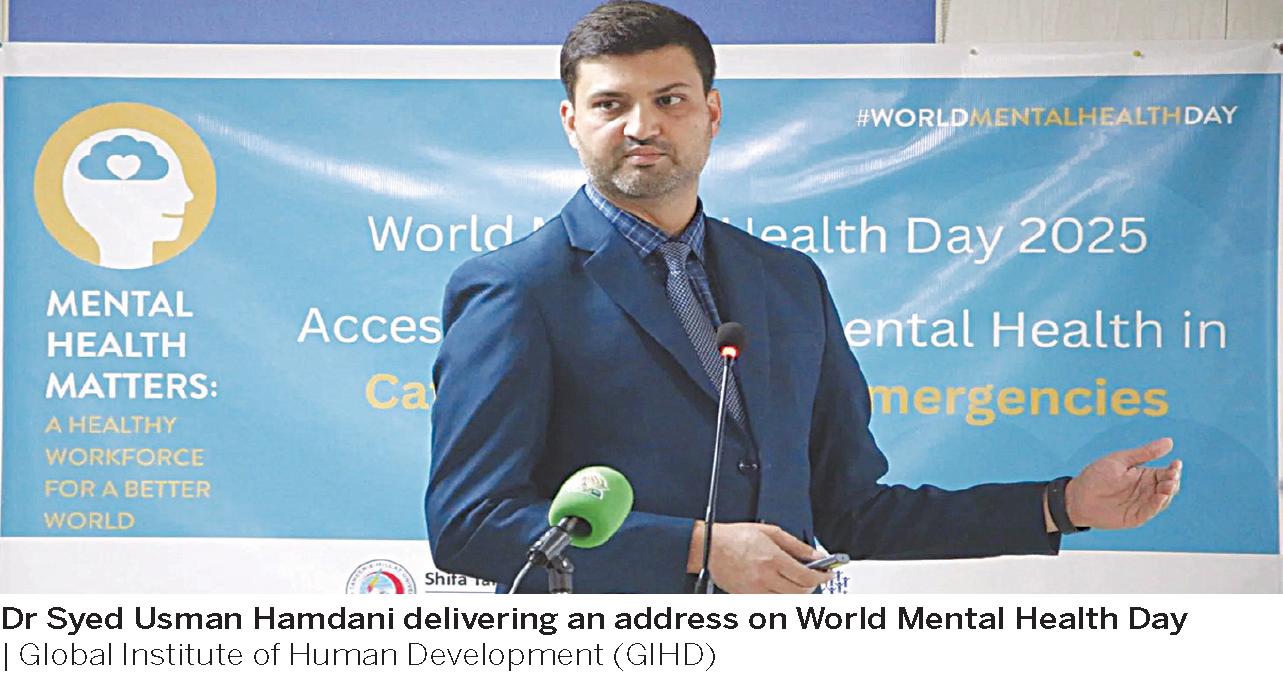
On October 1, 2026, Pakistan’s federal government launched the National Mental Health Policy 2026-2035. Its aim is to cater to 32.4 million people in need of mental healthcare, hoping to address a massive treatment gap. This potentially transformative initiative is spearheaded by the Ministry of National Health Services, Regulations and Coordination (MoNHSRC) in partnership with the World Health Organisation (WHO), the United Nations Children’s Fund (Unicef) and Shifa Tameer-i-Millat University’s (STMU) Global Institute of Human Development (GIHD).
In light of this, Eos spoke with Dr Syed Usman Hamdani, Director of GIHD. Dr Hamdani is also a member of Pakistan’s National Task Force on Mental Health and has contributed to the development of Pakistan’s National Mental Health Policy 2026-2035, working with the MoNHSRC and national and provincial stakeholders to translate evidence and national priorities into an actionable framework.
Q. What happens to previous provincial policies?
A. The National Mental Health Policy does not replace or invalidate existing provincial legislation. However, these were not consistently accompanied by comprehensive mental health policies and structured implementation plans, resulting in fragmented and uneven progress. The National Mental Health Policy 2026-2035 addresses this gap and aims to provide a unified national vision, shared strategic priorities and a framework for implementation, while fully respecting provincial autonomy. The objective is to move from legislation to implementation.
Q. Is this policy different and why should people believe it will be implemented?
A. What sets the National Mental Health Policy apart is that, for the first time since devolution, it provides a unified national framework shaped by consultations across all four provinces. Rather than relying on specialist-centred care, it integrates mental health into primary healthcare, universal health coverage, education and community services. Crucially, it proposes costed, time-bound national and provincial implementation plans, with clear responsibilities, budgets, measurable targets and accountability, alongside centres of excellence to strengthen training, research and technical capacity.
Q. How will services reach 32.4 million people and how soon?
A. Closing the gap requires more than psychiatric hospitals and psychiatrists. The policy proposes training general practitioners [GPs], psychologists, nurses and community health workers, backed by supervision, tele-psychiatry and outreach. Its 10-year goal is to steadily expand access to treatment.
Q. Who provides care where psychiatrists are unavailable?
A. With just 0.19 psychiatrists per 100,000 people, Pakistan cannot rely on specialists alone. The policy proposes more postgraduate training in psychiatry, psychology and psychiatric nursing, rural incentives and better career pathways. It also calls for training GPs through postgraduate courses, nationwide use of the World Health Organisation Mental Health Gap Action Programme [an initiative launched in 2008 to scale up services for mental, neurological and substance use disorders] and supervised task-sharing with counsellors, psychologists, nurses and community health workers. Specialists will remain essential for complex cases, supervision and referrals. We want to take mental healthcare closer to people.
Q. Will mental health become part of ordinary primary healthcare?
A. Yes, integration into primary healthcare is a central pillar. The policy seeks to move beyond urban tertiary psychiatric departments to provide and embed assessment, early identification, basic treatment, psychosocial support and referral in Basic Health Units, Rural Health Centres, Tehsil Headquarters Hospitals and District Headquarters Hospitals. Mental health should become part of routine care, such as diabetes and hypertension.
Q. Will care become affordable and publicly funded?
A. The policy recognises financial protection under Universal Health Coverage, calling for priority mental health services to be included in provincial Essential Packages of Health Services and public financing schemes such as Sehat Sahulat and provincial insurance schemes, with attention to outpatient care, essential medicines, severe mental disorders and continuum of care.
Q. How much funding is committed?
A. Mental health receives just 0.4 percent of the government health expenditure. The policy calls for dedicated budget lines, costed provincial implementation plans, financing-gap analysis and accountable budget holders. However, it is not a fully funded programme. Actual allocations must come through provincial budgets and strategic plans.
Q. Who implements it and how is progress measured?
A. It’s a shared responsibility. The federal Ministry of National Health Services, Regulations and Coordination provides national leadership, coordination, standards, technical direction and national monitoring. The provincial and federating-area governments lead service delivery, workforce development, regulation and financing in their jurisdictions. The policy proposes a national mental health coordination mechanism connected to existing health governance structures, accountable provincial implementation structures and centres of excellence.
Q. Does the policy address floods, conflict and economic stress?
A. The policy recognises that mental health is shaped by poverty, unemployment, violence, insecurity, displacement, disasters and climate change and calls for psychosocial support to be integrated into disaster preparedness, humanitarian and conflict responses, climate adaptation and recovery. ■ — ZTE