
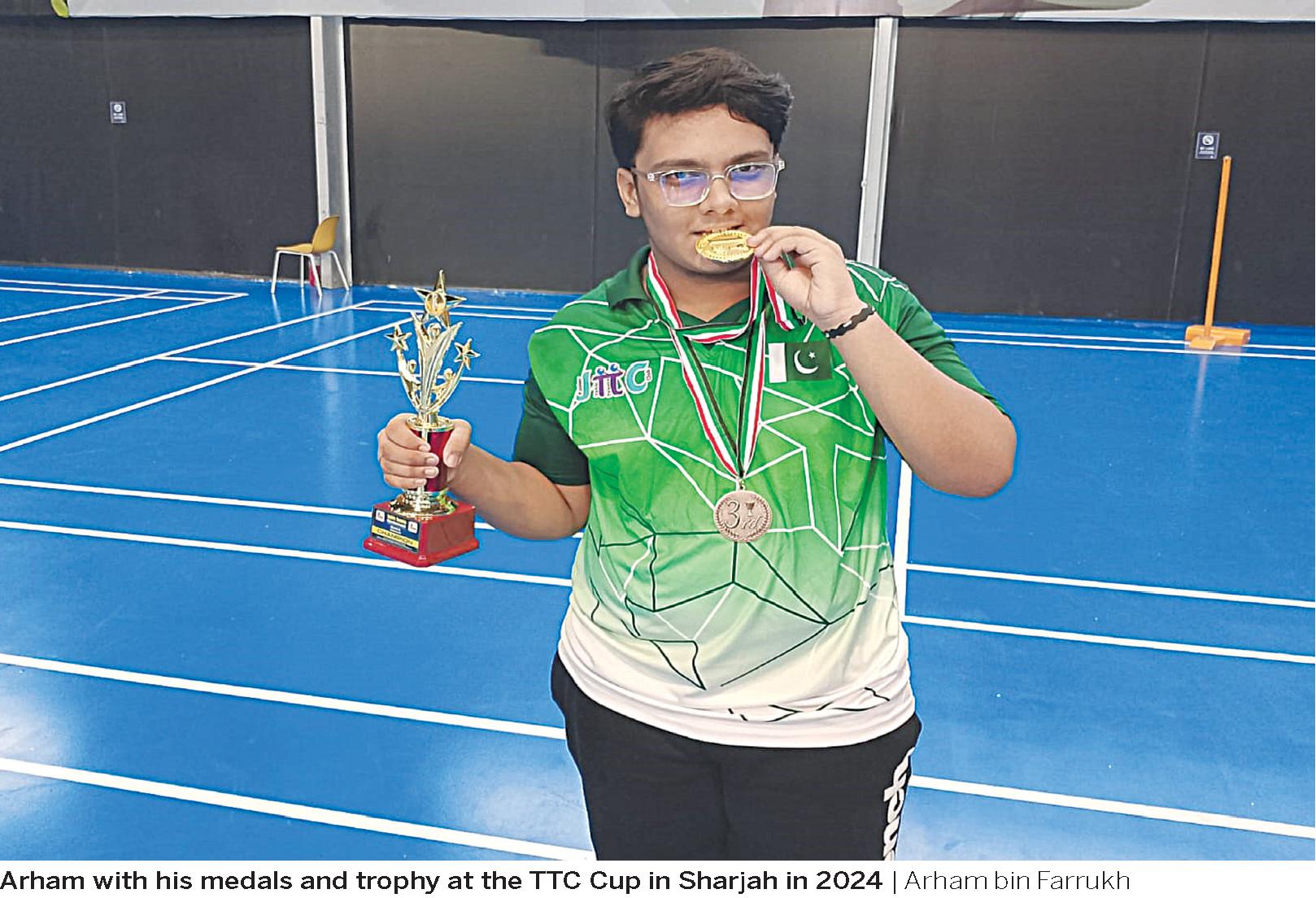
‘I know that my father only introduced me to table tennis so I could engage in something worthwhile when I was only eight years old,’ says 16-year-old Arham bin Farrukh. ‘However, it was a turning point for me.’
Today, Arham is one of the top juniors in Pakistan, and among the very few who have bagged international medals in the sport. In only six years, he has won 45 medals from the events he has competed in at the regional, national and international levels. His last two gold medals at the National Championships were in the U-19 doubles, with Muhammad Abbas. Arham recently won gold at the Pakistan Student Olympics in September as well.
The biggest highlight for him, however, remains his gold medal at the 2024 TTC Open International Table Tennis Championship U-21 singles event, when he defeated an Indian opponent in the final in Sharjah. He also bagged a bronze medal in the open category. This achievement makes him one of the few juniors who have won international medals in the sport in recent years; others include Hoor Jawad and Saroj Sajid.
Arham has been consistently winning medals since he made his debut in 2021. His first podium finish was at the All-Karachi School Championship, and after that there has been no looking back.
The teenager is not only carrying hopes for himself, but for the entire Karachi table tennis circuit, at both the national and international levels. Karachi was a hub of table tennis expertise from the 1950s to the 1980s. But over the decades, the decline has been substantial. He represents a community that is fighting to remain vibrant despite the Pakistan Table Tennis Federation’s lack of focus on honing players and financial constraints.
A DINING TABLE AT HOME
‘My first taste of table tennis was when my father decided that we play table tennis on our dining table, using a makeshift net in the middle,’ recalls Arham about his start in the game. ‘He got me interested in table tennis at that time because I had nothing else to do and was bored out of my mind.’
Arham’s father, Farrukh Kamal, has a story behind this that many parents can relate to. ‘During that time, I was babysitting Arham since my wife was away to take care of her parents. I could see that Arham was so bored. So I set up our dining table and began teaching him the basics.’
Farrukh was himself a top Sindh player during his youth and even won a silver medal in 2017 at the South Asian Veterans’ Championship. ‘We live in a small apartment, so I did whatever I could,’ explains Arham’s father.
Until then Arham used to practise Taekwondo and also play cricket. But table tennis soon caught his fancy. He also found table tennis more to his liking because, as an indoor activity, he did not have to deal with dust allergies that he used to get playing cricket.
‘But our games became something more meaningful when we recorded a video for the International Table Tennis Federation’s [ITTF] World Table Tennis Day in 2019, and sent it to them,’ says Arham. ‘Soon after, we found out that the ITTF had uploaded it to their social media pages. We got such an amazing response, too. It made me so happy, and I thought it was cool to play table tennis,’ recalls the current national U-19 doubles champion.
‘I feel most passionate about table tennis out of all the sports I have tried,’ Arham tells Eos. ‘I enjoy winning, and I am getting results, so it builds up my confidence as well. I think I am giving everything I have to it.’
STARS IN HIS EYES
Knowing how difficult it is to pursue a career in a non-cricket sport in Pakistan, however, Farrukh tried to warn Arham about the pitfalls. ‘I told him to carry on with cricket, but his heart was set on table tennis, so I relented.’
The youngster understands his father’s concerns, but his eyes are set on a steady and successful career beyond the junior level. While the junior singles title has so far eluded him on the national circuit, his 2024 success in international events was encouraging, and his confidence has only increased after winning the national U-19 doubles championship in 2025 and 2026.
Apart from TTC Cup wins, he has also represented Pakistan at the World Youth Ranking Tournament in Iraq in 2023, and went on to represent Pakistan at the Asian Juniors camp in Qatar in 2025.
‘I want to win it all,’ says Arham. ‘I want to win all national ranking events, the Masters Cup, and the National Championships, apart from the junior events. I’m also targeting South Asian youth and junior events and, ultimately, I want to represent Pakistan with the senior team and my dream is to qualify for the Olympics one day.’
THE SAME OLD STORY
With talent and persistence like his, the main things standing between Arham and his dream are financial constraints and the shortage of professional facilities. It is a deficit that even a driven mind like Arham’s cannot overcome by sheer will. But he keeps the faith.
‘All the medals I have won so far are because of the values instilled in me by my father,’ he says. ‘He is also my coach, and often tells me to keep things simple, remain consistent, and that good results will follow. And that I do not need to chase wins — I just need to enjoy my game.’
But it has been a tough road because of the lack of basic support and sponsorships. ‘We are doing everything on our own,’ points out Arham. ‘Even international participation becomes a challenge, as they ask us to pay for everything on our own, and there is no support for us.’
Farrukh wants his son to thrive and, towards that, he has bought a table worth Rs50,000 for Arham and has set it up in a room in their flat, despite their limited resources.
‘For Arham to become a world-class player, he needs better gear and professional coaching, which is extremely expensive,’ says Farrukh. ‘We can’t afford to send Arham to coaching camps abroad on our own, but we have come up with a programme with the help of local coaches.’
‘Arham primarily trains with me three days a week, and then he goes to practise with left-handed player Taha Ali three days a week for technical skills, and we get him more specialised training with veteran player and coach Hussain Virani right before a tournament because of the doubles game.’
‘It is a set-up we’ve developed ourselves,’ he adds. ‘As far as the facilities go, we only go to Sindh Sports Club once a month now. Earlier, we used to train at Islamia Club and the National Coaching Centre as well, but the floors there are so bad that players are likely to pick up an injury while playing on them, so we stopped going there.’
Being a veteran player himself, Farrukh believes Pakistan has a golden chance to capitalise on the talent today. He says that players from Khyber Pakhtunkhwa, such as Muhammad Abdal and Noor Ahmed, players from Punjab such as Ayan Haider and Abu Hurraira, and also his son’s doubles partner Abbas, can win international accolades for the country, if they get access to international coaches and better facilities.
For now, however, it is sheer grit like Arham’s that is powering them on. ■
The writer is a sports journalist. X: @NatashaRaheel