
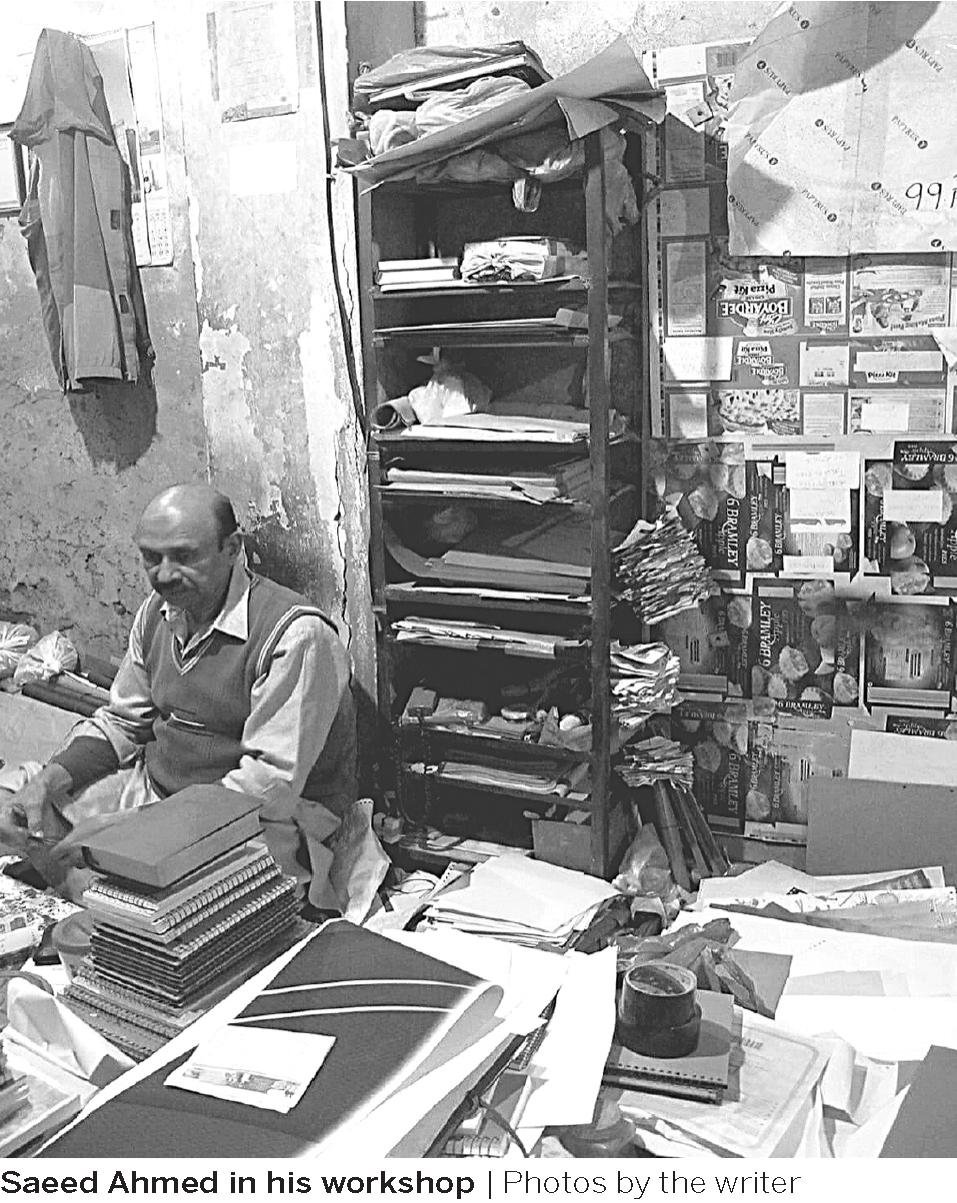
There is something about old shops that makes time feel reluctant to move.
Tucked into the narrow streets of Lahore’s New Anarkali, amid the shiny red-and-white boards of ‘Brand New Anarkali’, is a lane crowded with bicycles and tyre repair shops. At its end lies an even narrower alley, where an ageing, unmarked workshop sits behind a chipped blue facade and a rusting door. Inside, a bookbinding tradition lives on, passed down through generations.
This workshop has held on to ways of making that the rest of the city has long learned to live without. Here, things are still measured, cut and stitched by hand.
A book, for instance, is not simply assembled but patiently brought together, page by page, thread by thread, until a stack of loose sheets is transformed into a bound volume. The process demands patience and precision: sheets must be folded and arranged, signatures — a group of sheets of paper folded together to form a single unit, also called a section or gathering, that gets sewn into a book’s spine — carefully stitched together, spines reinforced, and covers measured and constructed before the book finally takes its form.
Today, Saeed Ahmed, in his sixties, carries on the work begun by his father, Abdul Aziz, who established the workshop in 1972. Saeed has spent nearly five decades binding books by hand. Even today, the one-room workshop remains largely in its original condition.
BOUND BY INHERITANCE
Abdul Aziz began bookbinding at the age of 22 and went on to work at the government printing press for more than three decades. Now 90 and living with dementia, he stopped coming to the workshop around three years ago. His son Saeed had gradually taken over, having spent years working alongside his father and learning the craft from him.
Bookbinding was not the only skill Saeed acquired. He also trained as a motor mechanic and could have pursued a different livelihood. Yet he chose to stay in his father’s workshop.
‘I had an attachment to the craft and wanted to continue what my father had started,’ he tells Eos.
His decision to stay has become increasingly difficult to sustain, however, as the demand for traditional handbound books has declined and publishers and printers increasingly rely on mechanised binding.
THREAD BY THREAD
Over the years, Saeed has also honed his expertise in restoring old and damaged books, a skill he inherited from his father. Unlike traditional bookbinding, says Saeed, restoration continues to attract customers and remains an important source of income for the workshop.
‘Some [books] arrive with little left of them beyond fragments of their original bindings, their pages loosened, torn and barely held together by age,’ he says.
In his hands, these remnants become the starting point of a painstaking restoration. He examines what remains, repairs and gathers the pages, reconstructs the spine and creates a new binding, preserving as much of the original book as possible.
He recently restored a 60-year-old Bible whose pages had become fragile, crumbling from age and badly damaged by insects. Watching him work, it becomes clear that restoration requires a different kind of sensitivity. He must know what to preserve, what to repair and how to hold together something that time has slowly pulled apart.
The small, ageing walls of the workshop preserve a body of knowledge that cannot easily be found in a manual or replicated by a machine. It lives in the movement of Saeed Ahmed’s hands, in his understanding of paper and thread, and in an intuition developed through decades of practice.
Time has left its marks on the workshop. An old calendar still hangs on the workshop wall, frozen on a date from decades ago. Around it, time has taken its toll, but the techniques practised here have endured.
A FRAGILE LEGACY
But Saeed is uncertain whether there will be anyone to carry the craft forward after him. He admits that he never considered teaching his daughters the craft, as he did not expect them to enter the workforce.
He has also struggled to find an apprentice willing to devote the time and patience required to master the craft. Even if he found someone, he is unsure whether he could afford to pay them.
Saeed is even considering selling the bookbinding machinery and continuing to restore old books from home. This would allow him to save on rent and concentrate on restoration, for which the clientele has remained consistent.
The difficulties confronting Saeed reflect a wider problem facing traditional crafts. As mechanisation transforms production, slower, labour-intensive ways of making things are becoming harder to sustain. Mass-produced notebooks and the increasing use of mechanised binding have reduced the market for traditional handbound books. For Saeed, this means fewer orders for a skill that takes years to master.
Despite possessing a skill refined over decades, Saeed struggles to make ends meet. He does not want to abandon the craft altogether and restoring books from home would still preserve at least one part of the trade he inherited from his father, he feels. But devotion alone cannot guarantee its survival. Without enough people willing to learn these skills, or customers who understand the time and labour involved in handmade work, such workshops become increasingly difficult to sustain.
The knowledge Saeed carries has taken decades to develop, yet it could disappear within a generation. Much of it exists not in written instructions but in the experience of the craftsman himself, making it difficult to recover once the workshops that sustain it close.
Preserving a craft, then, is not simply about preserving its techniques or the objects it produces. It also means ensuring that the people who carry that knowledge can continue to live by it. Otherwise, one day, all that may remain of these traditions will be the books themselves, still holding together the work of hands whose stories we failed to hold on to. ■
The writer is a visual artist currently based in Lahore. She can be contacted at hiraqurbanhussain@gmail.com