
Anyone who moves through Karachi learns to read its barriers.
Painted concrete blocks narrow the road outside a bank, wall off a side street or stand at the gates of ‘important’ buildings and institutions. These security measures were introduced to prevent political riots, deter acts of terrorism and protect places considered vulnerable or important. Given Karachi’s decades of unrest and political turmoil, what was initially meant to be a temporary measure gradually became a permanent feature of the city’s urban landscape.
But the impulse behind these structures is much older. At the palace of Ashurnasirpal II in Nimrud, pairs of colossal lamassu [winged bulls with human heads] stood at the entrances to hold back chaos. Some were carved with five legs, so that they stood firm from the front and strode forward from the side. In South Asia, armed dvarapalas [guardian statues] flanked temple doorways and in Gandhara warrior figures watched over the gates of monasteries. At the historic Sanchi Buddhist site in India, yakshis [nature spirits] lean from the gateways holding tree branches, offering protection as abundance rather than menace. A threshold was a vulnerable place and it needed a guardian.
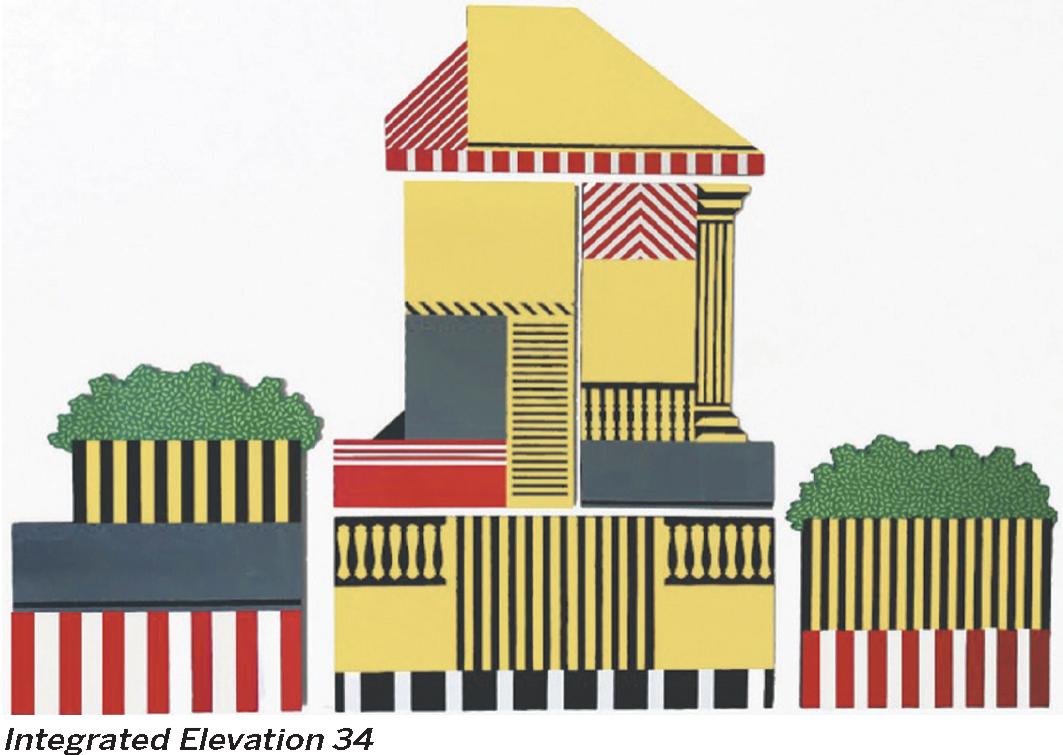
In this vein, Seema Nusrat’s exhibition ‘Studies in Integrated Facade II’ sets the modern block beside these ancestors. The ancient guardians were carved, ornamented and revered, and their ferocity was part of their rhetoric. The concrete block has no face, no myth and no rhetoric. It is poured in a hurry and asks only to be driven around. The old guardians were permanent by intent. Their modern counterparts are temporary by intent and permanent in fact.
What Nusrat studies is what happens after installation. In Integrated Elevation 22, a security barricade is rendered as a triptych, its three panels partly enveloped by foliage. The hard geometry of the block is softened and gradually swallowed by green.
Integrated Elevation 19 goes further. The barricade becomes part of a secure entrance, with flower pots built into the structure itself. The planter is the barrier and the barrier is the planter, an exact image of how security is absorbed into the architecture of important buildings until defence and design become difficult to distinguish. The yakshi at Sanchi would recognise the gesture.
Nusrat’s other works explore the barricades through a variety of designs, colour schemes and structural arrangements, carrying the same underlying tension between security and everyday life. These observations extend beyond the artworks and into the city itself. I recall once coming across a row of cement barricades being used to spread out clothes for drying. Elsewhere, a barricade had become part of the wall of a ramshackle, low-income dwelling.
But protection in this city is unevenly distributed — the block that shields one address can, a few streets away, become part of someone else’s shelter. The comparison also runs the other way. The ancient guardians no longer guard anything. Their thresholds are gone and the figures now survive as remnants of a vanished world. At the Metropolitan Museum of Art in New York (The Met), the Gandharan door guardian and a 10-foot-tall lamassu sculpture from Nimrud stand behind museum glass, far removed from the entrances and palaces they were once made to protect.
They have become stories and objects of archaeological spectacle, admired for their craft and read for what they reveal of the past. Seen this way, Nusrat’s barricades raise an uncomfortable question. They are accidental guardians, still working, still unadmired and still without a story anyone has bothered to tell. Will they one day be remnants too?
The exhibition shows how temporary barriers become permanent through everyday use, taking on roles no one intended for them. It leaves us asking what these guardians now stand to protect. ■
‘Studies in Integrated Facade II’ was on display at Canvas Gallery, Karachi from October 20-29, 2026
The writer is a university student with an interest in art, culture and urban history. He can be contacted at pakistaniumer04@gmail.com.
Instagram: @umersheikh__