
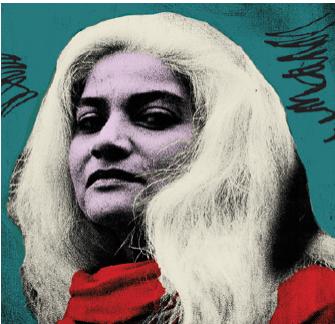
It’s never too late to change. It’s never too late to start over. Or, as the author George Eliot put it, ‘It is never too late to be what you might have been.’
Meanwhile, a Reddit contributor writes, ‘I’m tired of people telling me ‘It’s never too late to start over.’’ Another’s despair is palpable: ‘It’s beyond daunting to even think about when you’re just barely scraping by as it is. It’s like drowning in the ocean and someone says, ‘It’s never too late to buy a boat.’’ And then we have Rumi saying, ‘Start a huge, foolish project, like Noah. It makes absolutely no difference what people think of you.’
Between these two approaches lies the difference between starting something new and retrieving what got lost along the way. It is common to see life as a straight ladder or progression — school, work and then retirement. Nature teaches another way. A constant forward movement but with many possible pathways — a meandering river cutting through what it can, bypassing what it cannot, constantly adapting.
The American poet Robert Frost reflected the regret many feel: ‘Two roads diverged in a yellow wood,/ and sorry I could not travel both.’ Ghalib wondered how life might have turned out if different choices were made, ‘Woh har ik baat par kehna, ki yun hota toh kya hota [Saying at every turn, what if it had been this way].’
It is only hindsight that makes coherent the sequence of events in life. The Danish philosopher Soren Kierkegaard reminds us, ‘Life can only be understood backwards, but it must be lived forwards.’ In the moving forward, change is always possible, even inevitable. The elderly, or the ailing, accustomed to being independent, have the choice of accepting, even enjoying, the new relationships that emerge with caregivers, or succumbing to frustration. It is by listening to our quiet, inner voice that family feuds can end, billionaires may choose charity over profit or gangsters can dedicate their lives to social reform.
Retirement can be seen as an ending or an opportunity. Grandma Moses, an American housekeeper, started painting at the age of 76, when arthritis prevented her from embroidering. Discovered by an art collector at 78, she produced over 1,500 paintings before her death at 101. For some, retirement is time to share wisdom accumulated over a lifetime. A young 85-year-old, Dr Ishrat Husain, travels across the country sharing his insights into finance, governance and life, with learners of all ages.
Perhaps the greatest obstacle to change is not age or circumstance. It is the myth of a fixed identity. Statements such as, ‘I can’t help it — this is who I am’ are labels we create or that are given to us. Yet, we are rarely just one thing. A woman can be a mother to her child, a policewoman to her colleagues. Did Mustafa Zaidi identify as a civil servant or a poet? Will Iqbal Geoffrey be better known as a human rights lawyer or an artist? Dr Iftikhar Salahuddin, an established ENT surgeon, is also known as an author of historical books.
More readily accepted is transformation on a spiritual journey. Hindu philosophy formalises change into four stages of life: the student stage, the householder stage, the retirement stage and, finally, the wandering ascetic in search of moksha or liberation from the cycle of death and rebirth. Personal change in Sufism is not tied to age but follows two stages: fana or the annihilation of the ego of an independent self, followed by baqa or aligning with Allah’s presence in all things, returning to everyday life to serve creation.
Change can also be social or political. My brother, a doctor, responding to a question by students about his imagined future, hoped for a time when people would say, ‘We used to have wars.’ It is not that inconceivable. A mediaeval French peasant could not have imagined a Europe whose nations would no longer be at war against one another. A demonstrator at Sharpeville in 1960s South Africa, witnessing fellow protesters shot by the police, might never have imagined the end of apartheid some 30 years later.
Perhaps one day, a common humanity will prevail over divided identities in regions of conflict. As Rumi reminds us, ‘The wound is the place where the light enters you.’ ■
Durriya Kazi is a Karachi-based artist. She may be reached at durriyakazi1918@gmail.com