
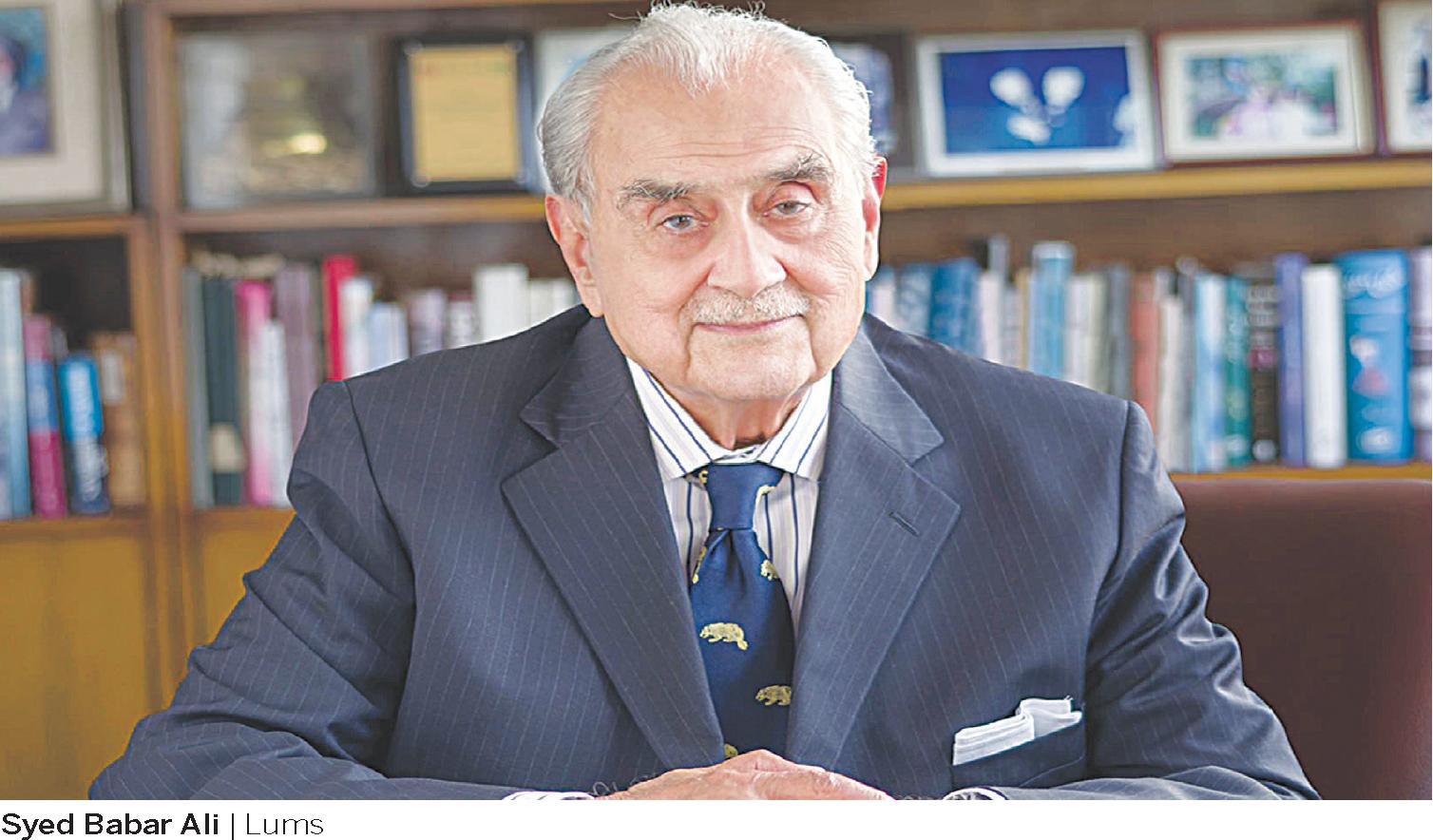
Syed Babar Ali needs no introduction — as one of Pakistan’s leading businessmen and philanthropists, his is one of the more recognised names in corporate circles, as well as in education, in conservation, and amongst cultural institutions and charitable trusts.
Babar sahib, or SBA as he is apparently known to friends and family, recently celebrated his 100th birthday, which prompted a flood of articles, social media posts and general reminiscences about his life and his immense contributions. This book, Syed Babar Ali: A Centennial Tribute, is another in this series of tributes, bringing together the memories and observations of a number of distinguished Pakistanis who have the utmost reverence and affection for SBA.
The author/editor, Muhammad Azfar Ahsan, has taken pains to compile this volume as a compendium of short essays, memoirs and reflections on Babar sahib’s legacy. As the preface states, the book is not a ‘conventional biography’ or a ‘celebratory narrative around personality’, but an ‘exploration of what sustained institution building looks like…’
In a sense, it is an exploration not of SBA’s achievements in his personal and professional life so much as his knack for building institutions that have proved their worth over time and will be his legacy in the longer run. In a society where individual success stories abound, but few durable institutions have managed to maintain standards over time, it is important to commend those with the vision to build and nurture such institutions.
Syed Babar Ali has done this throughout his life — from building his family business into a major conglomerate, to his crucial role in the establishment of the Lahore University of Management Sciences (Lums) as well as the Ali Institute of Education, to his pioneering role in building a software development company (Systems Ltd) when such initiatives were unknown. And then there is his unceasing support of a range of charities and cultural events. There is much to reflect on in his life.
The first part of the book, ‘Beginnings & Tributes’, begins with tributes (in Urdu) from poets Iftikhar Arif and Zehra Nigah, and ends with a profile of SBA, enumerating his educational background, his professional life and his major achievements in business and philanthropy.
The second part, titled ‘Interpreting a Legacy’, sets the tone for the volume as a whole, and consists of two essays by Azfar Ahsan which highlight SBA’s role as a builder of institutions, most notably business and educational institutions, his lifelong quest for knowledge and his enquiring mind, which remains as sharp and curious now as it was decades ago. It’s clear that, for the author, these are the key facets of SBA’s life and work.
This theme continues in the third section, ‘A Century of Construction’, which discusses SBA’s drive to establish systems and institutions that would endure long after individuals have left the scene. Hence, his efforts to hire professional managers for his flagship company Packages, emphasise quality control systems, and build long-term technological partnerships. SBA’s business venture in the dairy industry is also mentioned as an example of a successful agro-industrial partnership which, through the introduction of packaged UHT (ultra-high-temperature processed) milk, transformed consumer behaviour.
As the author emphasises, the initial few decades of SBA’s professional life were about the construction of economic systems and the establishment of business processes. In his mid-life and later years, he moved towards the construction of intellectual systems. These two phases of his life are not distinct from each other but are coherent, in that one led to the other.
Lums started as a business school, essentially to fulfil the business community’s need for professional managers. That it has grown far beyond that initial mandate is a testament to SBA’s continued intellectual engagement and his vision of how institutions should grow and develop.
One section of the book is titled ‘Portraits’, and consists of 16 chapters or ‘portraits of continuity’ authored by Azfar Ahsan. Each short portrait picks up a different subject, but all highlight key facets of SBA’s life and character. In ‘The Guardian of Lahore’s Soul’, SBA reflects on his love for the Old City of Lahore, its culture and traditions, and his work on heritage conservation with Kamran Lashari, former director general at the Walled City of Lahore Authority, and others.
‘The University He Never Built’ tells the story of how SBA was instrumental in shaping Habib University and advising its founders. ‘The Invisible Foundation’ recounts an anecdote from someone who had joined SBA for lunch on Pakistan’s Independence Day, and to whom he talked of the timeless advice that the pre-Islamic sage Hazrat Luqman gave to his son, and which is referred to in the Quran.
The next few sections of the book consist of a series of essays on SBA by some of Pakistan’s most distinguished citizens. These include jurists such as Justice Mansoor Ali Shah, scholars such as economist Dr Asim Ijaz Khawaja and historian Ayesha Jalal, diplomats such as Jalil Abbas Jilani and many others.
Some have personal anecdotes, such as Justice Shah’s remembrance of SBA’s support during the tumultuous weeks that constitutional amendments were being debated, Habib University president Wasif Rizvi’s account of accompanying SBA and his wife for ziarat [spiritual pilgrimage], and Beaconhouse National University vice chancellor Dr Moeed Yusuf’s recollection of how SBA was instrumental in his making up his mind to return to Pakistan after more than a decade in the US. All of them uphold the image of Babar sahib as someone whose life is an example of service and humility.
As the title of the book indicates, this volume is a tribute to a life well lived, and as such emphasises the many lessons that one can learn from SBA. It would, however, have been interesting to read more about the man himself — his memories of his young years, the times spent with his family and his many siblings, his years abroad, his hobbies and pursuits (what he does for fun, rather than his work or philanthropy).
It’s clear that SBA has a multi-dimensional personality and a range of skills (the book mentions his love of Persian poetry and his interest in cooking), and it would have been good to get to know him as a person in addition to reading about his undeniable achievements. All in all, though, this is a fitting tribute to one of Pakistan’s truly distinguished citizens. ■
The reviewer is a researcher and policy analyst