
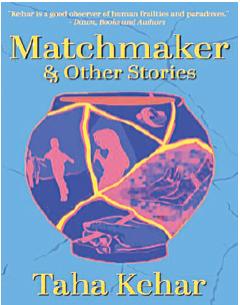
In an author’s note to this excellent collection of short fiction, Taha Kehar rightly notes that penning short stories is akin to the delicate and pure work of a miniaturist.
The notable author of a number of novels and collaborative works, Kehar had published some of the tales in Matchmaker & Other Stories in various publications before collecting them, and adding others, in this volume. Avid fans of his brilliant novel No Funeral For Nazia will undoubtedly hear about a prequel tale to that, titled ‘Sisters’, included in this book. While I can fully understand that readers will excitedly stampede like a herd of elephants towards the book for the sake of that story alone, virtually all the other pieces in Matchmaker are equally good.
As someone who has reviewed Taha’s writing prior to this point, as well as someone who has penned and published short story collections myself, I was struck by the unexpected twist in the eponymous tale of this book, ‘Matchmaker’. On finishing the story, I felt somewhat foolish that I hadn’t guessed the ending, but this might be because the focus of the story is the rampant colour-prejudice that exists across Pakistan’s marriage market.
Like the best of magicians, Kehar is supremely skilled at making people look in a different direction while pulling a rabbit out of a hat. He employs the same technique in other tales such as ‘Betrayal’ and ‘The Missing Spectacles’ (though less dramatically in the latter). Yet, all those stories contain value as well as veneer, in that they depict the plight of women who have had the misfortune to become involved with men who are weak and faithless at best, and downright villainous at worst.
In the final, and briefest, tale, ‘Conversations’, the author writes entirely in the first person and recounts how another individual lambasts him for dwelling far more on the female gender than on his own. While I did wonder as to why an intelligent author would care to include a rather stupid, not to mention tactless and inconsiderate, friend amongst his acquaintances, it is far more important to realise that freedom of choice of topic is the lifeblood of any good creative work.
Kehar pulls no punches when it comes to writing about harsh politics and the patriarchy strangling both art as well as journalism in varying degrees. ‘Ustadji’ [Respected Master] and ‘Truth Tellers’ offer an unflinching portrayal of how gubernatorial power can stifle both the beauty of art as well as the integrity of journalism. It does not matter that the oppressed in Kehar’s work are generally women; what is significant is that, within the limits of a few pages per story (with the exception of ‘Intruders’, all are relatively short), the author evokes the sympathy and interest of the reader without either belabouring his point or compromising on his art.
My personal favourite amongst the stories, ‘The Lost Words’, has a decidedly male protagonist. In this tale, the central character, Jamal, is suffering from writer’s block, and his friend Mina does her best to help him overcome it. But Jamal realises, as do most blocked writers, that authors need to wrestle with their own demons (in Jamal’s case it is an especially toxic ex-lover), in a very private and intensely lonely sense before they can begin to create again.
While I had a measure of sympathy for Jamal’s internal anguish, it is the chilling aspects of stories such as ‘The Incident’ (which underscores a horrific fate that overcomes a child) that I find most disturbing in this collection. Fortunately, Kehar is a past master at producing superb thumbnail sketches of humorous characters, especially aunts, mothers, mothers-in-law, and grandmothers. Fathers, even if they are performing important ceremonies such as nikaahs on Zoom during the Covid lockdown, get relatively short shrift (but there’s no arguing with the point that female characters lend themselves to being parodied far more smoothly than male ones do).
There are some malapropisms tossed in adroitly — such as when a woman refers to her daughter’s leftist ex-boyfriend as left-handed, or when someone calls corona a ‘canola virus’ — that leave the reader laughing out loud. I was reminded at times of Kehar’s early novel Typically Tanya, which had the best sense of comic timing I have perceived in South Asian fiction.
The book, therefore, takes one through a gamut of emotions and its canvas ranges from the personal and domestic to the political and military. The remarkable story ‘Nazneen’ is set around the time of the 1971 war and describes how the lives of ‘Banglas’ and ‘Bingos’ working in West Pakistan were affected by this dark and sad period of history. I do not wish to give away what is yet another brilliant twist in this book, so I will simply note that Nazneen’s fate, though mentioned only briefly, leaves a lasting — albeit very disquieting — impression on the reader.
The tale ‘Four Stories’ acts as a perfect counterbalancing point to ‘Nazneen’ by depicting, with perfect accuracy, the precious childlike wonder that many small children experience prior to the angst of young adulthood taking over.
With this volume of diverse and well-written tales, Kehar has proved himself to be that type of author who never compromises on his craftsmanship. Only those of us who have repeatedly grappled (often with limited success) with the genre of short story writing will be able to fully comprehend how every one of his pieces is inherently special in its own unique and inimitable way. Regardless of whether a tale is the length of a novelette or simply a couple of pages long, Kehar maintains a near-perfect balance between his underlying authorial agenda and those aspects of the work that remain open to speculation and interpretation.
The character of Nazia’s sister Naureen is one of the most beautifully delineated in the entire collection. While many will heave a sigh of relief at that, I am feeling more ecstatic at the fact that, having presented us with Matchmaker, Kehar may be looking into producing another volume of stories in the not-too-distant future.
At a literary festival, I once only half-jokingly referred to him as the reincarnation of Sir Arthur Conan Doyle, an author fascinated by both mystery and death. After reading this book and making note of Kehar’s literary skill and diversity, however, I feel that comparing his spirit to that of the legendary D.H. Lawrence (who was as good at writing stories as he was at constructing novels) might be equally apt.
The reviewer is Associate Professor of Social Sciences and Liberal Arts at the Institute of Business Administration.
She has authored two collections of short stories, Timeless College Tales and Perennial College Tales and a play, The Political Chess King