
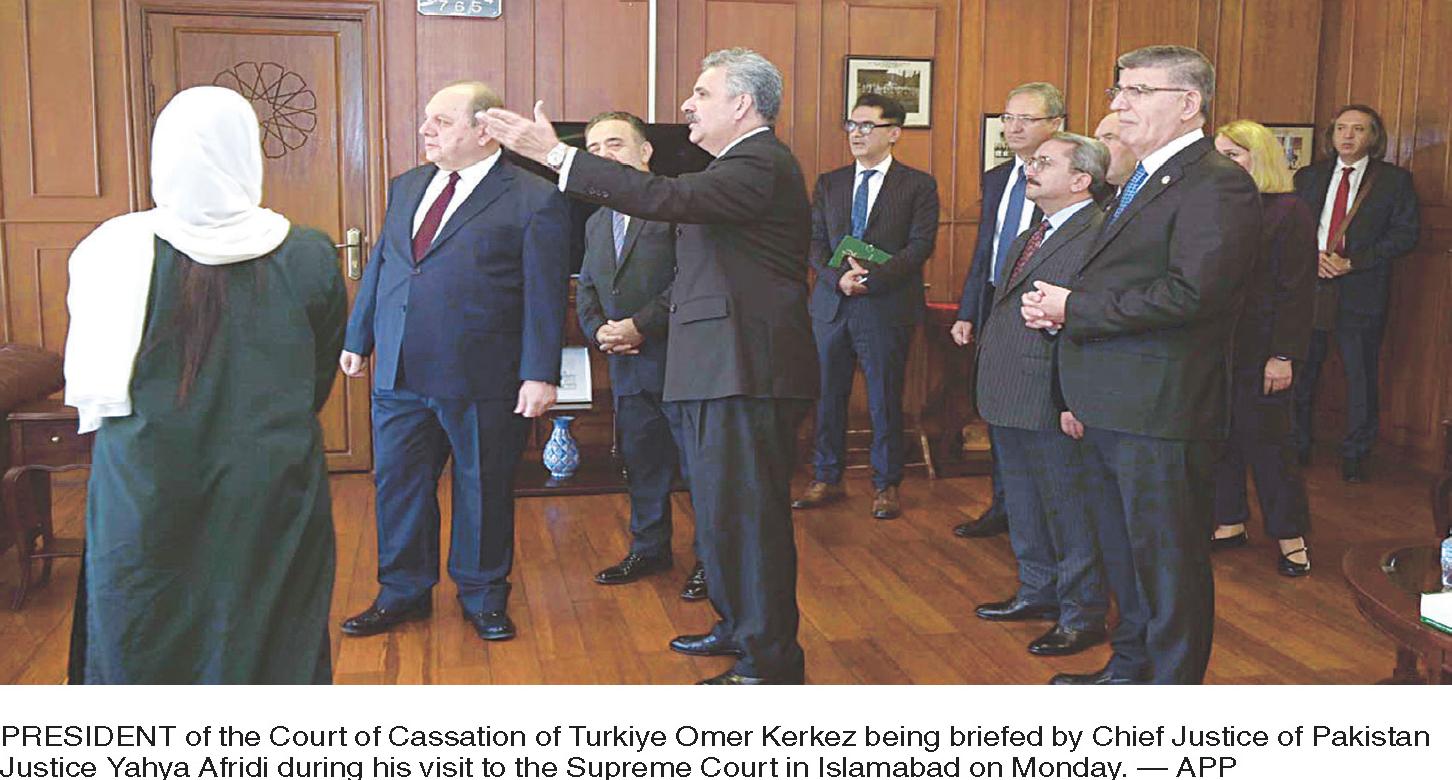
ISLAMABAD: The Supreme Court of Pakistan on Monday hosted a high-level judicial delegation from the Court of Cassation of the Republic of Turkiye, led by its president, Omer Kerkez.
The delegation was received by Chief Justice of Pakistan (CJP) Yahya Afridi at the Supreme Court.
During the visit, the CJP and the president of the Court of Cassation of Turkiye signed a Memorandum of Understanding (MoU) on bilateral judicial cooperation. The MoU establishes a framework for strengthening institutional relations, judicial exchanges, professional capacity-building and knowledge-sharing between the two judiciaries.
The signing ceremony was attended by Supreme Court judges, chief justices of the Supreme Court of Azad Jammu and Kashmir and the high courts, the federal minister for law and parliamentary affairs, the attorney general for Pakistan, members of the district judiciary and legal fraternity, media representatives and other dignitaries.
Welcoming the delegation, the CJP highlighted the historic and fraternal ties between Pakistan and Turkiye, recalling the solidarity extended by the people of the subcontinent during Turkiye’s struggle for independence and the contributions of Abdur Rehman Peshawri.
The CJP observed that the MoU translated these enduring bonds into meaningful institutional cooperation. Referring to the Supreme Court’s ongoing judicial reforms, he emphasised the importance of exchanging experiences and adopting best practices to enhance accessibility, predictability and accountability in the administration of justice.
In his remarks, Omer Kerkez expressed appreciation for the warm hospitality and reaffirmed the longstanding friendship between the two countries. Referring to Quaid-i-Azam Mohammad Ali Jinnah’s emphasis on justice and impartiality and Allama Mohammad Iqbal’s description of justice as ‘an inestimable treasure’, he highlighted the shared values underpinning the judicial systems of both nations.
He also drew attention to emerging challenges involving digitalisation, artificial intelligence, cross-border disputes and increasingly complex economic relations, underscoring the need for closer judicial collaboration and an exchange of expertise.
The MoU provides for cooperation in judicial education, professional training, institutional capacity-building and collaborative research. It envisages closer engagement between the Federal Judicial Academy of Pakistan and the Justice Academy of Turkiye through faculty exchanges, joint training programmes and academic initiatives.
Key areas of cooperation include cybercrime, financial crime, constitutionalism, human rights, judicial ethics, climate justice, gender-responsive justice, alternative dispute resolution and the integration of technology into courts.
The agreement also provides for judicial exchanges, joint conferences and seminars, and the sharing of judgements and legal developments. It further establishes a joint working group on judicial cooperation to identify priority areas, coordinate joint initiatives and monitor implementation, ensuring that the commitments translate into practical and sustained institutional engagement.