
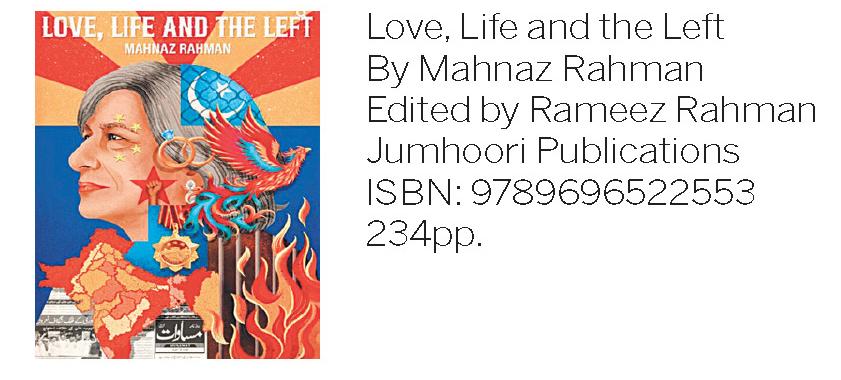
It’s a breeze going through Mahnaz Rahman’s memoir, Love, Life and the Left. An account of personal journeys can often make for tedious reading, more so when the writer has an exaggerated sense of self-importance. Mahnaz’s narrative, however, is characterised by brutal honesty. There’s no looking back at the past with rose-tinted glasses. Even the three ‘Ls’ of her passion — and the title of her memoir — are not spared.
Growing up as a child often faced with financial hardship and frequent moves between cities, Mahnaz’s unsettled circumstances appear to have made her more resilient — a quality she would increasingly draw on as an adult and well into her married life. The first test came when her father abandoned her mother to marry a doctor who was also a colleague (both were working for a textile mill). The family lived in a house provided by the mills, on the premises.
Mahnaz shows early disdain for the rich and the influential, including her father’s employers. She describes an incident of personal humiliation she faced as a child and claims to have (perhaps) witnessed a murder. The person who comes through shining and seems to have been the bedrock in Rahman’s life is her mother or ‘Ammi’.
Mahnaz is amazed by her mother’s tolerance of her father’s (sometimes) wayward life — getting addicted to opiates, frequently changing jobs and cities, as well as marrying a second time. But it is Ammi who provides support to Mahnaz when she herself faces problems in her marriage and in her relationship with her in-laws.
The first ‘L’ of the title is, of course, ‘Love’. The love of her life was her husband, Ahfaz ur Rahman, a journalist known for his activism and uncompromising position on the issue of press freedom. The chemistry between Mahnaz and Ahfaz stemmed from their shared political ideologies. And shared professions.
In fact, the pro-Pakistan Peoples Party (PPP) newspaper, Musawaat, was what brought them together. Moreover, both were leftists, idealistic, with a belief that journalism could help bring about change. While Ahfaz actively participated in movements for the rights of journalists — sometimes losing his job or facing imprisonment — Mahnaz carried the additional burden of ensuring a steady income, which kept the family afloat.
Mahnaz’s marriage to Ahfaz was opposed by her family, primarily on the basis of differences in economic status. Her husband lived with his family in a home that was without the basic necessities she was accustomed to, such as a gas supply and attached toilets. Mahnaz confesses that the adjustment was challenging, more so due to her in-laws’ generally hostile behaviour. Her situation was not helped by her husband’s mercurial temper, many examples of which she narrates and rues.
She admits how practical and personal consideration triumphed over her leftist idealism when it came to her own children. After vowing to friends and comrades that her children would be sent to schools where they would be seated on floor mats, ie working class schools, she sent them to Montessori and the trust Mama Parsi schools. It is candid admissions such as this that make the narrative warm and engaging.
Mahnaz’s active involvement in student politics at the University of Karachi brought her in contact with the left-wing liberals of the time, further strengthening her Marxist beliefs. In fact, she was the first woman to be elected to the position of vice president of the Economics Society, contesting from the platform of the leftist National Students Federation against the Jamaat-i-Islami’s student wing, the Jamiat.
Mahnaz’s memoirs will evoke many memories, particularly of those of her generation closely involved with the political movements or the journalism of the times. Many of us would get a sense of deja vu reading her experiences of press censorship and political repression during the military regime of Gen Ziaul Haq. She later went to work for Awaam, then a staunch PPP supporter, which, in tune with the times, later became a mouthpiece of the Mohajir/ Muttahida Qaumi Movement (MQM).
In 1985, Ahfaz and Mahnaz got the opportunity to move to China. This was a welcome break from the stress they faced at home, especially under the Zia regime. China, at the time, was undergoing a transformation that would define its future as a world power and economic giant, accepting many aspects of a Western lifestyle it had shunned earlier. This chapter is an interesting account of their eight years in China, although it will not reverberate with readers as much as the chapters on home ground and its many challenges.
Mahnaz lost the love of her life, Ahfaz, during the night of 11th and 12th April 2020. Her description of the last few moments is poignant; however, she has chosen to honour his memory through awards to journalists given out in his name each year.
Surprisingly, Mahnaz’s account of her life as an activist involved with several rights-based non-governmental organisations (NGOs) is not as straightforward as one would have wished. She expresses her and her husband’s aversion to international organisations, sharing — with many other leftists — suspicion of their objectives and activities. However, she was compelled to join the Aurat Foundation due to financial needs. This latter part of her memoir lacks the candour of the earlier chapters and the reader is left with the impression that she’s holding back, so as not to rock the boat.
Love, Life and the Left should inspire other feminists to write about their own lives and their involvement with rights movements. Although there is a fair degree of academic writing available on the women’s movement in Pakistan, there is currently inadequate literature on women’s personal experiences. Sadly, many pioneers of the women’s movement have left this world without telling their stories.
The reviewer is a human rights activist and a former chairperson of the Human Rights Commission of Pakistan