
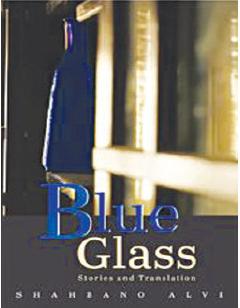
Blue Glass: Stories and Translation is a slim book of about 125 pages, comprising 10 short stories by Shahbano Alvi and her translations of four much longer stories by Zaheda Hina. It is the writer of the book, Alvi, who gives it weight. The previous collections of the author, both in English and Urdu, have proven that she is a storyteller worth reading, and Blue Glass is no exception.
Shahbano Alvi set up her own publishing house, Ushba, in 2001, after having worked for Oxford University Press for nearly a decade. An avid reader since childhood, she began her writing career only after her husband passed away. She found solace in putting her thoughts down on paper.
Short stories are Alvi’s genre of choice, and she really keeps them short. Before Blue Glass, Alvi has published two other collections in English, A Woman and the Afternoon Sun and A New Pigeon on the Block and one in Urdu called Aaj Se Ho Ja Razi [From Today, Consent].
Shahbano Alvi writes about what she sees and feels. Yet, she is scrupulously non-judgemental in her treatment of the subjects she broaches. She expects her readers to see her point of view but not necessarily subscribe to it.
The first story in Blue Glass is ‘A Boy, a Lame Wolf and the River.’ It lays down the groundwork for the use of symbolism, which is found in most of the author’s work. This tale is not based on the writer’s direct observation and, perhaps because of that, lacks the punch of the subsequent ones.
In two beautifully constructed stories — ‘The Ceiling Fan’ and ‘Blue Room and Cold Walls’ — inanimate objects are personified and given the powers of thought and of conveying comfort. The protagonists in both are young men. One wants a life different from that envisioned for him by his father and the other is the victim of decisions that his parents made years ago.
‘The Blue Glass Bottle and the Delft Pepper Shaker’ is based on the author’s life experience. In it, the reader is also treated to a brief history of Delft pottery. The superstitions which swirl around us are alluded to here and the blue glass bottle, which signifies tranquillity and protection, gives the name to this anthology.
The plight of the poor is repeatedly brought to the fore in Alvi’s prose. ‘The Weeping Willow and the Jacaranda and Bangalore Town’ shows the silent suffering of the vulnerable. The last story in the collection, ‘Mosaic: Tesserae of Life’, is exactly that. It is made up of five stories which, together, are like an array of snapshots presenting life in many dark colours and ominous shapes.
Alvi’s writing style is deceptively simple. Her vocabulary and her sentence construction make her work easy to read. But the plain language packs an impactful punch and holds many nuances of meaning.
The second part of the book is made up of Zaheda Hina’s work, who has written thousands of journalistic articles. She has also penned many short stories, which have been published in five volumes, and three novels. Much of her writing has been translated into Bengali, Hindi, Marathi and English. Hina has received the Saarc Literary Award and the Pride of Performance Award from the Government of Pakistan.
Shahbano Alvi calls Hina her friend and considers her to be ‘a fantastic writer.’ The stories included in Blue Glass are the ones given by the author to Alvi to translate into English.
The first story, ‘Echoes of Twilight’, though well translated, shows its Urdu origins very clearly. The lengthy descriptive passages about the sea and moon, which do nothing to enhance the plot line, are more easily acceptable in Urdu afsanay [short stories].
‘Hear me, Surraya’, the second story by Hina, is a well-conceived tale of terrorism in the name of Islam. It begins as a poignant account of a shopkeeper who cannot keep up with the times. Due to fanatical and incorrect interpretations of religion, his troubles multiply till he ends up a cripple, dependent on the oldest profession for his livelihood. The twist at the end leaves the reader shocked and dumbfounded.
The third story, ‘The Babylonian Well of Solitude’, begins as an account of an overworked Arab scholarship student in London. He is in love with an upper-class English girl but never finds the courage to open his heart to her. Even as the reader wonders how this mismatched love would proceed, the narrative pivots drastically. The author turns her attention toward terrorism, Muslim intellectuals of Andalusia and the crass ignorance of the ordinary British policeman.
The best has been saved for last and the translation of Zaheda Hina’s fourth story is outstanding on many levels. ‘There Was Once a Somebody and a Nobody’ is an engrossing tale of the rags-to-riches journey of a potter from Qazvin, Iran. His artistic temperament is repeatedly battered by adversities till his equilibrium becomes fragile. Even though he achieves success in worldly terms, the final blow fells him and he is unable to lift himself again.
The tale is also a discourse on the Persian art of storytelling, on Hafiz’s poetry and on the pottery of Iran. We learn about the fate of Baha’i adherents in their native land and are presented with an alternate account of the creation of the first man. Zaheda Hina comes through not just as an able writer of fiction but as a woman who is a treasure trove of knowledge. The way the story is devised and drafted is highly compelling.
Blue Glass is a thoroughly pleasurable read. Shahbano Alvi’s own stories are the fruits of keen observation and felicitous prose. Her translation of Hina’s fiction is superbly done, an obvious labour of love. Even though English newspaper readers may have peripherally heard of the journalistic prowess of Zaheda Hina, very few would have actually read her fiction. Alvi’s translations are a timely introduction to this talented writer.
The reviewer is a freelance writer and author of the novel The Tea Trolley, the memoir My Life as a Corporate Gypsy and the translator of Toofan Se Pehle: Safar-i-Europe Ki Diary