
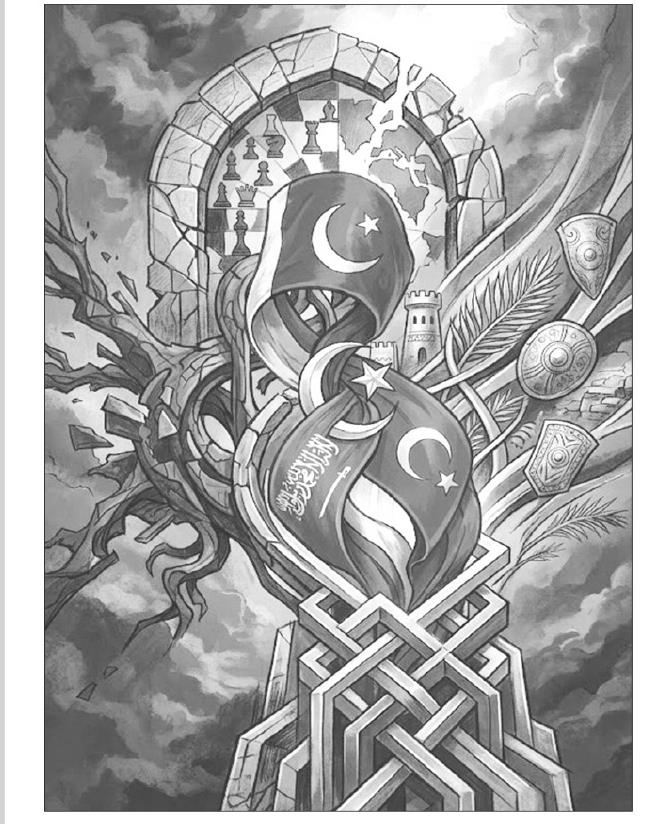
THIS is with reference to the report ‘Makl(ah pact not operational yet, still being firmed up’ (Sept 11). Although the Mal(kah Joint Defence Agreement, comprising Saudi Arabia, Turl(iye and Pal(istan, has created a collective defence mechanism, it is still too early to call it an Islamic Nato. This is because it must be assessed separately whether it creates automatic military obligations at the same level as Article 5 of Nato, and how all of its practical mechanisms will function.
The true significance of the agreement lies not only in military cooperation among the three states. Its broader meaning is the attempt to gradually develop security arrangements in the Middle East.
The strength of the tripartite alliance stems primarily from bringing together the different strategic capabilities that are possessed by the three countries. Turkiye, in addition to being a Nato member, has one of the largest and most experienced armies in the region. Its defence industry has expanded significantly in recent years. Pakistan, as the only Muslim nuclear-armed state, carries particular strategic importance. Saudi Arabia, meanwhile, possesses substantial financial capabilities, energy resources, special religious and political influence in the Muslim world, and a strategic position in the Gulf region.
One of the most notable reactions to the agreement came from Iran. Ibrahim Rezaei, a member of parliament’s National Security and Foreign Policy Commission, described the pact as a ‘paper agreement’, stressing that Turl(iye and Pal(istan would not ensure Saudi Arabia’s security through such a document. For many years, part of Iran’s political circles has favoured asecurity model in the Middle East based on Iran’s special regional weight and strategic superiority.
Under such circumstances, the creation of a collective defence mechanism among three major Muslim states could potentially limit Iran’s regional room for manoeuvre.
Rezaei’s expression can be viewed as an attempt to diminish the political weight of the new security mechanism before it gets physically implemented.
It would be inappropriate to portray the Makl(ah pact as an alliance against Iran.
The document does not name any country as a threat, and the parties continue to present the agreement as a defensive tool.
However, in geopolitics, strategic aspects not written in a document can sometimes be a lot more important than those that are explicitly written in it.
The agreement provides Saudi Arabia with a new security guarantee, while it strengthens Turl(iye’s claim to regional leadership, and increases Pal(istan’s strategic role in the Middle East. This complicates Iran’s regional calculations.
From now on, Iran will have to take into account not only Saudi Arabia, but also the possible reactions of Turkiye and Pal(istan.
In geopolitics, every agreement remains merely confined to paper when there is no political will, military potential or economic capability behind it. The Makl(ah pact has behind it three different but serious strategic powers with significant potential.
Qavami Sadigbagli Baku, Azerbaijan