
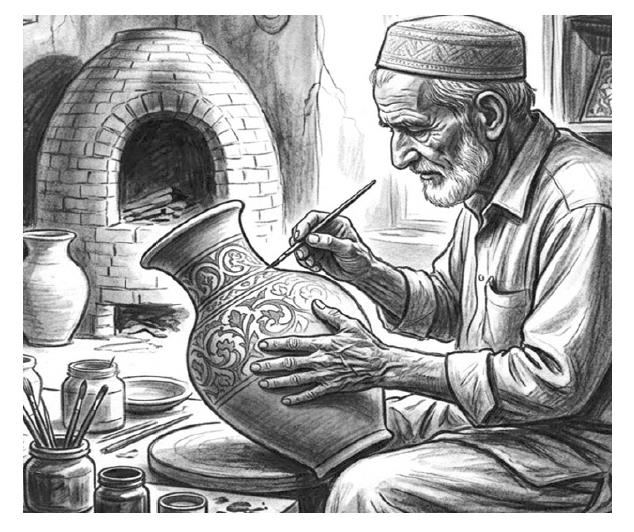
MULTAN is known as the city of saints, but it also claims to be the city of blue pottery. For centuries, kashi kari, the tan and turquoise glazes made in the old city, has flowed from small workshops in the old city, handed down from father to son, largely unchanged. Now, that chain is breaking. Today, in the potters’ quarter or in shops found in the old streets of Multan, there are fewer than 10 shops left. Young men from craftsmen families are moving to factory jobs or migrating for work instead of sitting at the wheel their fathers and grandfathers used to sit at. The reasons are not hard to understand: the work is slow, the margins are thin, and a piece that takes days to fire and glaze often sells for less than its labour is worth once it reaches a shop in Lahore or Karachi.
What makes this loss quieter than most isthatthe craft doesnot announceits own death. There is no sudden closure, no demonstration; simply one shop after another that goes silent when the old artisan has retired and nobody takes his place. By the time a craft is officially listed as endangered, it is too late to save it.
Multan’s blue pottery has survived Mughals, colonial rule and Partition. It may not survive indifference. A small push, whether through fair pricing, exhibitions or simply teaching the craft in local schools, could be the difference between a living tradition and a museum exhibit.
Mahnoor Adnan Multan