
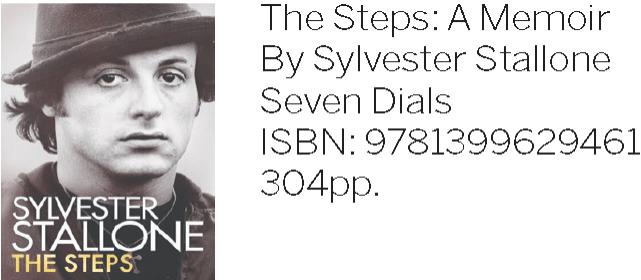
The Philadelphia Museum of Art may house works by some of the best painters of all time, yet its most famous attraction isn’t inside. The 72 steps outside, made iconic by Sylvester Stallone in Rocky (1976), hold a special place in movie buffs’ hearts and minds.
When the film’s underdog boxer sprints up them and raises his arms in triumph, he does more than celebrate a fight. He embodies the hope that an ordinary man can defy the odds. Stallone has spent much of his life telling this same story — on-screen and now in his memoir, The Steps.
Stallone’s early life was far removed from Hollywood glamour. His birth was difficult, his childhood unstable and even his name became a source of insecurity. At one point, he considered changing his name to Mike because Sylvester reminded him and others of a cartoon character. Thankfully, he didn’t, and he went on to join the ranks of the very Hollywood icons he grew up watching. Mike Stallone would have sounded funny if you think about it!
His path from nobody to somebody took him through many hardships. He worked as an usher, took whatever jobs came his way, and even cleaned a lion’s cage, just to stay in the city where he dreamed of making it big. He hated being considered insignificant, which led to an encounter with The Godfather director Francis Ford Coppola that culminated in him smashing a cake in his office kitchen!
Rejection followed him from Los Angeles to New York. He writes that his first audition was ‘shady’ and he constantly struggled to prove he belonged on screen. Before casting him in Bananas, Woody Allen reportedly told him he wasn’t intimidating enough. The future action star was still trying to establish himself, taking small roles and improvising whenever he thought it might help. Sometimes it worked; other times, it cost him a job.
Stallone writes in a conversational style, sharing his frustrations with humour while not concealing his temper. An altercation in his youth landed him in detention, and a later confrontation with a trash guy at a restaurant showed he had not entirely outgrown his impulsiveness. An incident involving his father at a polo club also left him unwilling to ride a horse for three decades.
Literature had a more constructive influence. Stallone found a kindred spirit in Edgar Allan Poe and began working on a Poe screenplay, hoping to establish himself as a serious screenwriter. He also took a job at a bookstore, where he befriended Sasha, a fellow worker who could decipher his often-unruly handwriting and type his scripts. She became his first wife and provided companionship during a difficult period in his life.
Stallone’s early years were marked by unlikely encounters like these. He crossed paths with actors Robert De Niro and Richard Gere, whose attempt to show off on a film set reportedly led to Gere’s removal from the project. Meanwhile, actor Henry Winkler became an important ally. The first ‘step’ of The Steps ends with Stallone arriving in Los Angeles and reconnecting with ‘The Fonz’, who helped him settle in the City of Angels.
The second ‘step’, or section, details the mechanics of survival in Hollywood: driving from New York to LA in the world’s ‘ugliest’ car, dealing with a highway mishap, and taking on bit parts in productions such as Death Race 2000 and Kojak. Financial pressures eventually forced him to sell his beloved dog, Butkus. Once he found work and could afford it, one of his first priorities was to get Butkus back. These episodes make The Steps more than a catalogue of disappointments. They reveal a man who understood the underdog’s emotional power because he had been one.
The third ‘step’, devoted to Rocky, is easily the book’s strongest. It also gives the memoir its title and purpose. Written in much the same spirit as the screenplay, this section recounts how Stallone refused to sell Rocky unless he could play the lead. Producers recognised the script’s potential but wanted an established actor in the starring role. Stallone was offered money he desperately needed, yet he refused to surrender the character he had created.
The account also provides the basis for I Play Rocky, the recently released film centred on Stallone’s struggle to bring his screenplay to the screen while insisting on playing Rocky himself. The central conflict is compelling because it was not simply about securing a role. Stallone believed that the character and his own understanding of the underdog were inseparable.
He also challenges the familiar claim that Rocky was inspired by Muhammad Ali’s bout with Chuck Wepner, identifying Rocky Marciano as a more significant influence. His insistence on telling the story his way runs throughout the memoir, sometimes making Stallone seem stubborn but also explaining why he was willing to risk everything for the film.
The casting process was hardly straightforward, even though the director John G. Avildsen and Sly were mostly on the same page. Talia Shire was the first choice for Rocky’s love interest Adrian, while the legendary actor Lee J. Cobb seemed interested in playing Rocky’s coach Mickey but refused to audition. Carl Weathers, who played Rocky’s rival Apollo Creed, initially doubted Stallone’s acting ability.
Even after production began, Stallone had to defend his decisions and push back against the producers’ ridiculous input. He recounts the infamous ‘pull the plug’ confrontation, in which he defied a producer over what he considered the film’s most important scene. He also highlights how he incorporated an incorrect poster into the screenplay and stood his ground on an alternate ending.
His determination extended to the film’s technical side. When the boxing coordinator was dismissed, Stallone took over, determined to make the fight sequences stand out from those in conventional sports films. The book wouldn’t have been complete without mentioning music director Bill Conti, whose score helped make Rocky a huge success. Sly recalls that when the film won Best Picture at the Oscars, Conti, who conducted the orchestra that night, performed the score.
Family offered little reassurance. Stallone’s father tried to intimidate him into fighting during Rocky’s climax, after pressuring Sly to give him a minor role. His mother didn’t attend the filming of Rocky or its eventual Oscar triumph because ‘she couldn’t bring a friend.’ These recollections lend a painful dimension to his determination to succeed, though his account occasionally leaves the reader wanting a more reflective examination of those relationships.
Usually, memoirs lose momentum as they progress. The Steps does the opposite: its third ‘step’ gains momentum because the man recounting Rocky’s making is the very writer whose career the film launched. The struggle is personal, the stakes are clear, and the outcome remains satisfying, even though readers already know it.
The Steps shows that Stallone’s rise was not simply a matter of believing in himself. He worked menial jobs, endured humiliation, made mistakes, and seized opportunities. His stubbornness could be counterproductive, but it also kept him from surrendering control of the one story he believed he was uniquely qualified to tell.
We already know how ‘that’ story ends; the memoir reminds us that the climb, on and off screen, was the real story. ■
The reviewer is a broadcast journalist who also writes on sports, film, television, and popular culture. X: @omair78