
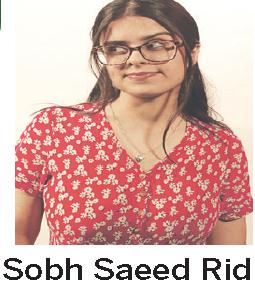
The Zeenat Haroon Rashid Writing Prize for Women for 2026 has been awarded to writer Sobh Saeed Rid for her moving memoir ‘The Man on the Computer’, about a long-distance relationship with an absent father. Sobh will receive a cash award of Rs100,000.
This year, the prize was awarded for non-fiction and was chosen by a judging panel that included writer and academic Noreen Masud, journalist and author Sanam Maher, as well as Sameer Rahim, novelist, critic and publisher at The Bridge Street Press, an imprint of Little, Brown.
The judging panel was impressed by the way small, tender details captured the complexity and emotional depth of a long-distance father-daughter relationship. They praised the writer’s ‘tremendous control, dry wit and human sympathy’ and ‘a narrative economy that is admirable and full of excellent detail.’ They agreed that, ‘This is a real writer.’
The author, Sobh Saeed Rid, is a 24-year-old journalist and writer from Khairpur Mirs, currently studying in New York where she is enrolled in NYU’s Joint Masters programme in Global Journalism & Near Eastern Studies. Her writing tends to ‘focus on the people and places that fall between the cracks of larger political and social narratives.’
In a very competitive year, the judges also highly commended five other shortlisted stories for their literary merit:
• ‘Real Estate’ by Istaara Amjad. A ‘mohalla [neighbourhood] to metropolis’ story. In imagining the communal childhood of her parents in D.G. Khan, the author reflects on her family’s move to the ‘city of lines and numbers’ in Islamabad.
• ‘Spinning Dissent: Life, Loom and the Punjabi Literary Tradition’ by Ayesha Latif. An impressive combination of literary criticism and life-writing. Drawing on texts as varied as Emily Wilson’s translation of The Odyssey to the lyrics of Bulleh Shah, the author weaves a powerful story of personal betrayal and survival.
• ‘The Cost of the View’ by Zahra Haider. A poetic and beautifully written account of a childhood in Islamabad and memories of nature and place, but also a quietly fierce indictment of the cost of modern development.
• ‘The Latticework Within: The Hidden Chronology of Parachinar’ by Ome Farwa. A lyrical account of Parachinar where, even though the beautiful wooden latticework of the city’s architecture is reduced to ashes, its suffocating influence remains internalised in the lives of women.
• ‘The Physiology of the Blank Margin’ by Fizza Abbas. An utterly original work that examines the intersection of pathology and poetry in the author’s imagination.
The winning story will be published by Eos, both online and in print in November, and shortly thereafter, all shortlisted stories will be published on the official prize website www.zhrwritingprize.com ■